
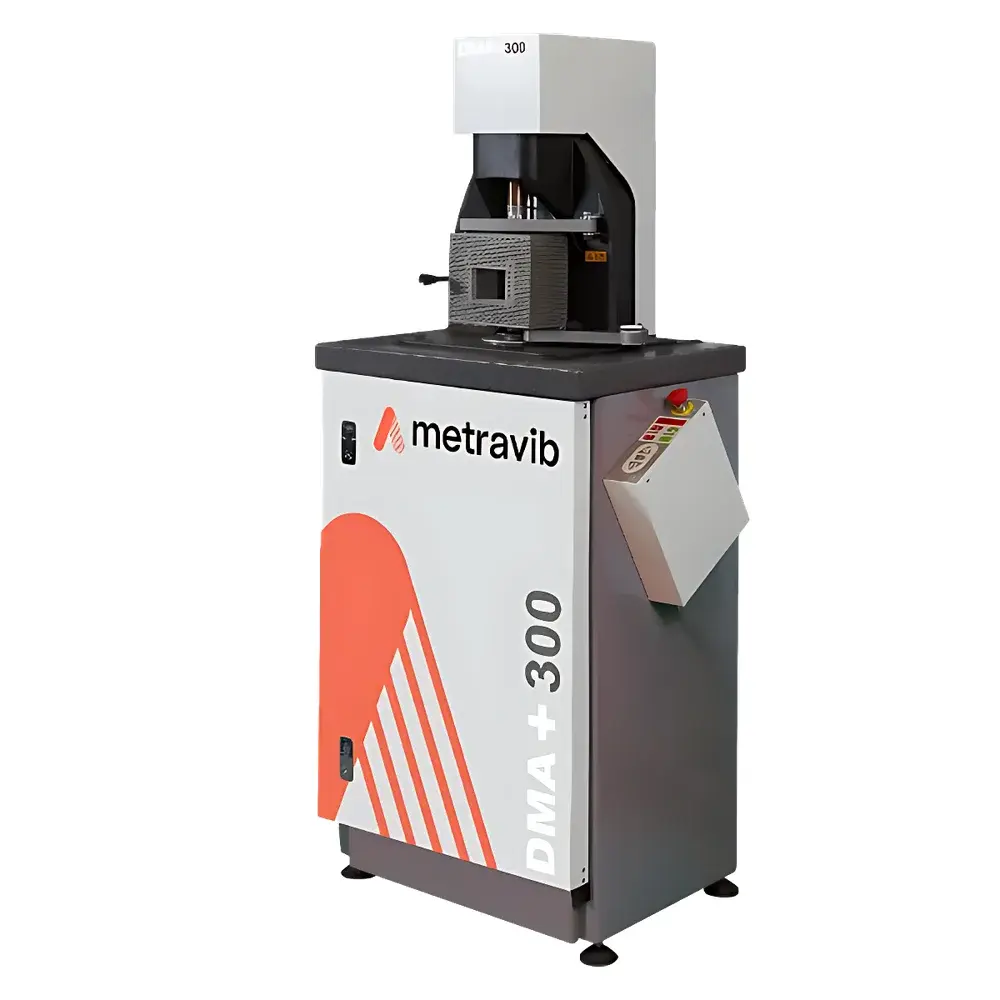
Metravib DMA+ 300 Advanced Dynamic Mechanical Analyzer
| Brand | Metravib |
|---|---|
| Origin | France |
| Model | DMA+ 300 |
| Instrument Type | Dynamic Mechanical Analyzer (DMA/DMTA) |
| Temperature Range | –150 °C to +500 °C |
| Temperature Accuracy | ±0.1 °C |
| Force Range | ±150 N (peak-to-peak: 300 N) |
| Displacement Range | ±6 mm (peak-to-peak: 12 mm) |
| Frequency Range | 1×10⁻⁵ Hz to 200 Hz (up to 1000 Hz with optional high-frequency module) |
| Minimum Detectable Force | 0.01 N |
| Minimum Detectable Displacement | 0.05 µm |
| Stiffness Measurement Span | >7 decades (250 Pa to 3×10¹² Pa) |
| Environmental Control Options | O₂ concentration control (10 ppm–20% vol), cryogenic cooling (LN₂ or air-cooled to –150 °C) |
Overview
The Metravib DMA+ 300 is a high-performance, research-grade Dynamic Mechanical Analyzer engineered for precision thermomechanical characterization of polymeric, elastomeric, composite, and viscoelastic materials across extreme thermal and mechanical conditions. Based on the principle of forced oscillatory deformation under controlled temperature and frequency sweeps, the DMA+ 300 quantifies storage modulus (E′), loss modulus (E″), and damping factor (tan δ) with exceptional sensitivity and reproducibility. Its monolithic, ultra-rigid frame—exceeding the stiffness of conventional hydraulic servo systems—minimizes parasitic compliance and ensures mechanical signal fidelity even at sub-micron displacements and nano-Newton force levels. Designed and manufactured in France, the instrument supports both tension, compression, bending, and shear modes, enabling full mapping of time–temperature–frequency superposition (TTS) behavior per ASTM D4065, ISO 6721, and ISO 11357-4 standards.
Key Features
- Ultra-stiff mechanical architecture with integrated air-bearing motion system, delivering sub-50 nm displacement resolution and <0.01 N force noise floor
- Unmatched dynamic range: simultaneous measurement of material stiffness spanning >7 decades—from 250 Pa (soft gels, hydrogels) to 3×10¹² Pa (carbon-fiber composites)
- Extended frequency coverage: standard 10⁻⁵–200 Hz; optionally upgradable to 1000 Hz for high-rate relaxation and glass transition kinetics analysis
- Precision temperature control from –150 °C (with liquid nitrogen cryostat) to +500 °C, with accuracy ±0.1 °C and ramp rates up to 60 °C/min
- Dual-mode actuation: capable of both dynamic oscillatory testing and quasi-static thermomechanical protocols—including creep, stress relaxation, and isothermal step-strain experiments
- Modular sample stage with interchangeable fixtures (tensile, 3-point bend, dual cantilever, shear sandwich, penetration, indentation) accommodating specimens from 0.5 mm to 100 mm in length
- Integrated environmental chamber with optional O₂ partial pressure regulation (10 ppm–20% vol) for oxidative aging studies compliant with ASTM D5510 and ISO 188
Sample Compatibility & Compliance
The DMA+ 300 accommodates rigid thermoplastics, thermosets, elastomers, biological tissues, thin films, fiber-reinforced laminates, and low-modulus hydrogels. Its wide force (±150 N) and displacement (±6 mm, peak-to-peak 12 mm) envelopes support both stiff structural components and highly deformable soft matter. All thermal and mechanical calibrations are traceable to NIST and LNE standards. The system meets essential regulatory requirements for quality-controlled environments: full audit trail logging, electronic signature support, and 21 CFR Part 11–compliant software architecture (optional). It supports GLP/GMP-aligned test protocols for automotive, aerospace, medical device, and pharmaceutical polymer qualification per ISO 10993-12 and USP .
Software & Data Management
Control and analysis are performed via Metravib’s proprietary ARES-G2 software platform—designed for scientific rigor and workflow efficiency. The interface provides real-time spectral visualization, automated TTS master curve generation (Williams–Landel–Ferry equation fitting), van der Pol and fractional Zener model regression, and multi-variable parameter mapping (e.g., tan δ vs. T vs. f). Raw data export is available in ASCII, HDF5, and universal .tdms formats. Batch processing, script-based automation (Python API), and integration with third-party LIMS or ELN systems are supported. All calibration records, method parameters, user actions, and timestamped metadata are stored in an encrypted relational database meeting ISO/IEC 17025 documentation integrity criteria.
Applications
- Characterization of viscoelastic transitions: precise determination of Tg, cold crystallization, melting endotherms, post-cure evolution, and secondary relaxations
- Nonlinear elastomer behavior: quantitative modeling of Payne and Mullins effects under large-amplitude oscillatory shear (LAOS)
- Curing kinetics: in-situ monitoring of resin gelation, vitrification, and network development via time-resolved modulus evolution
- Thermomechanical stability assessment: coefficient of thermal expansion (CTE), stress–strain hysteresis, and dimensional stability under thermal cycling
- Environmental degradation studies: coupled humidity/O₂/UV exposure modules enable accelerated aging correlation with mechanical property loss
- Composite interfacial analysis: detection of fiber–matrix debonding onset and interphase relaxation signatures through multi-frequency loss peak deconvolution
FAQ
What is the lowest measurable modulus with the DMA+ 300?
The instrument reliably resolves storage moduli down to 250 Pa using optimized low-force air-bearing configuration and active vibration isolation.
Can the system perform creep and stress relaxation tests?
Yes—its dual-mode electromechanical actuator supports both dynamic oscillatory and static load-hold protocols, with maximum displacement of ±6 mm and peak-to-peak capability of 12 mm.
Is liquid nitrogen required to reach –150 °C?
A liquid nitrogen cryostat is required for operation below –70 °C; an optional air-cooled refrigeration unit achieves –70 °C without consumables.
Does the software support time–temperature superposition (TTS)?
Yes—ARES-G2 includes automated WLF and Arrhenius shift factor calculation, master curve construction, and predictive modeling of long-term viscoelastic response.
Are there options for controlled-atmosphere testing?
An integrated gas manifold enables programmable O₂ partial pressure control from 10 ppm to 20% vol, supporting oxidation-sensitive polymer studies per ASTM D3045.



