
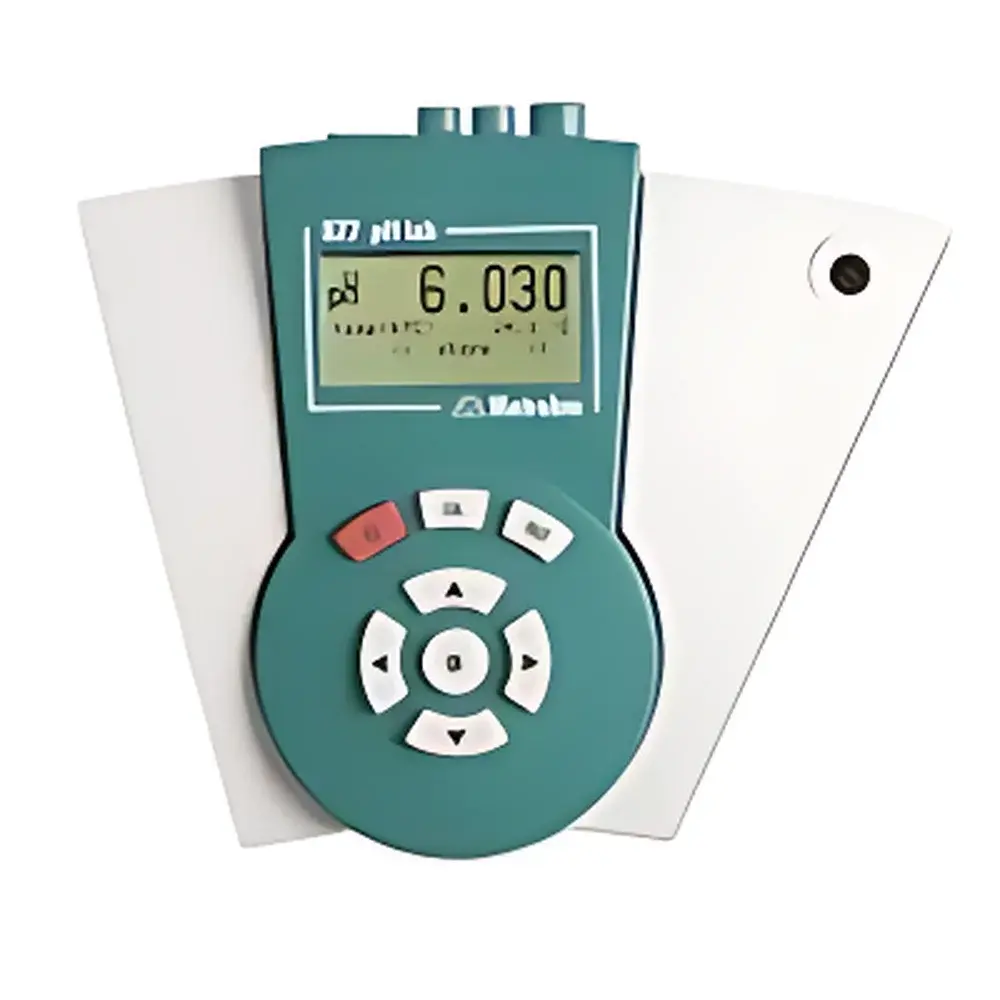
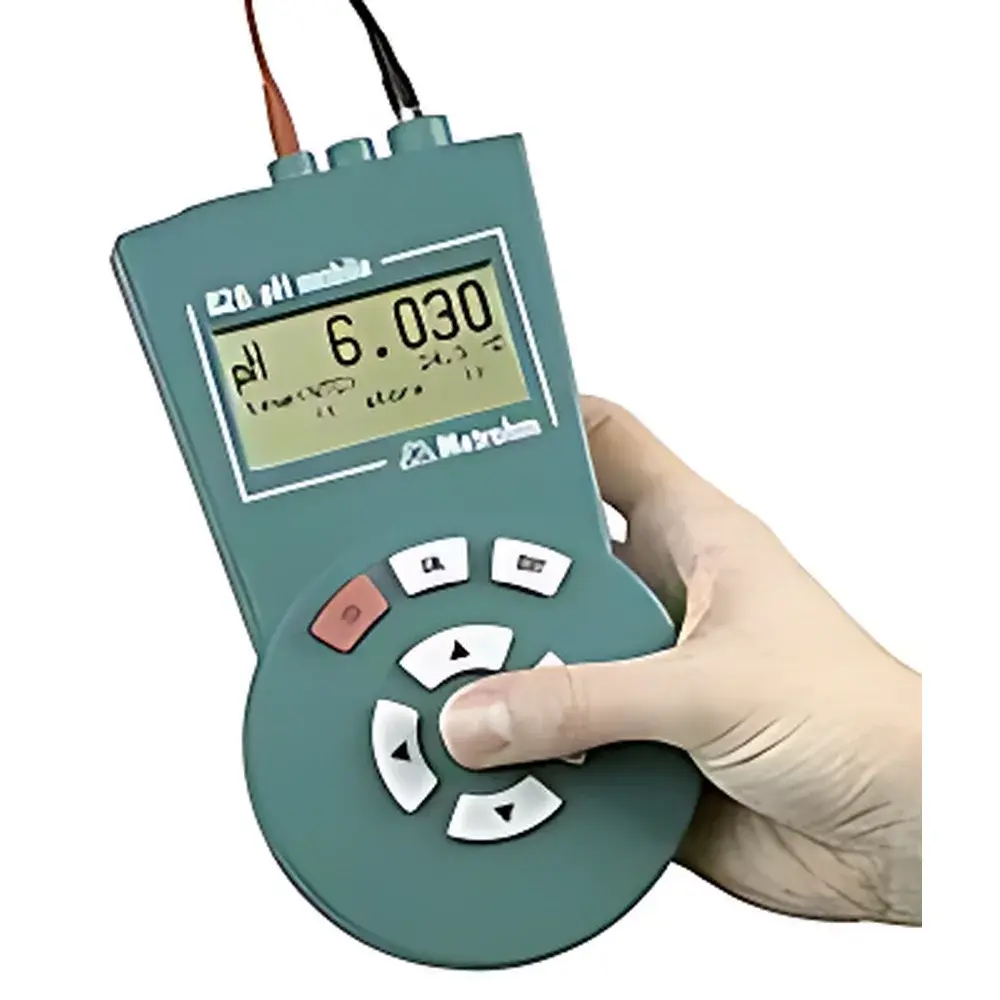
Metrohm 826 Portable / 827 Benchtop pH Meter
| Brand | Metrohm |
|---|---|
| Origin | Switzerland |
| Model | 826 (portable) / 827 (benchtop) |
| pH Range | 0–14 (extended range: –8 to 22) |
| mV Range | ±1200 mV |
| Temperature Range | –150.0 to +250.0 °C (Pt1000 sensor) / –5.0 to +250.0 °C (NTC sensor) |
| pH Resolution | 0.001 |
| mV Resolution | 0.1 mV |
| Temperature Resolution | 0.1 °C |
| Interface | Infrared (IrDA) for wireless data transfer to printers and PCs |
Overview
The Metrohm 826 Portable and 827 Benchtop pH Meters are precision electrochemical instruments engineered for reliable, traceable, and compliant pH and redox potential (mV) measurements in diverse laboratory, field, and industrial quality control environments. Based on potentiometric measurement principles—where the electromotive force generated at the interface between a glass pH electrode and sample solution is compared against a stable reference electrode—the system delivers high reproducibility across aqueous and semi-aqueous matrices. Designed and manufactured in Herisau, Switzerland, both models comply with fundamental metrological requirements defined in ISO 7027, ASTM D1293, and USP , ensuring suitability for routine QC, environmental monitoring, pharmaceutical water testing, and academic research where regulatory documentation integrity is essential.
Key Features
- True dual-platform architecture: The 826 model is optimized for rugged portability—IP67-rated housing, battery-powered operation (up to 200 hours), and integrated electrode holder—while the 827 offers enhanced stability via AC-powered benchtop design with anti-vibration feet and extended calibration memory.
- Infrared (IrDA) communication protocol enables secure, cable-free data exchange with Metrohm-certified thermal printers (e.g., PT-100) and Windows-based PCs running LabX Lite or TitraWin software—eliminating USB or Bluetooth interference risks in EMI-sensitive labs.
- Auto-recognized temperature compensation using either Pt1000 or NTC sensors ensures accurate thermal correction across extreme ranges—from cryogenic sample handling (–150 °C with Pt1000) to high-temperature sterilization validation (up to 250 °C).
- Calibration management supports up to five-point pH calibration with slope and offset diagnostics, automatic buffer recognition (DIN, NIST, Metrohm standard sets), and GLP-compliant audit trail logging—including operator ID, timestamp, buffer lot number, and electrode serial tracking.
- Robust electrode interface accommodates all Metrohm pH electrodes (e.g., Hydrona, Aquatrode Plus, Micro, and food-grade variants) with automatic detection of integrated temperature sensors and digital electrode identification (via iQ technology on compatible probes).
Sample Compatibility & Compliance
These meters are validated for use with aqueous solutions, buffers, beverages, dairy products, wastewater, pharmaceutical purified water (PW) and water-for-injection (WFI), and non-aggressive organic solvents (e.g., ethanol/water mixtures ≤30% v/v). Electrode selection determines matrix compatibility—for example, the Aquatrode Plus enables direct measurement in low-ionic-strength samples (e.g., rainwater, deionized water), while the Hydrona series provides chemical resistance for aggressive cleaning agents or alkaline caustic solutions. Both instruments meet CE marking requirements under the EU Electromagnetic Compatibility Directive 2014/30/EU and Low Voltage Directive 2014/35/EU. Data integrity features—including electronic signature support, user-level access control (admin/operator/guest), and 21 CFR Part 11–ready configuration options—facilitate compliance with FDA-regulated environments when deployed with validated software and procedural SOPs.
Software & Data Management
Raw measurement data, calibration records, and instrument status logs are exportable in CSV or XML format via IrDA link. When connected to LabX Lite (free desktop application), users gain automated report generation, trend analysis over time, deviation alerts, and seamless integration into LIMS workflows. All stored entries include embedded metadata: measurement ID, date/time stamp (with optional GPS tagging on 826 via external module), electrode type and age, ambient temperature/humidity (if logged), and full calibration history. Audit trails are immutable and timestamped by internal real-time clock synchronized to UTC—supporting ISO/IEC 17025 accreditation requirements for testing laboratories.
Applications
- Pharmaceutical: Monitoring pH of bulk drug substance solutions, cleaning validation swabs, and purified water systems per EP 2.2.3 and USP .
- Food & Beverage: Batch release testing of dairy products, fruit juices, and fermented beverages; shelf-life stability studies requiring precise acidification tracking.
- Environmental: Field-based pH profiling of surface water, groundwater, and soil leachates under EPA Method 9040C and ISO 10523.
- Chemical Manufacturing: In-process control of neutralization reactions, catalyst slurry conditioning, and waste stream characterization prior to discharge.
- Academic Research: Teaching core electrochemistry concepts—including Nernst equation validation, junction potential effects, and temperature-dependent pKa determination—in undergraduate and graduate labs.
FAQ
What electrode types are compatible with the Metrohm 826/827?
All Metrohm pH electrodes with BNC or mini-DIN connectors—including refillable, gel-filled, and solid-state variants—are supported. Automatic sensor recognition is available for iQ-enabled electrodes.
Can the instrument store calibration data after power-off?
Yes—calibration parameters, including slope, offset, buffer assignments, and date/time stamps, are retained in non-volatile memory for ≥10 years without battery backup.
Is temperature compensation mandatory during pH measurement?
While manual input is possible, automatic temperature compensation (ATC) is strongly recommended—and enabled by default—when a compatible Pt1000 or NTC probe is connected, per ISO 7027 Annex C guidelines.
Does the 826 portable model support GLP documentation in standalone mode?
Yes—internal memory stores full GLP-compliant records (operator ID, calibration data, measurement values) even without PC connection; data export requires IrDA pairing.
How often should the instrument be verified or recalibrated?
Daily verification using certified pH buffers (e.g., NIST-traceable pH 4.01, 7.00, 10.01) is recommended before critical measurements; formal recalibration frequency depends on usage intensity and risk assessment per ISO/IEC 17025 Clause 6.5.





