
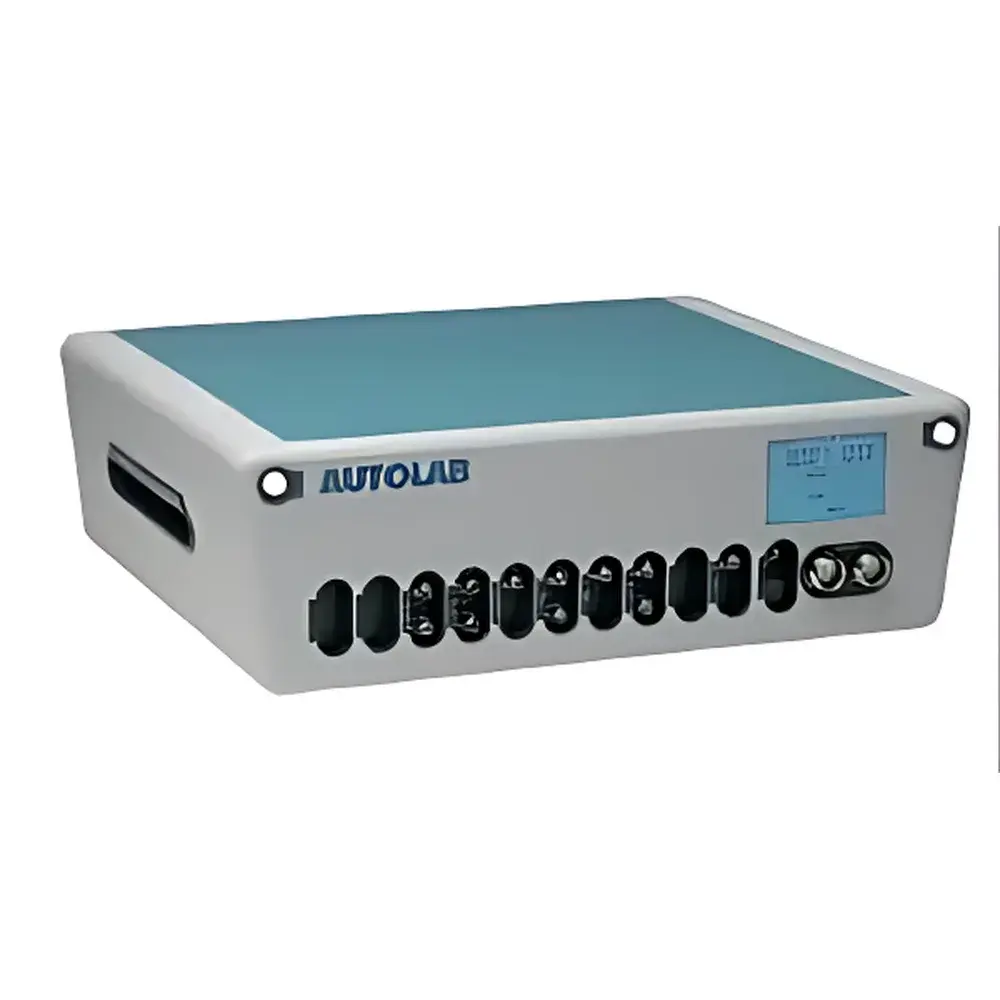
Metrohm PGSTAT 128N Electrochemical Workstation
| Brand | Metrohm |
|---|---|
| Origin | Switzerland |
| Model | PGSTAT 128N |
| Maximum Output Current | ±800 mA (expandable to ±10 A with BSTR10A module) |
| Maximum Output Voltage | ±12 V |
| Potential Scan Range | ±10 V |
| Current Ranges | 9 auto-ranging decades from 1 A to 10 nA (extendable to 100 pA with ECD module) |
| CV Scan Rate | 0.1 µV/s to 250 V/s (up to 250 kV/s with SCAN250 module) |
| Sampling Frequency | 50 kHz (up to 10 MHz with ADC10M module) |
| Potentiostat Bandwidth | >500 kHz |
| Supported Electrode Configurations | 2-, 3-, and 4-electrode systems |
| Compatible Software | GPES/FRA or NOVA |
| Core Electrochemical Techniques | DC methods, AC voltammetry, EIS (with FRA module) |
Overview
The Metrohm PGSTAT 128N is a high-performance, modular potentiostat/galvanostat designed for precision electrochemical characterization in research laboratories and quality control environments. Engineered for low-noise operation and rapid signal response, it implements a dual-channel, analog-controlled architecture optimized for stability across wide dynamic current ranges—from nanoampere-level corrosion monitoring to high-current battery cycling. Its core design adheres to fundamental potentiostatic principles: maintaining precise potential control at the working electrode versus reference, while accurately measuring resulting current through a dedicated feedback loop. The instrument supports standard three-electrode configurations (working, reference, counter), as well as two- and four-electrode setups for specialized applications such as high-impedance electrolyte measurements or grounded-cell configurations. With a base bandwidth exceeding 500 kHz and intrinsic voltage compliance of ±12 V, the PGSTAT 128N delivers high-fidelity transient response essential for fast-scan cyclic voltammetry, pulse techniques, and time-resolved impedance analysis.
Key Features
- Modular hardware architecture enabling seamless integration of optional functional modules—including FRA (Frequency Response Analyzer) for electrochemical impedance spectroscopy, SCAN250 for ultra-fast scan rates up to 250 kV/s, and ADC10M for 10 MHz sampling resolution.
- Auto-ranging current measurement across nine decades (1 A to 10 nA), with sub-picoampere sensitivity achievable using the ECD (Electrochemical Detector) module—critical for trace-level sensor development and low-conductivity media studies.
- High-voltage compliance (±12 V) and extended current capacity (±800 mA standard; expandable to ±10 A via BSTR10A booster module) support demanding applications such as Li-ion battery formation cycling, fuel cell polarization curve acquisition, and electrosynthesis under high-load conditions.
- Dual-channel independent control allows simultaneous or correlated experiments—for example, monitoring both working and auxiliary electrodes in rotating ring-disk configurations or performing galvanostatic/potentiostatic hybrid protocols.
- Low-noise analog front-end design minimizes thermal and quantization artifacts, ensuring reproducible baseline stability and accurate peak integration in microelectrode and ultramicroelectrode measurements.
Sample Compatibility & Compliance
The PGSTAT 128N interfaces with a broad spectrum of electrochemical cells—including standard aqueous and non-aqueous electrolytic cells, flow cells, thin-layer cells, and custom-built microfluidic or in situ/operando configurations. It complies with international instrumentation standards relevant to analytical electrochemistry, including IEC 61000-4 (EMC immunity), ISO/IEC 17025–2017 (for laboratory competence when used in accredited testing), and supports audit-ready data integrity practices when operated with NOVA software under 21 CFR Part 11-compliant configurations (e.g., electronic signatures, user access control, and immutable audit trails). Its hardware architecture enables traceable calibration via certified reference resistors and standard redox couples (e.g., ferrocene/ferricinium), facilitating GLP and GMP-aligned workflows in pharmaceutical and materials development labs.
Software & Data Management
Control and analysis are executed via Metrohm’s NOVA software platform—a Windows-based application supporting method scripting, real-time visualization, automated parameter optimization, and advanced post-processing (e.g., deconvolution of overlapping faradaic processes, Kramers-Kronig validation of EIS data, and equivalent circuit modeling). Legacy GPES/FRA compatibility ensures continuity for users migrating from earlier Autolab platforms. All raw data are stored in open binary formats (.dta) with embedded metadata (timestamp, instrument ID, method parameters, calibration history), enabling interoperability with third-party analysis tools (MATLAB, Python-based libraries such as PyEIS or ECpy). Data export supports CSV, ASCII, and structured HDF5 for long-term archival and FAIR (Findable, Accessible, Interoperable, Reusable) compliance.
Applications
- Battery and energy storage research: charge/discharge profiling, SEI layer formation studies, impedance mapping across state-of-charge, and differential capacity analysis (dQ/dV).
- Corrosion science: electrochemical noise monitoring (ENM), zero-resistance ammeter (ZRA) coupling, and localized electrochemical impedance spectroscopy (LEIS) when paired with scanning modules.
- Electrocatalysis: kinetic evaluation of oxygen reduction/evolution reactions (ORR/OER), hydrogen evolution reaction (HER) Tafel analysis, and catalyst stability assessment under accelerated stress testing (AST).
- Biosensor and bioelectrochemistry: amperometric detection of neurotransmitters, enzymatic electrode characterization, and redox protein electron transfer kinetics.
- Materials electrochemistry: electrodeposition control, conducting polymer switching behavior, and nanomaterial-modified electrode interface analysis.
FAQ
What electrode configurations does the PGSTAT 128N support?
It supports two-, three-, and four-electrode setups, enabling flexibility for grounded cells, high-impedance measurements, and rotating ring-disk electrode (RRDE) experiments.
Can the PGSTAT 128N perform electrochemical impedance spectroscopy (EIS)?
Yes—when equipped with the optional FRA module, it delivers frequency sweeps from 10 µHz to 1 MHz with phase accuracy better than 0.3° and magnitude error <0.1% in the mid-frequency range.
Is the instrument suitable for ultra-low-current measurements?
With the ECD module installed, current resolution extends down to 100 pA, making it appropriate for single-entity electrochemistry and nanopore sensing applications.
How is calibration performed and documented?
Calibration uses factory-traceable shunt resistors and redox standards; all calibration events—including date, operator, and deviation logs—are recorded automatically in NOVA’s audit trail when enabled.
Does Metrohm provide technical support for method development?
Yes—Metrohm Application Specialists offer remote and on-site assistance for experimental design, parameter optimization, and interpretation of complex electrochemical datasets, including EIS fitting and kinetic modeling.





