
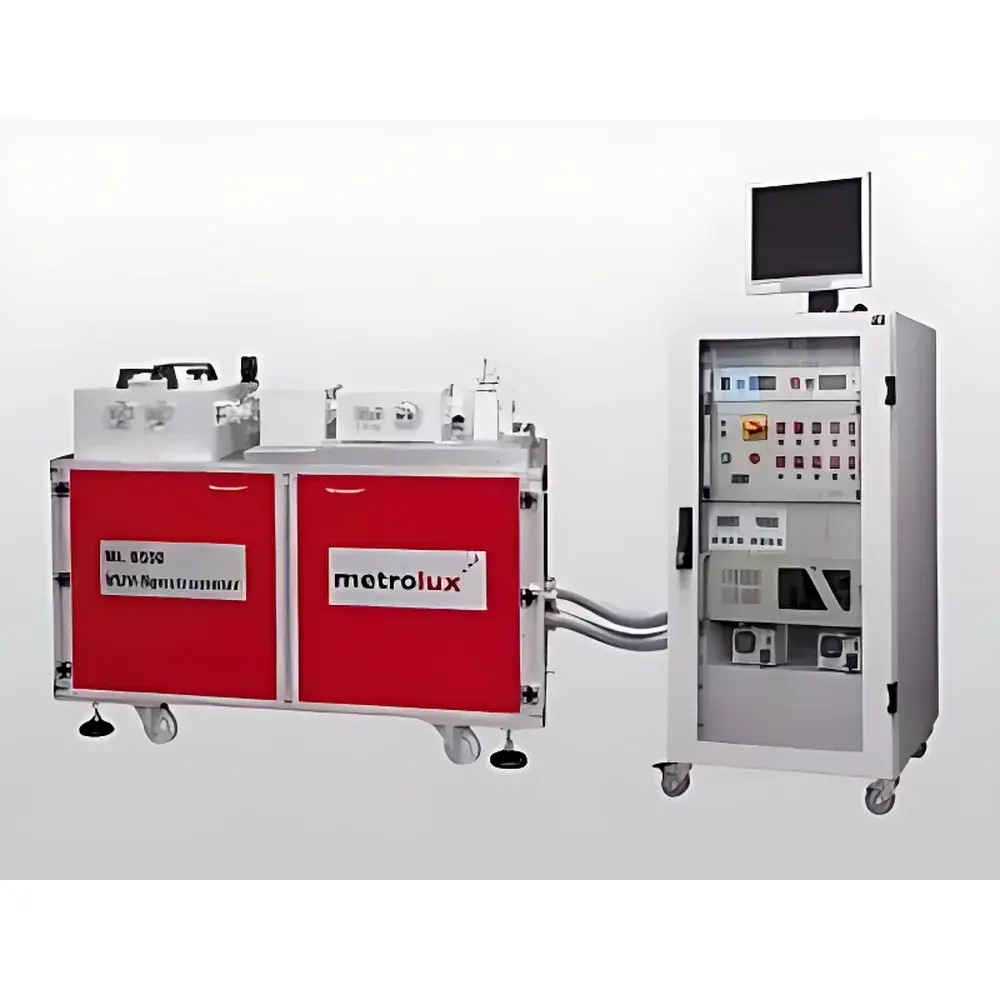
Metrolux ML6500 Vacuum Ultraviolet (VUV) Spectrophotometer
| Brand | Metrolux |
|---|---|
| Origin | Germany |
| Model | ML6500 |
| Wavelength Range | 115–230 nm (single lamp), 115–320 nm (dual lamp: D₂ + Xe) |
| Spectral Resolution | < 1 nm FWHM at 160 nm |
| Wavelength Reproducibility | < 0.1 nm (validated at 121.5 nm and 160 nm) |
| Operating Pressure | < 1×10⁻⁵ mbar |
| Transmittance Accuracy | < ±0.3% |
| Reflectance Accuracy | < ±0.5% |
| Out-of-Band Transmittance | < 0.1% |
| Scattered Reflectance (157 nm) | > 0.001% |
| Diffuse Reflectance (157 nm, 1 mm aperture) | < 5% |
| Scattered Reflectance (157 nm, 1 mm aperture) | < 5% |
Overview
The Metrolux ML6500 Vacuum Ultraviolet (VUV) Spectrophotometer is a high-precision optical measurement system engineered for quantitative characterization of transmittance, reflectance, and scattering properties in the deep and vacuum ultraviolet spectral region (115–320 nm). Unlike conventional UV-Vis spectrophotometers, the ML6500 operates under high vacuum (< 1×10⁻⁵ mbar) to eliminate atmospheric absorption—particularly O₂ and H₂O vapor—which strongly attenuates radiation below 190 nm. Its optical architecture is based on a modified Czerny–Turner monochromator design with optimized VUV-grade optics (MgF₂-coated Al mirrors, CaF₂ lenses, and low-outgassing mechanical construction), enabling stable, high-fidelity spectral acquisition across the Lyman-alpha line (121.6 nm), the F₂ excimer wavelength (157 nm), and the critical 160–230 nm window used in semiconductor photomask metrology and thin-film optical coating development.
Key Features
- Vacuum-compatible optical path maintained continuously at < 1×10⁻⁵ mbar via turbomolecular pumping system with integrated pressure monitoring and interlock logic
- Dual-lamp configuration: Deuterium lamp (115–230 nm) and xenon arc lamp (160–320 nm), each with automated shutter and intensity stabilization
- Spectral resolution < 1 nm FWHM at 160 nm—verified by atomic emission line profiling of hydrogen and argon plasma sources
- Wavelength reproducibility < 0.1 nm, independently confirmed at 121.5 nm (H Ly-α) and 160 nm using calibrated spectral line references
- Low-scatter optical train featuring off-axis parabolic mirrors and minimized internal reflections; stray light suppression optimized for 157 nm applications
- Modular sample stage accommodating transmission cells (CaF₂ or MgF₂ windows), reflective mounts (kinematic alignment), and variable-angle goniometric reflectance configurations
Sample Compatibility & Compliance
The ML6500 supports solid, thin-film, and gas-phase samples compatible with ultra-high vacuum environments. Common use cases include optical coatings on fused silica or CaF₂ substrates, lithographic resists, dielectric multilayers for EUV optics, and VUV-transparent window materials (e.g., LiF, MgF₂, sapphire). All optical components comply with ISO 10110 surface quality standards for VUV applications. The system meets essential requirements for GLP-compliant laboratories: full audit trail logging (wavelength calibration events, lamp usage hours, vacuum history), electronic signature support per FDA 21 CFR Part 11 (when paired with validated LIMS integration), and traceable calibration against NIST-traceable VUV line sources (e.g., H, He, Ne spectral lamps). It is routinely deployed in facilities adhering to ASTM E275, ISO 9221, and SEMI F20 standards for optical thin-film characterization.
Software & Data Management
Control and analysis are executed via Metrolux SpectraControl v4.x—a Windows-based application developed for deterministic instrument control and metrological data integrity. The software provides real-time spectral preview, multi-point mapping routines (for spatial uniformity assessment), and automated sequence execution (e.g., angle-resolved reflectance sweeps). All raw spectra are stored in HDF5 format with embedded metadata: timestamp, vacuum status, lamp identity, slit width, detector gain, and calibration coefficients. Export options include ASCII (tab-delimited), CSV, and XML formats compliant with ASTM E1382. Data validation modules verify signal-to-noise ratio thresholds (>1000:1 at 157 nm), baseline stability (<0.05% drift over 10 min), and spectral fidelity against reference standards before report generation.
Applications
- Quantitative evaluation of anti-reflective and high-reflectance coatings for 157 nm lithography optics
- Characterization of VUV transparency degradation in space-grade optical materials exposed to synchrotron radiation
- In-process monitoring of sol-gel derived oxide films during thermal annealing (transmission edge shift analysis)
- Validation of optical constants (n, k) for novel wide-bandgap semiconductors (e.g., AlN, BN) via Kramers–Kronig analysis
- Gas-phase absorption cross-section measurements for atmospheric science and plasma diagnostics (e.g., O₂, NO, SO₂ in 115–200 nm range)
- Calibration transfer between synchrotron beamlines and laboratory-scale VUV instrumentation
FAQ
What vacuum level is required for reliable operation below 130 nm?
A continuous pressure of ≤1×10⁻⁵ mbar is mandatory to suppress oxygen absorption bands and ensure photon flux stability; the integrated vacuum management system includes automatic pump-down sequencing and leak-rate verification.
Can the ML6500 measure diffuse reflectance at 157 nm with angular resolution?
Yes—the optional goniometric reflectance module enables incidence angle variation from 10° to 85° and collection cone definition (1 mm aperture at PMT input), supporting BSDF modeling per ASTM E259.
Is NIST-traceable calibration included with the system?
A factory calibration certificate referencing primary VUV line sources (H, He, Ne) is supplied; on-site recalibration services are available through Metrolux’s European Metrology Network.
How is lamp aging compensated during long-term measurements?
The software logs cumulative lamp-on time and applies intensity normalization using built-in reference photodiode signals; deuterium lamp output drift is tracked against the 121.6 nm Lyman-alpha line.
Does the system support compliance with pharmaceutical regulatory requirements?
When deployed with validated SpectraControl software and documented SOPs, the ML6500 satisfies key elements of USP , ICH Q5E, and Annex 11 for analytical instrument qualification in regulated environments.




