
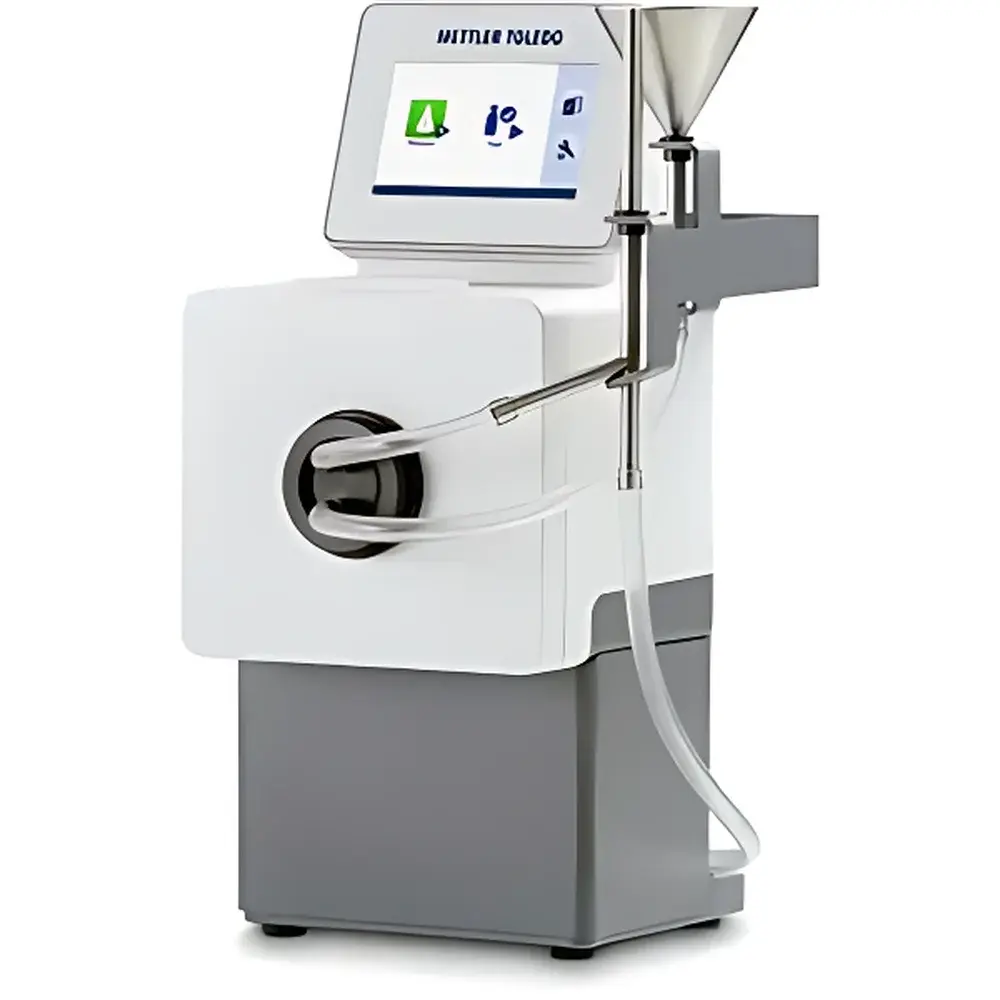
METTLER TOLEDO Easy Bev Desktop Refractometer
| Brand | METTLER TOLEDO |
|---|---|
| Origin | Germany |
| Product Type | Benchtop Refractometer |
| Temperature Control | Yes |
| Digital Display | Yes |
| Refractive Index Range | 1.32–1.58 nD |
| Accuracy | ±0.0001 nD |
| Repeatability | ±5×10⁻⁵ nD |
| Brix Range | 0–100 % w/w |
| Brix Accuracy | ±0.05 % w/w |
| Temperature Control Range | 15–25 °C |
| Minimum Sample Volume | 50.00 mL |
| Max. Method Storage | 6 |
| Display | 4.3″ capacitive color touchscreen |
| Connectivity | 3× USB-A, 1× USB-B |
| Compliance | GB/T 12143-2008 |
Overview
The METTLER TOLEDO Easy Bev Desktop Refractometer is a purpose-built optical measurement instrument engineered for high-throughput quality control in beverage manufacturing and R&D laboratories. It operates on the principle of critical angle refractometry—measuring the refractive index (nD) of transparent or translucent liquid samples by determining the angle at which light undergoes total internal reflection at the sample-prism interface. This fundamental optical property correlates directly with solute concentration (e.g., sucrose content), enabling precise, non-destructive quantification of dissolved solids. Designed specifically for juice, soft drink, syrup, and fermentation broth analysis, the Easy Bev integrates thermally stabilized optics, vertical sample handling architecture, and application-optimized firmware to deliver metrologically traceable results aligned with industry-standard calibration protocols. Its compact benchtop footprint and robust mechanical design support integration into regulated environments where routine compliance with internal QC specifications and national standards—including GB/T 12143-2008 for fruit juice analysis—is required.
Key Features
- Vertical prism orientation with integrated sampling funnel minimizes residue accumulation and facilitates rapid, drip-free sample loading—critical for viscous or pulp-containing beverages.
- Active Peltier-based temperature control (15–25 °C) ensures measurement stability within ±0.1 °C, eliminating manual water-bath dependency and supporting ISO/IEC 17025-compliant thermal equilibration.
- High-resolution 4.3″ capacitive color touchscreen with context-sensitive on-screen guidance reduces operator dependency and training time; supports multilingual UI (English, German, French, Spanish, Chinese, etc.) for global deployment.
- Color-coded pass/fail result display (green/red) against user-defined specification limits enables immediate visual assessment without interpretation delay—enhancing line-side decision speed.
- FastStart™ auto-detection (hardware-enabled) initiates measurement immediately upon sample contact, reducing cycle time per analysis to under 10 seconds.
- Onboard method storage for up to six preconfigured measurement protocols—including dual-unit reporting (nD and % w/w Brix)—supports multi-product facilities without software reconfiguration.
Sample Compatibility & Compliance
The Easy Bev accommodates aqueous solutions typical of beverage matrices: clarified juices, carbonated soft drinks, concentrated syrups, wine must, and post-fermentation wort. Its 50 mL minimum volume requirement is optimized for representative sampling while minimizing waste—particularly valuable during pilot-scale trials or raw material screening. The instrument complies with GB/T 12143-2008 for determination of soluble solids in fruit and vegetable juices, and its measurement uncertainty profile meets the repeatability threshold (±5×10⁻⁵ nD) specified in ASTM D1218 and ISO 2173 for routine refractometric analysis. While not certified for FDA 21 CFR Part 11 out-of-the-box, audit trails and electronic signature support are available via optional EasyDirect PC software integration—enabling alignment with GLP/GMP documentation requirements when deployed with controlled access and versioned method files.
Software & Data Management
Data export and method management are handled through EasyDirect PC Software (supplied separately), which connects via USB-B interface. This platform enables secure transfer of measurement records—including timestamp, operator ID, method name, nD, Brix, temperature, and pass/fail status—to CSV or PDF formats. User management supports role-based permissions (administrator/operator), and all changes to methods or system settings are logged with date/time stamps—providing foundational traceability for internal audits. Although direct LIMS connectivity is not embedded, the software’s structured output format permits seamless ingestion into third-party laboratory information management systems via standard import modules. All firmware updates are delivered via USB-A media, ensuring version control integrity in offline production environments.
Applications
- Raw material acceptance testing: incoming sugar syrups, fruit concentrates, and malt extracts.
- In-process monitoring: Brix tracking during juice blending, pasteurization hold steps, and fermentation progression.
- Final product release: verification of label claims for soluble solids content in ready-to-drink beverages and isotonic solutions.
- QC deviation investigation: rapid root-cause analysis of batch-to-batch variability in sweetness or density-related attributes.
- Method transfer support: standardized nD/Brix correlation curves for customer-specific formulations across regional labs.
FAQ
What temperature range is actively controlled during measurement?
The Peltier element maintains prism temperature between 15 °C and 25 °C, adjustable in 0.1 °C increments.
Is calibration traceable to NIST or PTB standards?
Yes—calibration uses certified refractive index reference liquids (e.g., distilled water, sucrose standards) with documented traceability to national metrology institutes.
Can the instrument store calibration history?
Calibration events are recorded in the system log with date, operator ID, and reference value used—but full calibration curve data requires export via EasyDirect software.
Does it support automatic unit conversion between nD and Brix?
Yes—user-selectable conversion tables (ICUMSA, AOAC, and custom) are embedded; Brix values are calculated in real time using temperature-compensated algorithms.
What maintenance is required for long-term accuracy?
Daily prism cleaning with recommended solvent (e.g., isopropanol), quarterly verification with control standards, and annual performance qualification per internal SOPs.




