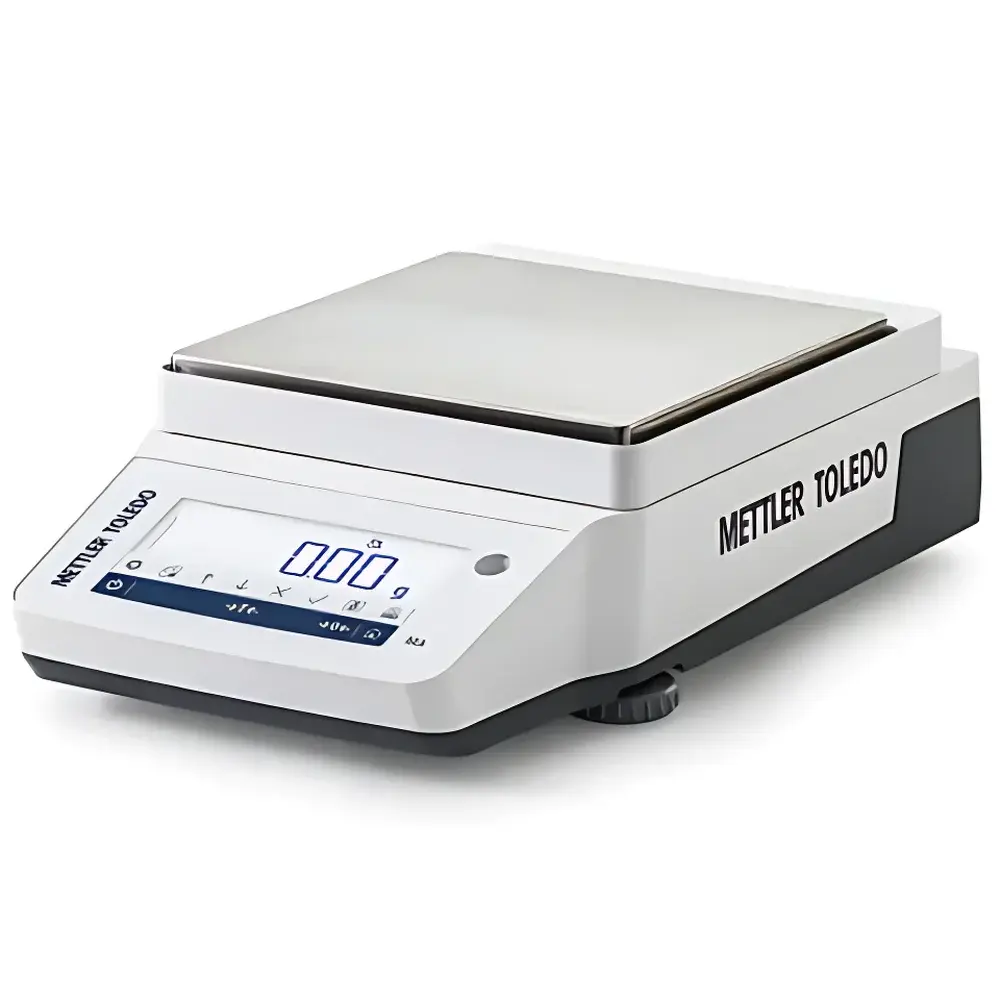
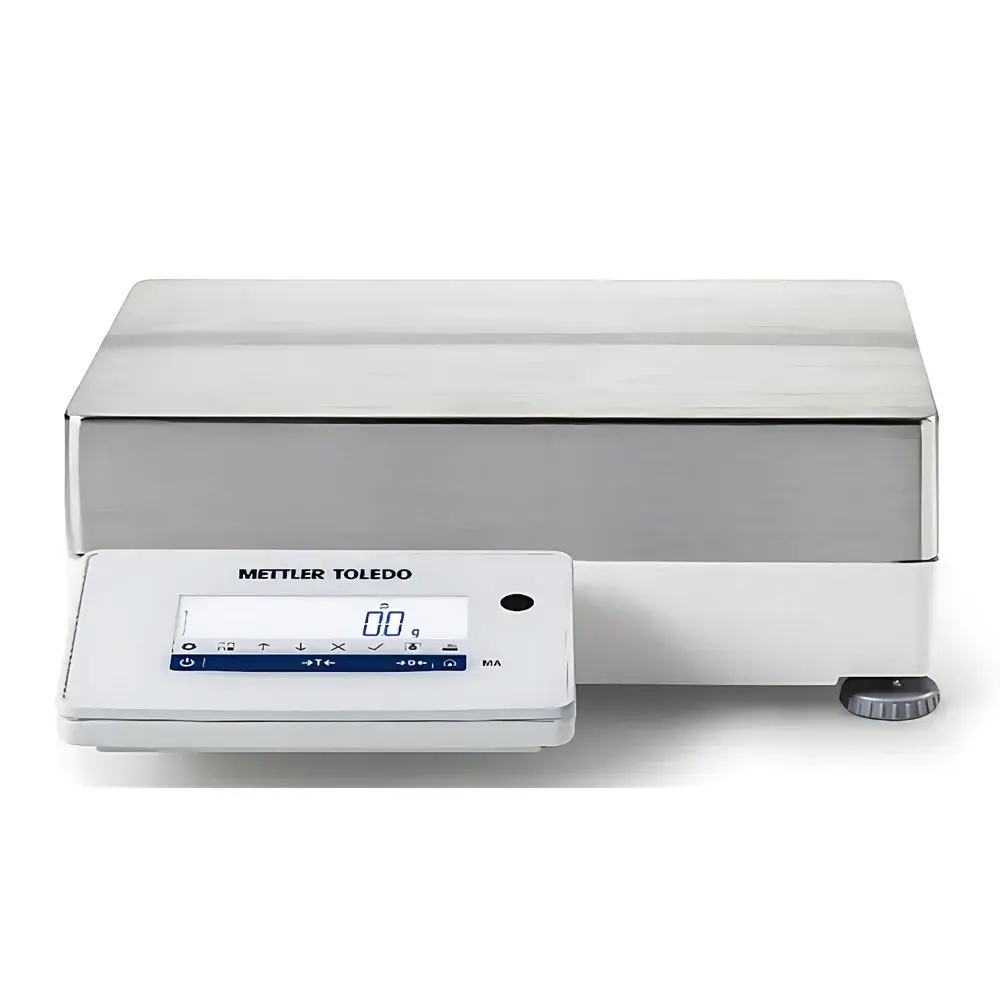
METTLER TOLEDO MA16001L Precision Balance
| Brand | METTLER TOLEDO |
|---|---|
| Origin | Shanghai, China |
| Model | MA16001L Precision Balance |
| Display | High-brightness LCD with on-screen guidance |
| Interface | USB-A, RS232 |
| Calibration | Internal test weight–driven automatic calibration |
| Construction | Robust housing with scratch-resistant glass draft shield and chemical-resistant keypad |
| Compliance | Designed to support GLP/GMP documentation workflows |
Overview
The METTLER TOLEDO MA16001L Precision Balance is an entry-level analytical-grade weighing instrument engineered for reproducible mass determination in routine laboratory, quality control, and educational environments. Operating on electromagnetic force compensation (EMFC) principle, the balance delivers stable, drift-compensated measurements under standard ambient conditions (20 ± 5 °C, 30–70% RH non-condensing). With a readability of 1 mg (0.001 g) and maximum capacity up to 16,000 g—depending on configuration—the MA16001L bridges the functional gap between compact top-loading balances and higher-tier analytical instruments. Its design prioritizes operational robustness, intuitive human-machine interaction, and seamless integration into regulated documentation ecosystems without requiring advanced training or dedicated infrastructure.
Key Features
- High-contrast, backlit LCD display with dynamic on-screen prompts guiding users step-by-step through tare, sample placement, stabilization, and result confirmation—reducing operator dependency and procedural variability.
- Touch-sensitive membrane keypad with tactile feedback and chemical-resistant surface, optimized for frequent cleaning with ethanol or isopropanol solutions per ISO 17025-compliant lab hygiene protocols.
- Integrated internal calibration system utilizing factory-traceable test weights; auto-calibration triggered manually or scheduled at user-defined intervals to maintain metrological traceability.
- Dual communication interface architecture: RS232 for legacy printer or LIMS connectivity and USB-A host port supporting direct data export to flash drives, eliminating intermediate PC transfer steps and reducing transcription errors.
- Modular draft shield assembly with removable side panels and front sliding door—designed for rapid decontamination and compatibility with standard fume hood footprints.
- Stainless steel weighing pan (180 mm diameter) mounted on a rigid load-cell suspension system engineered to minimize mechanical hysteresis and thermal drift during repeated loading cycles.
Sample Compatibility & Compliance
The MA16001L accommodates a broad range of solid and granular samples—including powders, tablets, metal components, polymer pellets, and pre-weighed vials—within its physical envelope and load limits. Its open-top design and low-profile pan facilitate easy access for spatula-based handling and minimizes static charge accumulation during powder weighing. While not certified for hazardous area use (e.g., ATEX/IECEx), the balance meets IEC 61010-1 safety requirements for laboratory electrical equipment and complies with electromagnetic compatibility (EMC) standards EN 61326-1. For regulated industries, it supports audit-ready documentation through timestamped data logging (when connected via USB or RS232), enabling alignment with FDA 21 CFR Part 11 principles when paired with validated third-party software for electronic signature and record retention.
Software & Data Management
No proprietary software installation is required for basic operation; however, the MA16001L is fully compatible with METTLER TOLEDO’s LabX Lite software (freely downloadable) for centralized device management, customizable report templates, and automated data archiving to network drives or SQL databases. Raw weighing data exported via USB-A appears as plain-text .csv files with columns for timestamp (YYYY-MM-DD HH:MM:SS), net weight, gross weight, tare value, stability flag, and operator ID (if enabled). All data streams include checksum validation to ensure integrity during transmission. The balance firmware supports user-defined data field labeling—critical for SOP-driven workflows in pharmaceutical QC labs adhering to USP and EP 2.1.5 guidelines.
Applications
- Raw material receipt inspection and batch release testing in pharmaceutical and food manufacturing facilities.
- Preparation of standard solutions and buffer formulations in clinical chemistry and environmental testing laboratories.
- Gravimetric analysis of filter media before/after particulate collection in air quality monitoring programs.
- Teaching fundamental metrology concepts—including uncertainty estimation, repeatability assessment, and calibration hierarchy—in undergraduate chemistry and engineering curricula.
- Inventory management of reference standards and certified reference materials (CRMs) where traceable mass verification is required prior to use.
FAQ
What is the typical repeatability specification for the MA16001L at full capacity?
Repeatability is typically ≤ ±0.002 g under controlled conditions, verified using calibrated test weights per OIML R 76-1 Annex C procedures.
Does the MA16001L support external calibration with user-provided weights?
Yes—external calibration mode is accessible via service menu; however, internal calibration remains the recommended method for daily verification per METTLER TOLEDO’s Good Weighing Practice™ framework.
Can the balance be integrated into a LIMS environment?
Yes—via RS232 serial output with ASCII protocol or USB virtual COM port emulation, enabling direct ingestion by LIMS platforms supporting standard weighing device drivers.
Is the MA16001L suitable for use in a cleanroom classified as ISO 5?
While the unit itself carries no ISO 14644-1 certification, its smooth, non-porous surfaces and absence of ventilation grilles make it deployable in ISO 5 environments when installed with appropriate gowning and static mitigation protocols.
How often should the internal calibration be performed?
Calibration frequency must be risk-assessed per application; METTLER TOLEDO recommends initiation upon power-up and after significant ambient temperature shifts (>2 °C), or at least once per shift in high-throughput settings.