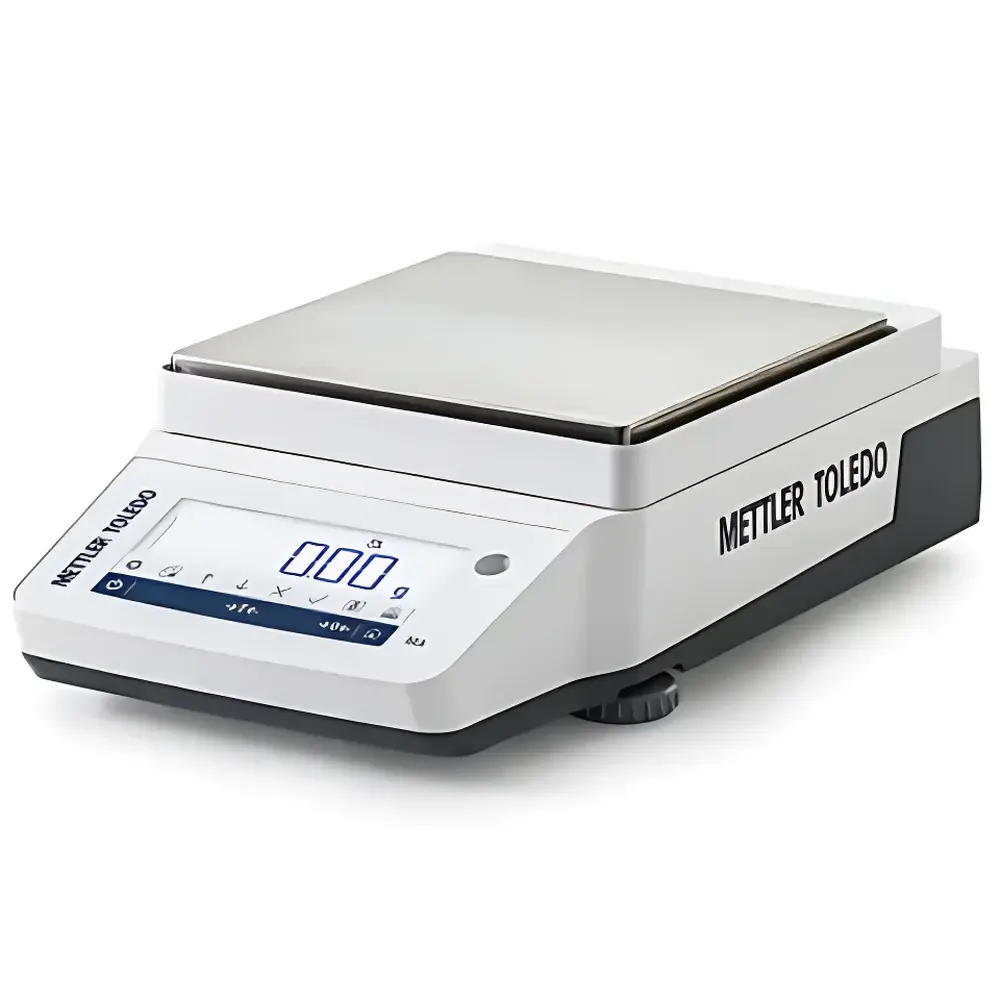
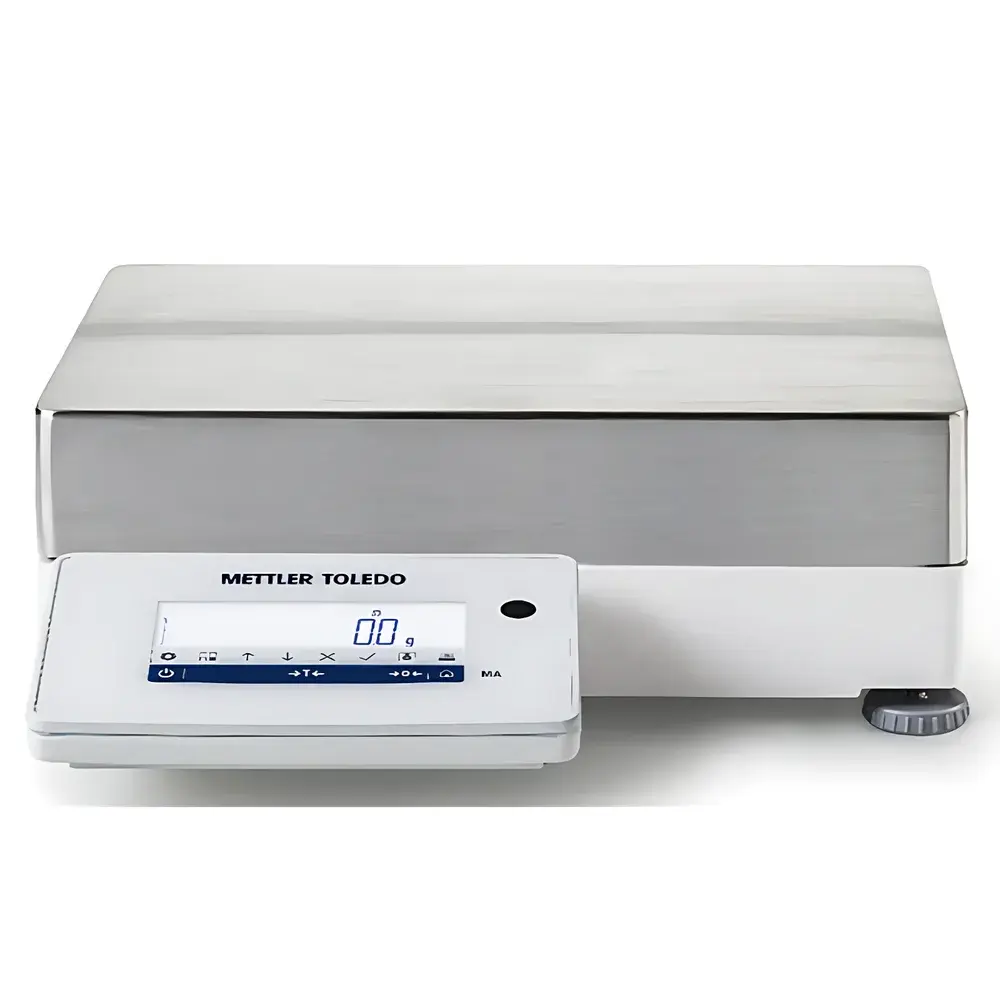
METTLER TOLEDO MA32000L Precision Balance
| Brand | METTLER TOLEDO |
|---|---|
| Origin | Shanghai, China |
| Model | MA32000L Precision Balance |
| Maximum Capacity | 32,000 g |
| Readability | 1 g |
| Calibration | Internal automatic calibration with built-in test weight |
| Display | High-brightness LCD with graphical user interface |
| Interface | USB-A, RS232 |
| Construction | Robust stainless steel pan, scratch-resistant glass front panel |
| Compliance | ISO/IEC 17025 support, GLP/GMP-compliant data handling, FDA 21 CFR Part 11 ready (with optional software) |
Overview
The METTLER TOLEDO MA32000L Precision Balance is an industrial-grade analytical weighing instrument engineered for high-throughput laboratory and production environments where reliability, repeatability, and regulatory traceability are critical. Utilizing electromagnetic force restoration (EMFR) technology, the MA32000L delivers stable, drift-compensated measurements across variable ambient conditions—including minor air currents, temperature fluctuations, and vibration-prone workbenches. With a maximum capacity of 32 kg and readability of 1 g, it bridges the functional gap between precision balances and compact benchtop scales—making it ideal for formulation, quality control sampling, bulk material verification, and packaging line checks. Its design follows METTLER TOLEDO’s long-standing commitment to metrological integrity: each unit undergoes factory calibration against traceable NIST-equivalent standards and supports routine performance verification via internal automatic calibration using a built-in test weight.
Key Features
- Electromagnetic force restoration (EMFR) sensor architecture ensures high linearity, low hysteresis, and minimal creep over extended operation cycles.
- Internal automatic calibration system activates on schedule or manually—eliminating manual intervention while maintaining compliance with ISO 9001 and ISO/IEC 17025 requirements for measurement uncertainty management.
- Graphical high-brightness LCD display with intuitive icon-based navigation guides users step-by-step through weighing, formulation, percentage calculation, checkweighing, and density determination workflows.
- Touch-sensitive front-panel keys with tactile feedback reduce operational errors and support glove-compatible use in controlled environments.
- Scratch-resistant tempered glass front panel and stainless steel weighing pan resist chemical exposure, abrasion, and frequent cleaning with ethanol or isopropanol—meeting lab hygiene and cGMP surface compatibility expectations.
- Dual communication interfaces (USB-A and RS232) enable direct connection to thermal printers, LIMS systems, ERP platforms, and USB flash drives for secure, timestamped data export without middleware.
Sample Compatibility & Compliance
The MA32000L accommodates a broad range of sample types—from powders and granules to packaged goods and irregularly shaped components—within its large 180 mm × 220 mm weighing pan area. Its draft shield–free open design facilitates rapid loading/unloading and integration into automated workflows, while optional static-dissipative accessories mitigate electrostatic interference during low-mass powder handling. From a regulatory standpoint, the balance supports audit-ready documentation: all calibrations, adjustments, and user actions are logged with timestamps, operator IDs (via optional password-protected login), and digital signatures when paired with METTLER TOLEDO LabX software. Data files comply with ALCOA+ principles (Attributable, Legible, Contemporaneous, Original, Accurate, Complete, Consistent, Enduring, Available) and can be configured to meet FDA 21 CFR Part 11 electronic record requirements—including electronic signatures, audit trails, and role-based access control.
Software & Data Management
While the MA32000L operates autonomously with embedded application modules (e.g., parts counting, percent weighing, animal weighing), full traceability and enterprise integration require LabX™ software—a platform validated for GxP environments. LabX enables centralized method management, real-time data validation, automatic report generation (PDF/CSV), and seamless transfer to SAP QM, Thermo Fisher SampleManager, or Waters Empower. All raw weighing data—including metadata such as environmental conditions (when connected to optional temp/humidity sensors), calibration history, and user activity logs—is stored in encrypted SQLite or SQL Server databases. Export formats include .xlsx, .pdf, and ASTM E1382-compliant structured text for third-party analytics pipelines.
Applications
- Pharmaceutical QC labs: Raw material receipt inspection, batch release testing, excipient dispensing verification.
- Food & beverage manufacturing: Ingredient batching, net content verification per EU Directive 76/211/EEC, HACCP monitoring checkpoints.
- Chemical R&D: Catalyst dosing, polymer blending ratios, reaction stoichiometry checks.
- Academic teaching labs: Student experiments requiring robustness under high-usage conditions and clear visual feedback.
- Contract manufacturing organizations (CMOs): Audit-ready documentation for client-facing quality reports and regulatory submissions (e.g., ANDA, MAA).
FAQ
Does the MA32000L support external environmental sensors?
Yes—optional temperature and humidity probes can be connected via the RS232 port to log ambient conditions alongside each weighing event.
Can calibration certificates be generated directly from the balance?
No—the MA32000L does not generate formal calibration certificates onboard; however, calibration logs and verification reports are exportable via USB or RS232 for inclusion in external calibration management systems.
Is the balance compatible with Windows 11 and macOS Ventura+
Yes—when used with LabX software (v3.10 or later), the MA32000L supports Windows 11 (64-bit) and macOS 13+ via native USB virtual COM port drivers.
What is the warm-up time required before first use?
The recommended stabilization period is 30 minutes after power-on under typical lab conditions (20–25°C, <60% RH); this ensures thermal equilibrium of the EMFR sensor and optimal repeatability.
How frequently should internal calibration be performed?
METTLER TOLEDO recommends initiating internal calibration at least once per shift in production environments, or prior to any critical measurement sequence—especially following ambient temperature changes exceeding ±2°C.