
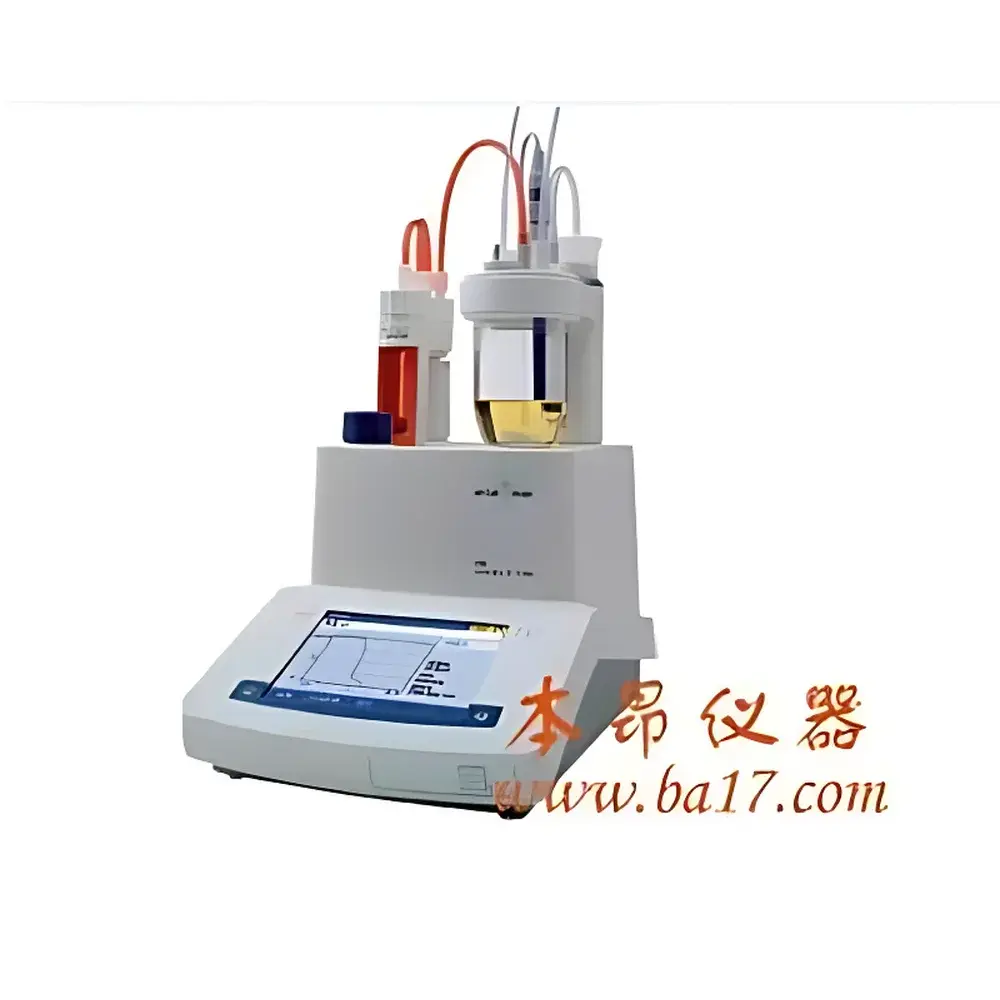
Mettler Toledo V20 Coulometric Karl Fischer Moisture Analyzer
| Origin | Shanghai, China |
|---|---|
| Manufacturer Type | Authorized Distributor |
| Regional Origin | Domestic (China) |
| Model | V20 |
| Price | USD 13,500 (FOB Shanghai) |
| Detection Range | 10 ppm – 100% water content |
| Measurement Resolution | 0.5 µg H₂O |
| Electrode Potential Resolution | 0.1 mV |
| Titrator Resolution | 1/20,000 steps (0.25 µL with 5 mL burette) |
| Drift | < 5 µg H₂O/min |
| Repeatability | ±0.3% (for samples containing >10 mg H₂O) |
| Operating Temperature | +5 °C to +40 °C |
| Relative Humidity | ≤80% at 31 °C |
| Display | 5.7″ QVGA TFT color touchscreen (320 × 240 px) |
| Dimensions (L×W×H) | 333 × 210 × 320 mm |
| Weight | 4.2 kg |
| Interface Standards | Ethernet, 3× USB, RS232, CAN bus, TTL |
Overview
The Mettler Toledo V20 Coulometric Karl Fischer Moisture Analyzer is a fully automated, high-precision titration-based instrument engineered for quantitative determination of water content in liquid, solid, and gaseous samples across pharmaceutical, chemical, petrochemical, and polymer industries. Unlike volumetric KF systems relying on standardized titrant delivery, the V20 employs coulometric generation of iodine at the anode—enabling trace-level quantification down to 10 ppm with sub-microgram resolution. Its electrochemical endpoint detection follows the classic Karl Fischer reaction stoichiometry (I₂ + SO₂ + H₂O + 3RN + CH₃OH → 2RN·HI + RN·HSO₄CH₃), monitored via dual-platinum electrode polarization at ±0.1 mV resolution. Designed as the direct successor to the DL31/DL38 series, the V20 integrates modern hardware architecture with regulatory-ready software workflows compliant with GLP, GMP, and FDA 21 CFR Part 11 requirements.
Key Features
- One Click® workflow automation for moisture analysis, solvent replacement, and system conditioning—reducing operator dependency and procedural variability.
- RFID-enabled reagent recognition: automatically validates KF titrant identity, concentration, expiry date, and next calibration due date—blocking use of expired or incompatible reagents.
- Solvent Manager functionality: enables fully sealed, hands-free waste evacuation and fresh solvent dosing via single-touch command—minimizing analyst exposure to toxic solvents (e.g., pyridine-free methanol-based reagents) and preventing overflow-related contamination.
- 9-language TFT touchscreen interface (Chinese, English, German, French, Italian, Russian, Korean, Spanish, Portuguese) with customizable home screen layout and intuitive drag-and-drop method builder.
- Real-time electrochemical monitoring: dual-channel potentiometric detection with adjustable polarization voltage (–2000 to +2000 mV) and current range (0–24 µA), delivering robust endpoint discrimination even in complex matrices.
- Modular connectivity: standard Ethernet port for LabX network integration; three USB ports supporting printers, flash drives, and peripheral devices; RS232, CAN bus, and TTL interfaces for legacy equipment synchronization.
Sample Compatibility & Compliance
The V20 accommodates diverse sample types—including hygroscopic solids (e.g., APIs, excipients), viscous liquids (oils, resins), and low-volatility gases—via optional oven coupling (e.g., S300 or OMNIS Dryer modules). All methods support ASTM E203, ISO 760, USP , and EP 2.5.12 compliance. Instrument qualification documentation includes IQ/OQ/PQ templates aligned with Annex 11 and ALCOA+ data integrity principles. Audit trail functionality records user actions, parameter changes, and result modifications with time-stamped, non-erasable entries—fully satisfying FDA 21 CFR Part 11 electronic record requirements.
Software & Data Management
LabX™ PC software provides centralized method deployment, remote instrument control, and automated report generation in nine languages. Raw data—including titration curves, drift correction logs, and reagent consumption metrics—are stored in encrypted SQLite databases with configurable backup intervals. Reports adhere to GLP formatting standards: include instrument ID, analyst name, sample ID, environmental conditions, reagent lot numbers, and digital signatures. Data export supports CSV, PDF/A-1b, and XML formats for LIMS integration. All electronic records maintain full traceability under 21 CFR Part 11-compliant user authentication (password + optional smart card).
Applications
- Pharmaceutical QC: water content verification in lyophilized powders, tablet coatings, and sterile injectables per USP .
- Polymer manufacturing: residual monomer hydration assessment in PET, nylon, and polycarbonate resins prior to extrusion.
- Battery electrolyte analysis: ultra-trace moisture detection (<20 ppm) in LiPF₆ solutions where H₂O induces HF formation.
- Fuel testing: ASTM D6304-compliant water measurement in gasoline, diesel, and aviation turbine fuels.
- Food ingredient certification: moisture quantification in hygroscopic additives (e.g., citric acid, sodium benzoate) affecting shelf-life stability.
FAQ
What distinguishes coulometric from volumetric Karl Fischer titration?
Coulometric KF generates iodine electrochemically at the anode, enabling precise microgram-level water quantification without physical titrant dispensing—ideal for samples with 1000 ppm).
Does the V20 support oven-based sample introduction?
Yes—when coupled with Mettler Toledo’s S300 or OMNIS Dryer modules, the V20 enables controlled thermal release of bound water from solids and semi-solids, extending its applicability to polymers, ceramics, and pharmaceutical intermediates.
How does the Solvent Manager ensure safety and reproducibility?
It automates solvent exchange under inert gas purge, eliminating manual handling of hazardous reagents while maintaining consistent cell conditioning—critical for achieving <5 µg/min system drift and inter-batch repeatability within ±0.3%.
Is LabX software validated for regulated environments?
LabX 3.7+ includes built-in validation packages (IQ/OQ scripts, test protocols, and summary reports) supporting GxP audits per FDA, EMA, and PMDA guidelines.
Can the V20 be integrated into a laboratory network?
Yes—Ethernet connectivity enables seamless integration with LabX Server, enterprise LIMS, and centralized data repositories. Role-based access control ensures secure multi-user operation across departments.







