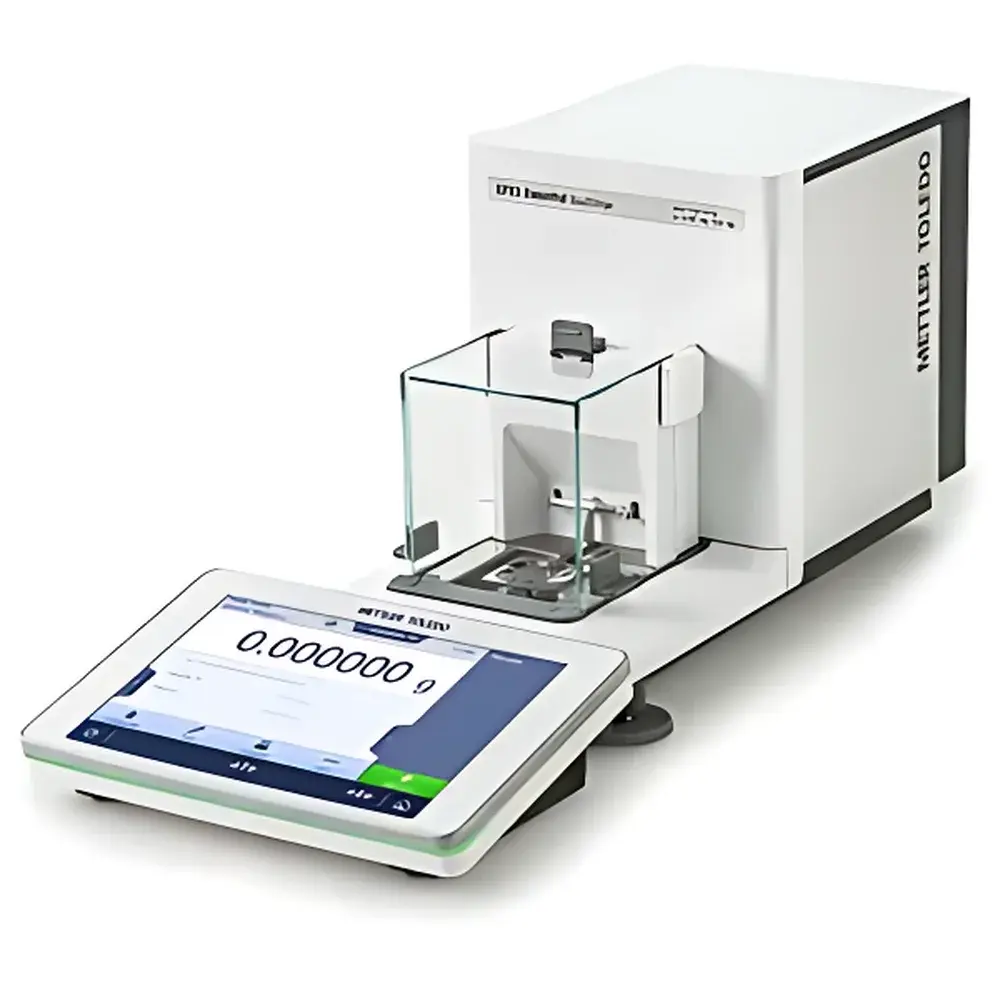
METTLER TOLEDO XPR3DUE/AC Ultra-Micro Balance
| Brand | METTLER TOLEDO |
|---|---|
| Origin | Switzerland |
| Type | Ultra-Micro Balance |
| Model | XPR3DUE/AC |
| Maximum Capacity | 3.2 g / 1.2 g |
| Readability | 0.01 mg / 0.001 mg |
| Repeatability (typ.) | 0.0008 mg |
| Minimum Weight (USP <41>, 0.1% tolerance, typ.) | 1.6 mg |
| Stabilization Time | 6 s |
| Pan Dimensions (W × D) | 32 mm × 32 mm |
| Dimensions (H × W × D) | 196 mm × 195 mm × 478 mm |
| Built-in Calibration | FACT (Fully Automatic Calibration Technology) |
| Display | 7-inch color TFT touchscreen |
| Connectivity | RS232 (optional), USB-A, USB-B, Ethernet, Bluetooth (optional) |
| 21 CFR Part 11 Compliance | Yes (with LabX software) |
| User Management | Unlimited users with role-based permissions |
| Leveling Guidance | Integrated digital level indicator |
| Static Detection | Not automated |
| Minimum Weight (U=1%, k=2, typ.) | 0.16 mg |
| Certified Readability | 1 mg |
Overview
The METTLER TOLEDO XPR3DUE/AC is an ultra-micro balance engineered for laboratories requiring trace-level mass measurement with uncompromising precision and regulatory compliance. Operating on electromagnetic force compensation (EMFC) principle, it delivers high-resolution weighing performance down to 0.001 mg readability across dual-range configurations (3.2 g / 1.2 g). Its robust monolithic sensor architecture, combined with active temperature control and advanced vibration damping, ensures stable readings even in non-ideal environments—critical for applications where microgram-level accuracy directly impacts analytical validity. Designed specifically for GxP-regulated workflows, the XPR3DUE/AC integrates seamlessly into quality control, formulation development, and reference standard preparation processes in pharmaceutical and fine chemical manufacturing.
Key Features
- Dual-range weighing capability: 3.2 g at 0.01 mg readability and 1.2 g at 0.001 mg readability—enabling flexibility between routine ultra-micro and high-sensitivity trace analysis.
- FACT (Fully Automatic Calibration Technology) with internal motorized weights ensures drift-free operation and eliminates manual recalibration; temperature-triggered and time-scheduled calibration maintains metrological integrity over extended use cycles.
- 7-inch full-color TFT capacitive touchscreen with intuitive icon-driven interface supports glove-compatible operation and multi-language navigation without external peripherals.
- Integrated leveling guidance system provides real-time visual feedback via on-screen tilt indicators, reducing setup time and minimizing operator-induced error during installation or relocation.
- Comprehensive user management framework supports unlimited accounts with configurable roles (e.g., Operator, Supervisor, Administrator), password enforcement, and audit trail logging aligned with ALCOA+ data integrity principles.
- Modular connectivity options—including USB-A (for peripheral devices), USB-B (for PC integration), Ethernet (for networked LabX deployment), and optional RS232/Bluetooth—enable scalable integration into LIMS, MES, and electronic lab notebook (ELN) ecosystems.
Sample Compatibility & Compliance
The XPR3DUE/AC accommodates small-volume solid samples, powders, crystalline reference standards, and coated substrates commonly handled in vials, crucibles, or static-dissipative weighing boats. Its compact 32 mm × 32 mm weighing pan minimizes air current interference while supporting standard micro-scoops and pipette tips. The balance meets ISO/IEC 17025 requirements for calibration laboratories and conforms to USP and for minimum weight determination and analytical balance qualification. When paired with METTLER TOLEDO’s LabX software, it satisfies FDA 21 CFR Part 11 requirements—including electronic signatures, audit trails with immutable timestamps, and role-based access control—making it suitable for GLP and GMP environments subject to regulatory inspection.
Software & Data Management
LabX software serves as the central platform for method creation, instrument control, result validation, and report generation. It enforces SOP-driven workflows, automatically captures metadata (operator ID, timestamp, environmental conditions), and applies statistical evaluation (e.g., repeatability, linearity, eccentricity) per ISO 17025 Annex C. All raw weighing data—including intermediate values, calibration logs, and maintenance history—are stored in a secure SQL database with version-controlled backups. Export formats include PDF, CSV, XML, and direct output to LIMS via ODBC or RESTful API. Electronic signature functionality complies with Annex 11 and ICH GCP guidelines, ensuring data traceability from acquisition to archival.
Applications
- Pharmaceutical QC: Accurate dispensing of potent active pharmaceutical ingredients (APIs) and excipients in low-dose tablet formulations.
- Reference Standard Preparation: Gravimetric dilution of certified reference materials (CRMs) for HPLC, GC-MS, and ICP-MS calibration curves.
- Catalyst Research: Precise mass dosing of noble metal catalysts (e.g., Pt, Pd, Rh) in heterogeneous reaction studies.
- Materials Science: Weighing nanomaterial dispersions, thin-film coatings, and MEMS components prior to SEM/TEM analysis.
- Regulatory Submissions: Generating auditable mass data packages required for ANDA, NDA, and marketing authorization applications under EMA and PMDA frameworks.
FAQ
What is the smallest sample mass that can be weighed with documented reliability?
The minimum weight is 1.6 mg under USP criteria (0.1% tolerance, typical); for expanded uncertainty U = 1% (k = 2), the minimum is 0.16 mg—both verified during factory calibration and documented in the certificate of conformance.
Does the XPR3DUE/AC support automatic static charge detection and compensation?
No—the model does not include integrated electrostatic detection or ionization; users must employ external anti-static tools (e.g., ionizing bars, conductive weighing vessels) when handling insulating samples.
Can the balance operate independently without LabX software?
Yes—it functions fully as a standalone instrument with local method storage, touchscreen operation, and direct data export via USB or printer; LabX is required only for advanced compliance, network integration, and centralized data governance.
Is the weighing chamber removable for cleaning or maintenance?
The draft shield assembly is tool-free and modular, allowing rapid disassembly and reinstallation without recalibration; all optical and mechanical alignments are maintained through precision-machined locating features.
How frequently must FACT calibration be performed?
FACT initiates calibration automatically upon detecting temperature changes ≥1.5 °C or at user-defined intervals (e.g., every 2, 4, or 8 hours); no manual intervention is required unless triggered by system diagnostics or preventive maintenance protocols.