
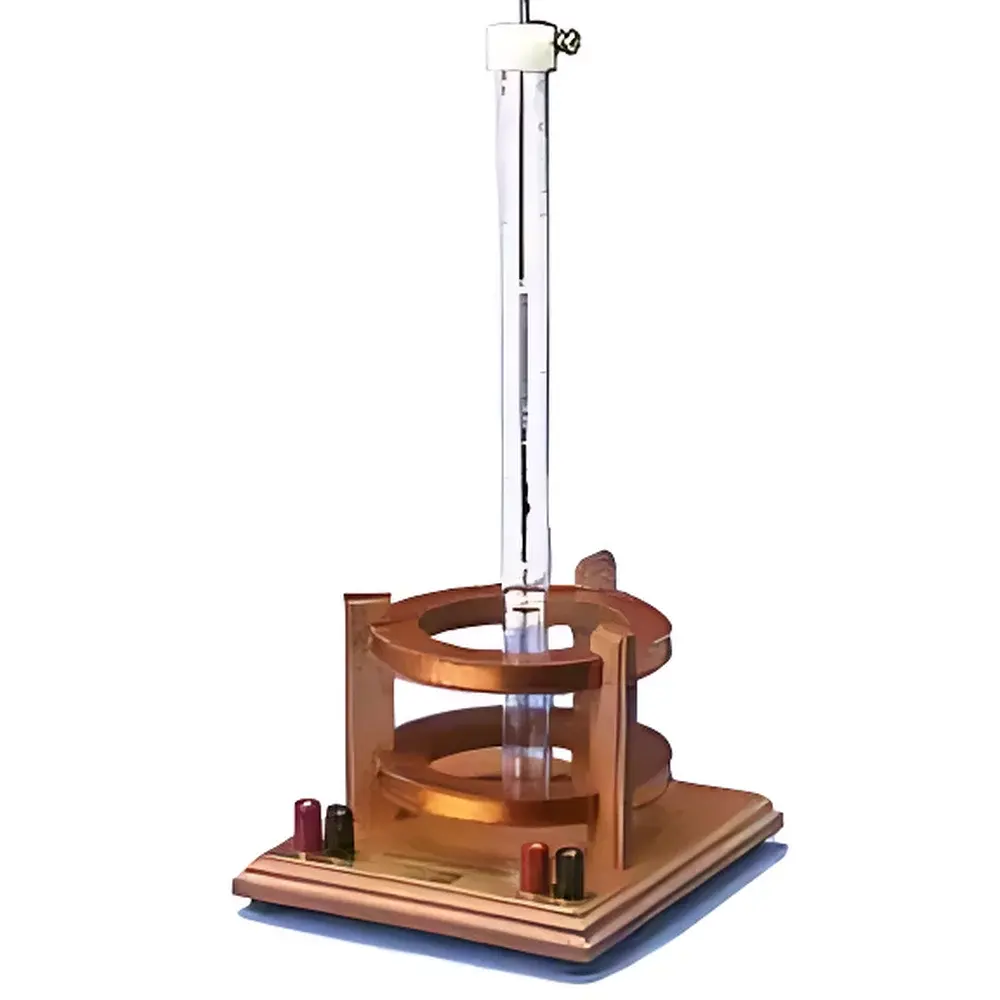
MF1-A Magnetic Force & Dipole Moment Teaching Apparatus
| Origin | USA |
|---|---|
| Manufacturer Type | Authorized Distributor |
| Origin Category | Imported |
| Model | MF1-A |
| Pricing | Available Upon Request |
Overview
The MF1-A Magnetic Force & Dipole Moment Teaching Apparatus is a precision-engineered educational instrument grounded in classical electromagnetism principles. It enables direct experimental investigation of the force and torque experienced by a permanent magnetic dipole in spatially varying magnetic fields—quantitatively verifying the fundamental relation Fz = m·(dB/dz), where m is the magnetic dipole moment and B is the magnetic flux density. Unlike abstract derivations in introductory physics curricula, the MF1-A operationalizes this relationship using a well-characterized neodymium-iron-boron (NdFeB) disk magnet as a physical realization of an ideal point dipole. Paired with a calibrated Helmholtz coil system, the apparatus generates a highly uniform and precisely controllable axial field gradient (dB/dz) over a defined region—enabling students to measure force as a function of position, current, and orientation. Designed for pedagogical rigor, it bridges theoretical formalism with reproducible laboratory practice, supporting curriculum-aligned learning outcomes in undergraduate and advanced high school physics laboratories.
Key Features
- High-stability NdFeB disk magnet (diameter: 12.7 mm, thickness: 3.2 mm) with certified remanent magnetization, serving as a robust physical model for an ideal magnetic dipole
- Pair of precision-wound Helmholtz coils (150 mm diameter, 100 turns each) with matched winding symmetry and low inductance for rapid field modulation and minimal eddy-current artifacts
- Integrated digital force sensor (full-scale range: ±500 mN, resolution: 0.1 mN) mounted on a linear translation stage with micrometer-driven z-positioning (0.01 mm resolution)
- Programmable DC current source (0–2.5 A, 0.01 A resolution) with real-time current monitoring and thermal protection
- Modular baseplate with standardized optical rail compatibility (30 mm spacing) for integration with photogates, position encoders, or video motion analysis systems
- Comprehensive instructor’s manual containing 8 validated lab protocols—from qualitative torque visualization to quantitative dB/dz mapping and dipole moment calibration via equilibrium deflection
Sample Compatibility & Compliance
The MF1-A is optimized for use with solid-state permanent magnets exhibiting coercivity >10 kOe and remanence >1.2 T—primarily sintered NdFeB grades N42–N52. The apparatus does not support ferrofluids, paramagnetic salts, or current-carrying loops as primary samples; however, optional add-on kits enable comparative studies with solenoid-based dipoles. All electrical components comply with IEC 61010-1:2010 safety standards for laboratory equipment. Mechanical construction adheres to ISO 2768-mK general tolerances. The force sensor and current source are CE-marked and meet EN 61326-1 requirements for electromagnetic compatibility in educational environments.
Software & Data Management
The MF1-A operates without proprietary software dependency: analog voltage outputs (force, coil current, position) are accessible via standard BNC connectors for integration with third-party data acquisition systems (e.g., PASCO Capstone, Vernier LabQuest, National Instruments DAQmx). Optional Python-based open-source acquisition scripts (provided under MIT License) support time-synchronized sampling at up to 1 kHz. All raw datasets export to CSV format with embedded metadata (timestamp, calibration coefficients, user-defined experiment ID). While the apparatus itself does not implement FDA 21 CFR Part 11 or GLP audit trails, its modular architecture supports institutional validation protocols when deployed within accredited teaching labs requiring traceable measurement workflows.
Applications
- Verification of magnetic force dependence on field gradient: measuring Fz vs. z to reconstruct dB/dz profiles across the Helmholtz region
- Determination of magnetic dipole moment magnitude via static equilibrium method: balancing magnetic force against gravitational or spring restoring forces
- Torque measurement as a function of angular orientation: demonstrating τ = m × B and identifying stable/unstable equilibrium positions
- Comparative analysis of field homogeneity: quantifying deviation from ideal Helmholtz condition using measured dB/dz uniformity over ±15 mm
- Student-led inquiry into E&M misconceptions—e.g., distinguishing magnetic “poles” from monopoles, clarifying why ∇·B = 0 constrains net force to depend on gradient—not field magnitude alone
- Capstone project extension: coupling with Hall probe arrays to map 2D field gradients or integrating with Arduino-based feedback control for active stabilization experiments
FAQ
Is the MF1-A compatible with existing lab infrastructure such as PASCO or Vernier interfaces?
Yes—the device provides analog voltage outputs (0–5 V) for force, current, and position signals, fully compliant with PASCO UI-5000 and Vernier LabQuest 3 input specifications.
Does the apparatus include calibration certificates for the force sensor and Helmholtz coils?
Each unit ships with NIST-traceable calibration documentation for the load cell (±0.5% full-scale uncertainty) and coil geometry (±0.2 mm dimensional verification).
Can the MF1-A be used to demonstrate magnetic levitation?
While stable passive levitation of the NdFeB disk is not achievable with the standard Helmholtz configuration due to Earnshaw’s theorem constraints, the apparatus supports dynamic stabilization demonstrations when paired with optional PID-controlled current modulation modules.
What safety precautions are required during operation?
Standard lab PPE applies; no ionizing radiation or high-voltage hazards are present. Users must observe maximum current limits (2.5 A) to prevent coil overheating, and avoid placing ferromagnetic tools near the active field region to prevent projectile risk.
Is teacher training or curriculum support available?
Yes—complimentary virtual onboarding sessions and NGSS/APS-aligned lesson plans are provided upon purchase, including rubrics for formative assessment of conceptual mastery in magnetic interactions.




