
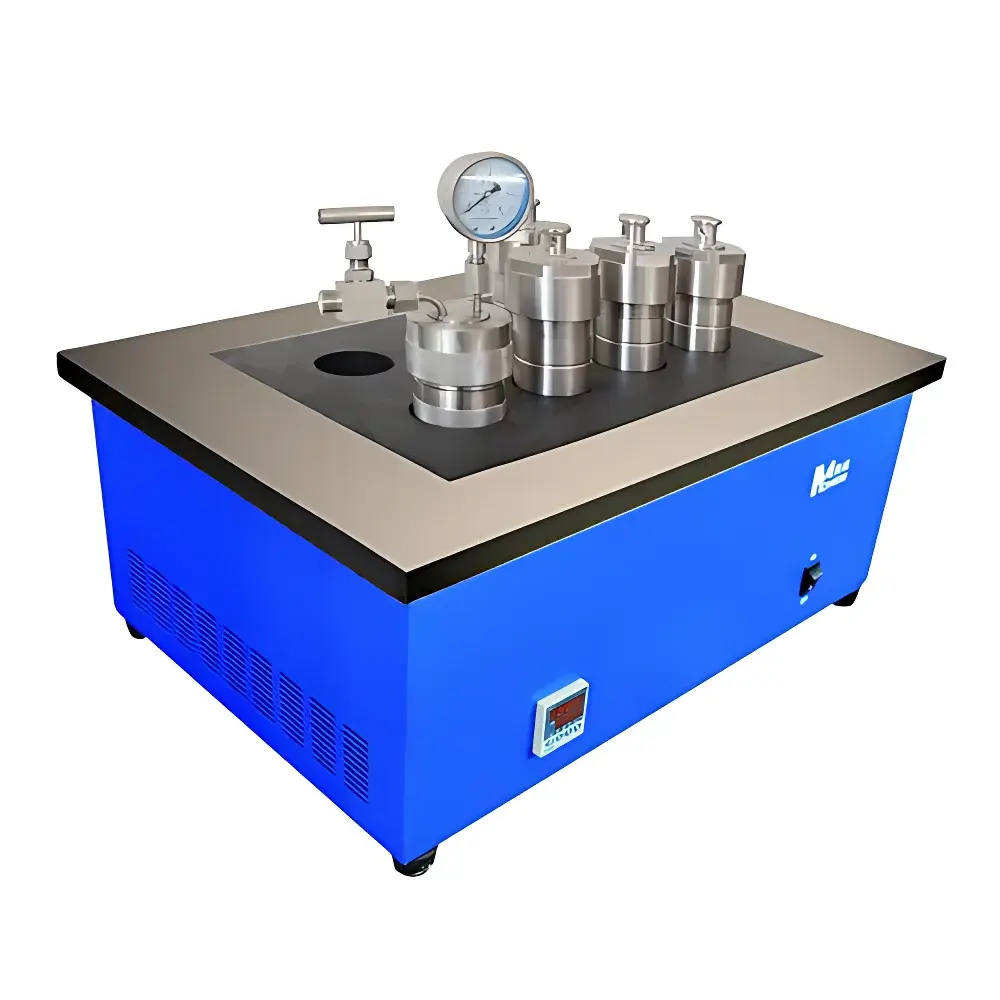
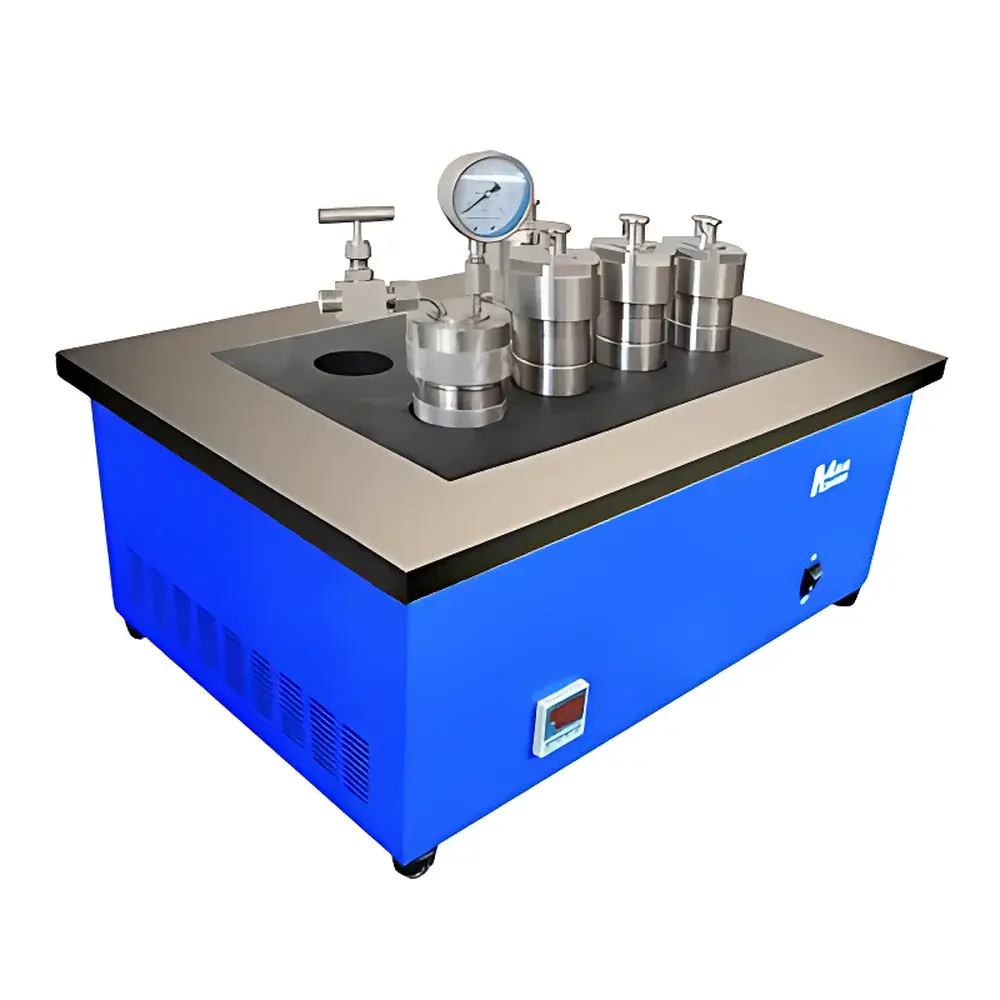
MICHEM DR Series High-Pressure Graphite Block Digestion System
| Brand | MICHEM |
|---|---|
| Origin | Beijing, China |
| Manufacturer Type | Authorized Distributor |
| Product Category | Domestic |
| Model | DR Series High-Pressure Graphite Digestion System |
| Price Range | USD 1,400 – 7,200 |
| Instrument Type | Graphite Block Digester |
| Automation Level | Semi-Automatic |
| Digestion Positions | 6 or 8 (customizable) |
| Max Heating Temperature | 260 °C |
| Temperature Control Accuracy | ±0.2 °C |
| Heating Principle | Infrared-Enhanced Graphite Block Heating |
| Heating Block Material | High-Purity Graphite with PTFE Coating |
| Pressure Rating | 10 MPa (dual-layer sealed digestion vessels) |
| Temperature Program Steps | Up to 30 segments |
| Max Power Consumption | 1.2 kW (DR-6G) / 3.0 kW (DR-8G) |
| Input Voltage | AC 220 V, 50 Hz, 10 A (DR-6G) / 16 A (DR-8G) |
| Dimensions (W×D×H) | 470×350×270 mm (DR-6G) |
| Sample Vessel Capacity | 100 mL × 6 or × 8 |
Overview
The MICHEM DR Series High-Pressure Graphite Block Digestion System is a semi-automated, benchtop sample preparation instrument engineered for closed-vessel acid digestion of solid and semi-solid matrices under elevated temperature and pressure conditions. It operates on the principle of conductive and infrared-enhanced heating via a high-purity graphite block, enabling rapid, uniform thermal transfer to multiple digestion vessels simultaneously. Unlike open-beaker hot plates or microwave digestion systems, the DR Series combines the robustness and scalability of block digestion with the safety and reproducibility of pressure-rated vessels—making it particularly suited for routine, high-throughput laboratories performing elemental analysis by ICP-OES, ICP-MS, AAS, or IC. Its design adheres to core principles of analytical chemistry sample integrity: minimizing analyte loss (especially volatile elements such as As, Hg, Se, and Sb), preventing cross-contamination, and ensuring complete matrix decomposition in aggressive acidic media (e.g., HNO₃, HCl, HF, H₂O₂ mixtures).
Key Features
- High-purity graphite heating block with electrophoretically applied PTFE coating — delivers exceptional corrosion resistance, thermal homogeneity (<±0.5 °C inter-hole variation), and ease of cleaning after repeated exposure to concentrated acids and alkalis.
- PID-based digital temperature control with 30-step programmable ramp-soak profiles — supports gradient heating, dwell stabilization, and automatic power cutoff upon cycle completion.
- Dual-layer, pressure-rated digestion vessels rated to 10 MPa — constructed from reinforced PTFE-lined quartz or high-strength polymer composites (depending on configuration), compliant with GB/T 150 (China’s pressure vessel standard) and aligned with ASTM D3682 and ISO 11047 guidelines for trace metal digestion.
- Modular platform accommodating either 6 or 8 digestion positions — scalable footprint optimized for lab space efficiency; custom configurations available for specialized throughput requirements.
- Integrated safety architecture including over-temperature cutoff, pressure relief venting, and real-time thermal monitoring — designed to meet GLP-compliant operational protocols in regulated environments.
Sample Compatibility & Compliance
The DR Series is validated for digestion of diverse sample types including soils, sediments, biological tissues (plant/animal), foodstuffs, polymers, catalysts, and geological materials. It supports EPA Method 3050B, 3051A, and 3052; ISO 17294-2; and GB/T 17138–1997 for heavy metal extraction. All digestion vessels are inert to HF up to 5% concentration when used with appropriate liner materials. The system’s pressure containment design ensures quantitative recovery of volatile analytes without requiring post-digestion reflux or cold-finger condensation — a critical advantage over conventional hot-block or sand-bath methods. Documentation packages include factory calibration certificates traceable to NIM (National Institute of Metrology, China) and optional IQ/OQ documentation support for GMP-aligned labs.
Software & Data Management
While the base DR Series operates via front-panel keypad interface, optional RS-232 or USB connectivity enables integration with LIMS or laboratory data management platforms. Temperature logs (time-stamped, with setpoint/actual deviation) can be exported in CSV format for audit trail generation. When deployed in regulated settings (e.g., environmental testing labs under CNAS or FDA oversight), the system supports 21 CFR Part 11-compliant electronic records when paired with validated third-party acquisition software — including user access controls, electronic signatures, and immutable audit trails for all method edits and run executions.
Applications
- Routine digestion prior to ICP-OES/ICP-MS quantification of trace metals in environmental monitoring programs.
- Preparation of certified reference materials (CRMs) for calibration verification across multi-element workflows.
- Method development for novel matrices (e.g., lithium-ion battery cathodes, microplastics, or nanomaterials) requiring controlled oxidative dissolution.
- Quality control digestion in pharmaceutical excipient testing per USP and EP 2.4.8.
- Academic research involving sequential extraction schemes or speciation studies where reproducible thermal history is essential.
FAQ
What safety certifications does the DR Series hold?
The system complies with GB 4793.1–2019 (Safety requirements for electrical equipment for measurement, control, and laboratory use) and includes CE-marked components. Pressure vessels conform to GB/T 150.1–2011.
Can the DR Series be used with hydrofluoric acid (HF)?
Yes — when equipped with quartz or specially lined polymer vessels; standard PTFE-only vessels are not recommended for >2% HF without supplemental cooling or dilution protocols.
Is method validation support provided?
MICHEM provides application notes, digestion protocol templates, and CRM recovery data (e.g., NIST SRM 2710a, GBW 07401) upon request; full method validation services are available through authorized application labs.
How is temperature uniformity verified across digestion positions?
Each unit undergoes factory verification using calibrated Pt100 probes placed in adjacent wells; certificate reports inter-well deviation at 260 °C (typically ≤±0.4 °C).
What maintenance is required for long-term reliability?
Annual inspection of graphite block surface integrity, PTFE coating adhesion, and vessel sealing gaskets is recommended; no routine lubrication or sensor recalibration is needed under normal operating conditions.
Related Products



