
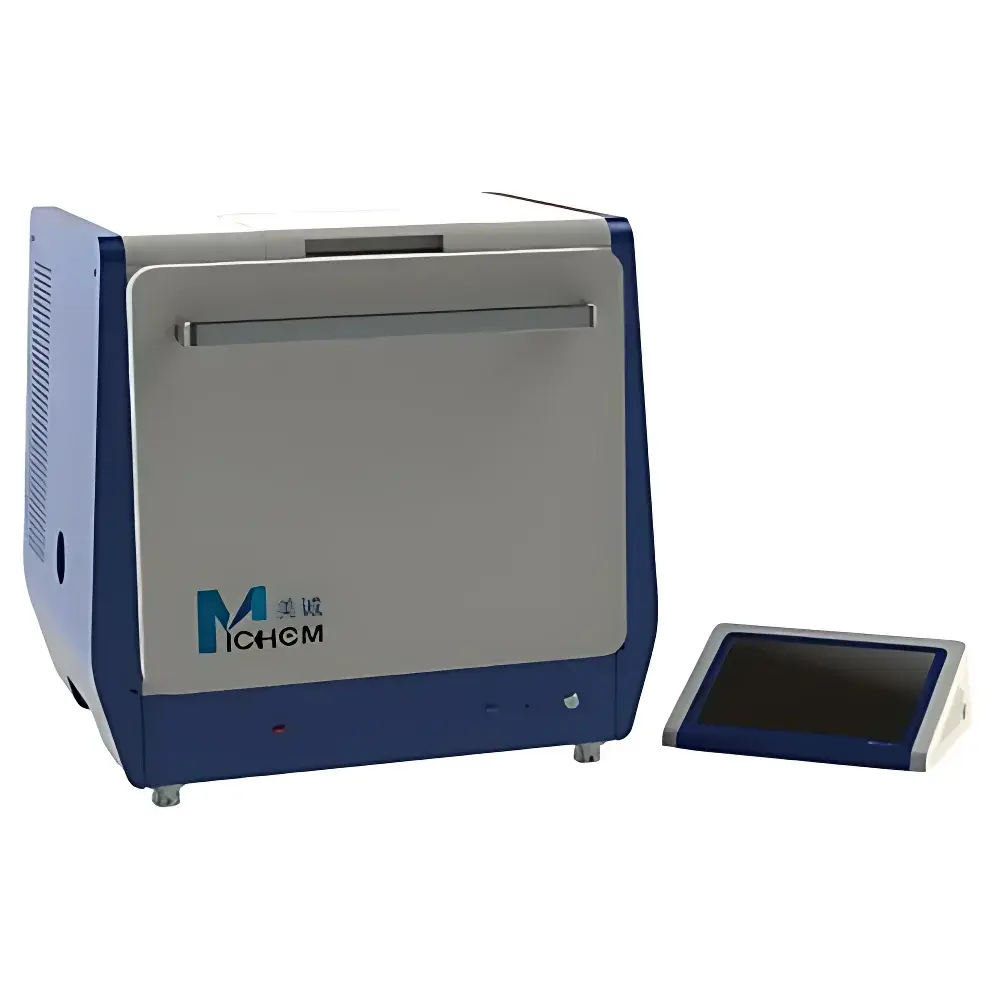
MICHEM MD8 High-Throughput Microwave Digestion System
| Brand | MICHEM |
|---|---|
| Model | MD8 |
| Origin | Beijing, China |
| Category | Microwave Digestion Instrument |
| Cavity Volume | 53 L (316L stainless steel, dual-sided 6-layer PFA coating) |
| Sample Capacity | 20 samples per batch (switchable 12/20-position rotor) |
| Microwave Source | Dual magnetron (2450 ±13 MHz), max output power 2400 W |
| Max Operating Temperature | 230 °C |
| Max Rated Pressure | 6 MPa (870 psi) |
| Max Burst Pressure | 10 MPa (1450 psi) |
| Temperature Control | PT100 platinum resistance sensor, range 0–300 °C, accuracy ±0.1 °C |
| Pressure Control | High-precision pressure transducer, range 0–10 MPa, accuracy ±0.01 MPa |
| Safety | Horizontal sliding door pressure-release mechanism (Patent ZL200420032536), dual-stage explosion protection, burst disc–based directional venting |
| Cooling & Ventilation | Corrosion-resistant variable-frequency centrifugal fan, airflow 5.8 m³/min |
| Microwave Leakage | ≤0.3 mW/cm² (IEC 61000-4-3 compliant) |
| Control System | Closed-loop PID with real-time frequency modulation |
| Interface | 10″ industrial-grade capacitive touchscreen, USB 2.0 port, SD card slot |
| Software | MDUI-P platform with built-in method library, GLP-compliant audit trail, auto-diagnostic routines, and adaptive cooling/fume extraction logic |
| Power Supply | 220 V, 50/60 Hz, 16 A, rated input 3600 W |
| Dimensions (W×D×H) | 650 × 675 × 650 mm |
| Net Weight | 80 kg |
| Digestion Vessel | Frame-type high-pressure rotor |
| operating temp/pressure | 230 °C / 6 MPa |
Overview
The MICHEM MD8 High-Throughput Microwave Digestion System is an industrial-grade sample preparation instrument engineered for precise, reproducible, and safe closed-vessel microwave-assisted acid digestion of solid and semi-solid matrices. It operates on the principle of dielectric heating—where microwave energy (2450 ±13 MHz) couples directly with polar molecules (e.g., HNO₃, HCl, HF) in sealed reaction vessels—to rapidly elevate temperature and pressure within chemically inert TFM-lined PEEK+GF composite vessels. Unlike conventional hotplate or block digesters, the MD8 delivers uniform volumetric heating via dual magnetrons arranged in a staggered configuration inside a 53 L resonant cavity constructed from 316L stainless steel with six-layer imported PFA coating—ensuring long-term resistance to aggressive acids (e.g., aqua regia, hydrofluoric acid) and mechanical creep under sustained thermal load. Its design targets laboratories requiring high sample throughput without compromising analytical integrity—particularly where trace metal analysis by ICP-OES, ICP-MS, AAS, or AFS demands complete matrix dissolution and minimal blank contribution.
Key Features
- Industrial-class 53 L microwave cavity fabricated from electropolished 316L stainless steel with dual-sided, six-layer PFA coating—certified for corrosion resistance against concentrated mineral acids and prolonged exposure to elevated temperatures.
- Dual magnetron system (2400 W max output) with phase-shifted emission geometry ensures homogeneous electromagnetic field distribution, minimizing cold spots and enabling consistent digestion across all 20 positions.
- Patented horizontal sliding-door pressure-release mechanism (ZL200420032536) combined with dual-stage safety architecture—including rupture-disc–based directional venting and real-time pressure monitoring—meets ISO/IEC 17025 and CLSI GP26-A4 requirements for laboratory safety management.
- Frame-type rotor with quick-swap 12/20-position configuration (ZL201520214863.9); each TFM inner vessel (100 mL) is housed in a reinforced PEEK+GF outer sleeve rated to 10 MPa and 300 °C, supporting both EPA Method 3051A/3052 and ISO 11466 applications.
- Contact-based dual-parameter control: PT100 sensor (±0.1 °C accuracy, 0–300 °C) and piezoresistive transducer (±0.01 MPa, 0–10 MPa) provide direct in-vessel measurement—eliminating inference errors common in infrared or fiber-optic remote sensing.
- Closed-loop PID frequency modulation dynamically adjusts magnetron output based on real-time temperature/pressure feedback—reducing energy consumption by >20% versus open-loop systems while lowering acoustic emissions to <58 dB(A).
Sample Compatibility & Compliance
The MD8 accommodates a broad spectrum of sample types—including soil, sediment, biological tissue, foodstuffs, pharmaceutical excipients, polymer additives, and environmental filters—across regulatory workflows aligned with US EPA SW-846 Methods 3051A (microwave-assisted acid digestion for metals), 3052 (silica-containing matrices), and ASTM D5511/D5512 for waste characterization. Vessel chemistry (TFM/PEEK+GF) complies with FDA 21 CFR §177.1550 and EU Regulation (EC) No 1935/2004 for food-contact materials. All hardware and software components are designed to support GLP/GMP documentation requirements: MDUI-P firmware logs user actions, method parameters, sensor outputs, and fault events with timestamped, non-erasable records—fully compatible with 21 CFR Part 11 electronic signature validation when deployed on validated networked workstations.
Software & Data Management
The MDUI-P control platform runs on a hardened 10″ capacitive touchscreen with 24° ergonomic tilt and EMI-shielded circuitry. It features an embedded method library covering >120 pre-validated protocols for food, clinical, environmental, and geochemical matrices—each editable with granular control over ramp rate (1–50 °C/min), hold time, power profile, and cooling sequence. Data acquisition includes simultaneous logging of temperature, pressure, reflected power, and digestion time at 1-second intervals. Raw datasets export via USB 2.0 or SD card in CSV/Excel-compatible format; optional integration with LIMS via TCP/IP enables automated result forwarding to QA/QC dashboards. Built-in self-diagnostic routines perform hardware verification at startup and continuously monitor sensor drift, magnetron efficiency, and cavity integrity—alerting users via on-screen prompts and audible signals before operational deviation exceeds defined thresholds.
Applications
The MD8 serves as a primary sample preparation tool in accredited testing laboratories performing elemental analysis by atomic spectroscopy. Its high batch capacity (20 samples) and robust thermal/pressure control make it ideal for routine analysis in municipal water quality monitoring (EPA 200.8), heavy metal screening in dietary supplements (USP /), leachability testing of consumer products (ASTM D3960), and residual catalyst quantification in active pharmaceutical ingredients (ICH Q2(R2)). It is also routinely deployed in university research labs for nanomaterial digestion prior to single-particle ICP-MS, and in contract testing organizations supporting ISO/IEC 17025 accreditation audits—where documented traceability, method ruggedness, and inter-laboratory reproducibility are mandatory.
FAQ
What safety certifications does the MD8 meet?
The MD8 conforms to IEC 61000-4-3 (EMC immunity), IEC 60335-1 (household appliance safety), and GB 4706.21 (Chinese national standard for microwave ovens), with microwave leakage tested and certified at ≤0.3 mW/cm²—well below the international limit of 5 mW/cm².
Can the MD8 be integrated into an automated sample prep workflow?
Yes—via its USB 2.0 interface and standardized data schema, the MD8 supports scheduled batch execution and post-run data ingestion into third-party laboratory automation software (e.g., Thermo Fisher SampleManager, LabVantage) using configurable CSV templates.
Is method validation support available for regulatory submissions?
MICHEM provides application notes documenting performance qualification (PQ) protocols—including precision, recovery, LOD/LOQ, and robustness studies—for EPA, ISO, and pharmacopeial methods; these serve as foundational documentation for method transfer and regulatory filing.
What maintenance is required for long-term reliability?
Routine maintenance includes quarterly inspection of PFA cavity coating integrity, annual calibration of PT100 and pressure transducers using NIST-traceable standards, and replacement of TFM vessels after 100 cycles or visible etching—no magnetron servicing is required under normal operation due to redundant thermal cutoffs and duty-cycle limiting.
Does the MD8 support multi-acid digestion protocols involving HF?
Yes—the TFM inner vessels and PEEK+GF outer sleeves are chemically resistant to hydrofluoric acid up to 40% concentration at 230 °C; however, HF use requires strict adherence to OSHA 29 CFR 1910.1200 hazard communication protocols and dedicated fume hood ventilation.



