
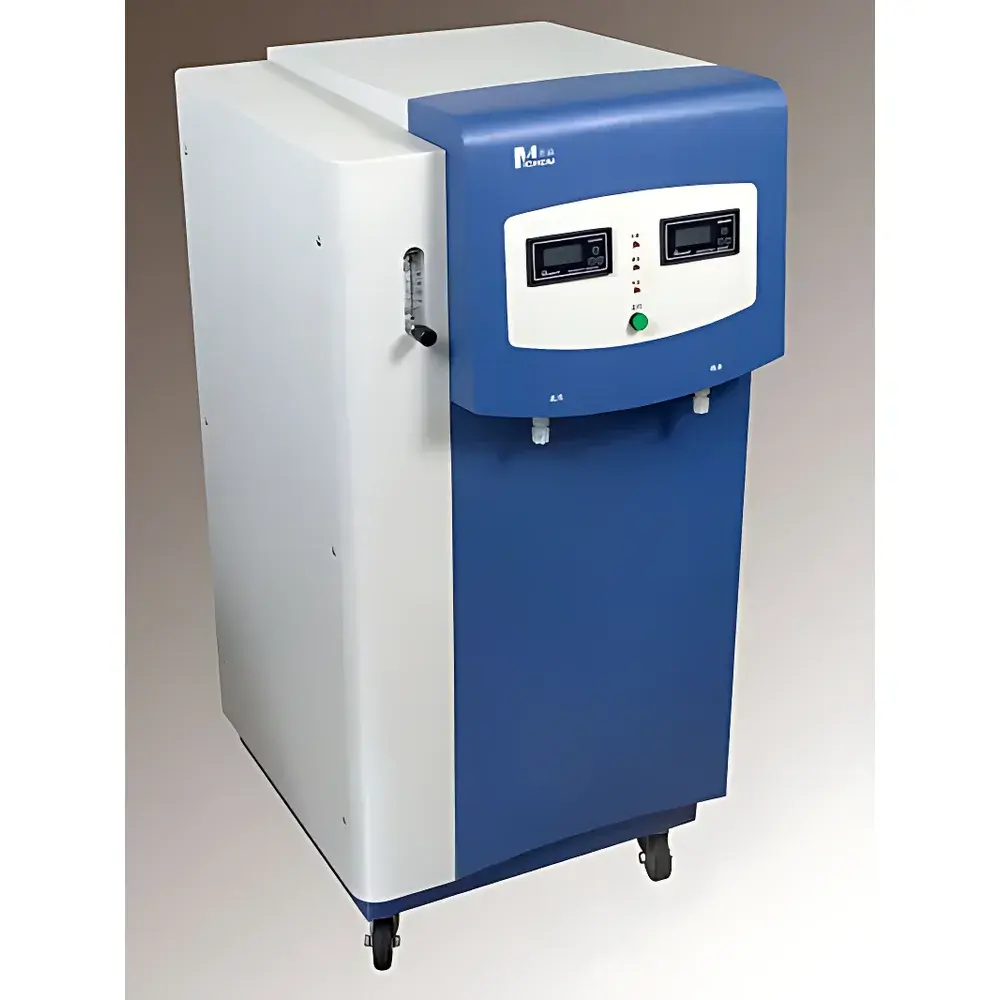
MICHEM MW-D10 Laboratory-Grade Ultra-Pure Water System
| Brand | MICHEM |
|---|---|
| Origin | Beijing, China |
| Model | MW-D10 |
| Pure Water Grade | Type I (GB/T 6682) |
| Resistivity | 18.25 MΩ·cm @ 25 °C |
| Heavy Metals & Soluble Silica | < 0.1 ppb |
| Total Organic Carbon (TOC) | ≤ 10 ppb |
| Microbial Count | < 1 CFU/mL |
| Endotoxin | < 0.001 EU/mL |
| Particles (>0.1 µm) | < 1 particle/mL |
Overview
The MICHEM MW-D10 Laboratory-Grade Ultra-Pure Water System is an integrated, dual-loop purification platform engineered for precision analytical laboratories requiring consistent, on-demand Type I ultrapure water per GB/T 6682, ASTM D1193, CLSI (formerly NCCLS) and CAP standards. It employs a multi-stage purification architecture combining pre-filtration, reverse osmosis (RO), electrodeionization (EDI) or mixed-bed ion exchange, dual-wavelength UV photooxidation (185/254 nm), and optional 0.22 µm final filtration to remove ionic, organic, microbial, particulate, and endotoxin contaminants from municipal tap feed water. The system delivers 10 L/h of ultrapure water at sustained resistivity ≥18.25 MΩ·cm, with real-time monitoring of conductivity, temperature, TOC, and pressure across critical process points. Its design prioritizes long-term stability, operator safety, and compliance readiness—making it suitable for HPLC, LC-MS, ICP-MS, cell culture, molecular biology, and trace elemental analysis where background interference must be minimized.
Key Features
- Dual-output configuration: Simultaneous production of Type III pure water (1–5 µS/cm) and Type I ultrapure water (≥18.25 MΩ·cm) from a single unit, eliminating cross-contamination risk via physically separated flow paths.
- Six-stage purification train: Includes sediment/carbon prefiltration, high-rejection RO membrane (TDS rejection >99%), post-RO degassing, mixed-bed deionization, 185/254 nm UV oxidation (reducing TOC to ≤10 ppb), and optional sterile-grade terminal filtration (Sartorius 0.22 µm).
- NSF-certified components: Critical consumables—including Dow FilmTec™ RO membranes and Kevlar®-reinforced composite housings—comply with NSF/ANSI Standard 58 and WQA Gold Seal requirements.
- Intelligent monitoring suite: Integrated 0.01 cm⁻¹ stainless-steel conductivity sensor with ±0.1 °C temperature compensation; LCD touchscreen interface displaying real-time resistivity, TOC, inlet pressure, tank level, and system status.
- Automated safeguards: Dry-run protection, full-tank auto-shutoff, low-inlet-pressure lockout, and predictive cartridge life algorithms with visual/audible alerts for scheduled maintenance.
- Low-noise operation: Optimized booster pump (<20 dB[A]) and vibration-damped chassis enable installation in shared lab spaces without acoustic disruption.
Sample Compatibility & Compliance
The MW-D10 is validated for use with feed water meeting municipal tap specifications (TDS ≤360 ppb, conductivity ≤550 µS/cm, pressure ≥0.2 MPa). Its output meets or exceeds the most stringent international benchmarks: GB/T 6682–2008 (Grade I), ASTM D1193–2020 (Type I), CLSI GP17-A3, and CAP Laboratory Accreditation Program water quality requirements. Endotoxin levels (<0.001 EU/mL) and bacterial counts (<1 CFU/mL) support applications in sterile technique environments, while ultra-low TOC (≤10 ppb, verified by OI Analytical online TOC analyzer) ensures compatibility with sensitive spectroscopic and mass spectrometric workflows. All wetted materials are USP Class VI compliant, and system logs retain audit trails for GLP/GMP-aligned documentation.
Software & Data Management
While the MW-D10 operates as a standalone instrument, its embedded firmware supports data export via USB port for external archiving. Conductivity, temperature, and alarm history are timestamped and stored for ≥30 days. Optional RS-232 or Ethernet modules (sold separately) enable integration into centralized lab infrastructure management platforms. The system does not require proprietary software for routine operation but provides raw parameter files compatible with common CSV-based LIMS ingestion protocols. Full calibration records, maintenance logs, and component replacement dates are accessible through the service menu—supporting FDA 21 CFR Part 11 readiness when paired with institutional electronic signature policies.
Applications
- HPLC and UHPLC mobile phase preparation and column equilibration
- ICP-MS and ICP-OES diluent and standard preparation
- Cell culture media formulation and reagent dissolution
- PCR, qRT-PCR, and next-generation sequencing (NGS) assay setup
- Atomic absorption spectroscopy (AAS) and GF-AAS blanking
- Electrophysiology buffer preparation and patch-clamp solutions
- Calibration standard dilution for clinical chemistry analyzers
FAQ
What feed water quality is required for stable operation?
Municipal tap water with TDS ≤360 ppb and conductivity ≤550 µS/cm is sufficient. Pre-treatment is not required unless local water contains high chlorine, iron, or hardness—consult MICHEM’s site assessment guide for region-specific recommendations.
How often must consumables be replaced?
RO membrane service life averages 2–3 years under typical usage; mixed-bed cartridges last 6–12 months depending on feed water load. The system calculates remaining capacity based on actual throughput and displays replacement prompts 72 hours in advance.
Is the MW-D10 compliant with FDA 21 CFR Part 11?
The base unit supports ALCOA+ data integrity principles (Attributable, Legible, Contemporaneous, Original, Accurate) and retains tamper-evident audit logs. Full Part 11 compliance requires institutional implementation of electronic signatures, role-based access control, and periodic validation—functions enabled via optional network modules and documented SOPs.
Can the system be upgraded to include TOC monitoring?
Yes. The MW-D10 chassis accommodates factory-installed online TOC analyzers (OI Analytical Model 1030W or equivalent) with analog output integration and calibrated range 1–100 ppb.
What certifications apply to wetted materials?
All fluid-contact polymers meet USP Class VI biological reactivity standards. RO membranes carry NSF/ANSI 58 certification; UV lamps comply with IEC 62471 photobiological safety classification.



