
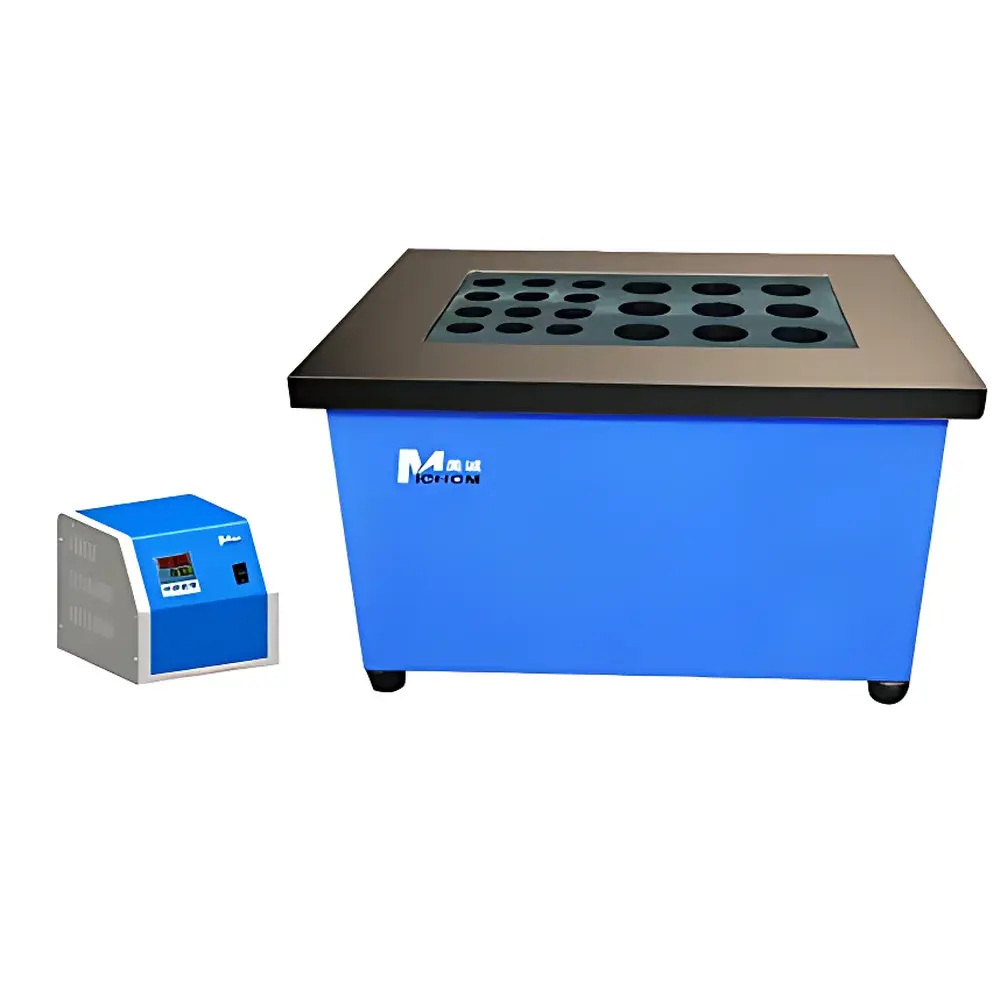
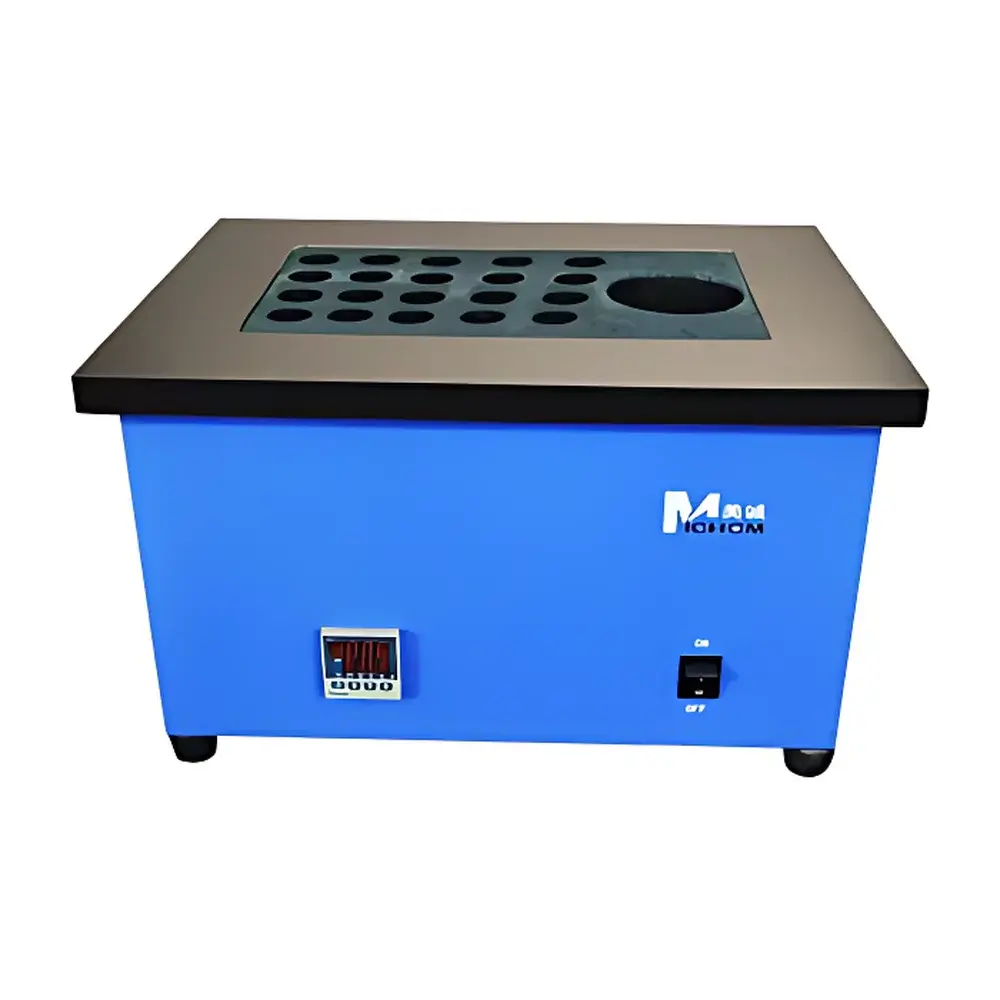
MICHEM RC Series Graphite Block Digestion System
| Brand | MICHEM |
|---|---|
| Model | RC-15 / RC-24 / RC-40 / RC-54 |
| Heating Material | High-Purity Graphite with Multi-Layer PTFE Coating |
| Max. Temperature | 460 °C |
| Temperature Accuracy | ±1.0 °C |
| Heating Uniformity | ±2.0 °C across block |
| Control System | PID Digital Controller with 30-Step Programmable Ramp/Soak |
| Sample Capacity | 15 × 100 mL, 24 × 50 mL, 40 × 100 mL, or 54 × 50 mL |
| Power Rating | 1200 W (RC-15/RC-24) / 3000 W (RC-40/RC-54) |
| Input Voltage | AC 220 V, 50 Hz, 16 A |
| Dimensions (W×H×D) | 470×350×270 mm (RC-15/RC-24) / 670×460×270 mm (RC-40/RC-54) |
| Compliance | Designed for GLP-compliant sample preparation workflows |
Overview
The MICHEM RC Series Graphite Block Digestion System is a benchtop electric heating digestion instrument engineered for reproducible, high-throughput acid digestion of solid and semi-solid samples under atmospheric pressure. It operates on the principle of conductive heating via a high-purity graphite block—thermally stable up to 460 °C—with uniform heat distribution achieved through integrated circumferential heating architecture. Unlike conventional hot plates or ceramic heaters, the RC Series eliminates thermal gradients across the block surface, ensuring consistent reaction kinetics across all sample positions. Its remote control interface physically separates the operator from the digestion zone during operation, mitigating exposure to volatile acidic fumes (e.g., HNO₃, HCl, HF, H₂SO₄ vapors) generated during open-vessel digestion—a critical safety enhancement for routine elemental analysis sample preparation.
Key Features
- Uniform Conductive Heating: High-density, high-purity graphite heating block with multi-layer PTFE coating ensures exceptional thermal conductivity and chemical inertness. The one-piece circumferential heating design minimizes radial and axial temperature deviation—achieving ≤±2.0 °C inter-well uniformity at setpoint.
- Corrosion-Resistant Construction: Entire heating surface—including block, well walls, and platform—is coated using an electrostatic spray process optimized for adhesion and longevity in aggressive media. Withstands prolonged exposure to concentrated nitric, hydrochloric, hydrofluoric, and perchloric acids without delamination or pitting.
- Precision PID Temperature Control: Microprocessor-based digital controller supports 30-segment programmable ramp-and-soak profiles. Temperature accuracy is maintained within ±1.0 °C over full operating range (room temperature to 460 °C), with adjustable heating rate, over-temperature alarm, auto-shutdown, and real-time digital display.
- Scalable Throughput Architecture: Four standard configurations (RC-15, RC-24, RC-40, RC-54) accommodate varying lab volumes—from method development to routine QA/QC. All models support custom well diameter and depth (e.g., Φ23–42 mm × 40–50 mm) to match vessel geometry and volume requirements (5–100 mL).
- Remote Operation & Ergonomic Safety: Detachable control unit enables placement outside the fume hood or at a safe distance (>1 m), reducing inhalation risk and enabling unattended operation during extended digestion cycles (e.g., overnight ashing or reflux steps).
Sample Compatibility & Compliance
The RC Series is validated for digestion of diverse matrices including soil, sediment, sludge, plant tissue, food homogenates, pharmaceutical excipients, polymer composites, and biological fluids. It complies with regulatory digestion protocols required prior to atomic absorption spectroscopy (AAS), atomic fluorescence spectroscopy (AFS), inductively coupled plasma optical emission spectrometry (ICP-OES), and ICP-mass spectrometry (ICP-MS). Its design supports adherence to EPA Methods 3050B (acid digestion of sediments and soils), 3051A (microwave-assisted extraction followed by open-vessel acid digestion), ASTM D3682 (aluminum in water), ISO 11047 (heavy metals in plastics), and USP <231> (heavy metals limit test). The system meets GLP documentation requirements when paired with audit-trail-capable data loggers and is compatible with 21 CFR Part 11–compliant software add-ons for electronic record integrity.
Software & Data Management
While the base RC Series features standalone PID control with local digital display, optional RS-485 or USB interfaces enable integration with laboratory information management systems (LIMS) or third-party data acquisition platforms. Users may export time-stamped temperature logs (sample ID, setpoint, actual temp, ramp rate, dwell duration) in CSV format for traceability. Firmware updates are delivered via secure vendor portal, and calibration verification reports can be generated per ISO/IEC 17025 internal audit schedules. No proprietary cloud services are embedded—ensuring full data sovereignty and compatibility with air-gapped analytical environments.
Applications
- Preparation of environmental samples (soil, wastewater sludge, airborne particulates) for trace metal quantification by ICP-MS
- Digestion of food and feed products for Cd, Pb, As, Hg analysis per EU Commission Regulation (EC) No. 1881/2006
- Pharmaceutical raw material testing per USP <231> and ICH Q5D guidelines
- Decomposition of catalysts, battery electrodes, and electronic waste prior to leachate analysis
- Support digestion step for microwave-pre-treated samples requiring post-digestion acid removal (i.e., “hot plate赶酸” or acid evaporation)
- High-volume QC labs performing >50 digestions/day where repeatability and operator safety are prioritized over ultra-rapid turnaround
FAQ
Can the RC Series be used with hydrofluoric acid (HF)?
Yes—the PTFE-coated graphite block and well structure are chemically resistant to HF at concentrations up to 40% v/v below 200 °C. However, HF digestion must be conducted inside a certified HF-rated fume hood with appropriate PPE (e.g., calcium gluconate gel on hand).
Is the temperature calibration traceable to NIST standards?
Each unit ships with a factory calibration certificate referencing ITS-90 thermocouple standards. Field recalibration using a Class A Pt100 probe and accredited dry-block calibrator is supported per ISO/IEC 17025 Clause 6.5.
What maintenance is required for long-term stability?
Annual visual inspection of PTFE coating integrity and graphite surface erosion is recommended. No lubrication or consumable parts are required. Cleaning is performed with dilute NaOH or citric acid solution followed by DI water rinse—never abrasive tools.
Does the RC Series meet CE or UL safety certification?
The RC Series conforms to IEC 61010-1:2010 for electrical safety in laboratory equipment. CE marking is applied for EU market compliance; UL 61010-1 listing is available upon request for North American installations.
Can I integrate this digester into an automated sample prep line?
Yes—digital I/O ports (optional) support TTL-level start/stop triggers and status feedback (ready, heating, error). Mechanical integration with robotic arms requires custom mounting brackets, which MICHEM provides as OEM engineering support.



