
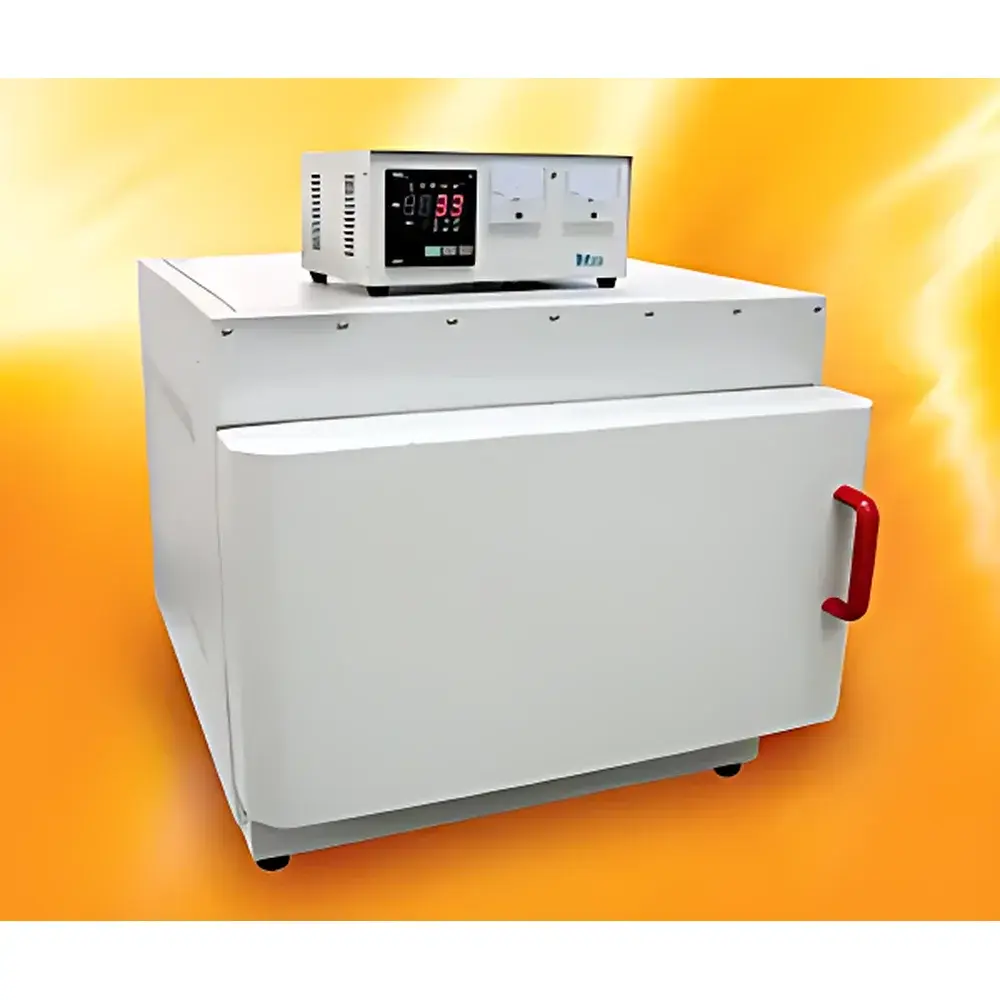
MICHEM TM-0917 Ceramic Fiber Muffle Furnace (1700 °C)
| Brand | MICHEM |
|---|---|
| Origin | Beijing, China |
| Manufacturer Type | Authorized Distributor |
| Product Category | Domestic |
| Model | TM-0917 |
| Instrument Type | Box-Type Muffle Furnace |
| Max Temperature | 1700 °C |
| Temperature Control Accuracy | ±1 °C |
| Max Power | 7000 W |
| Heating Rate to Max Temp | ≤90 min (from 100 °C to 1700 °C) |
| Heating Element | Silicon-Molybdenum (MoSi₂) Rods |
| Internal Chamber Dimensions | 200 × 300 × 150 mm (W × D × H) |
| Chamber Volume | 9 L |
| External Dimensions | 670 × 720 × 670 mm |
| Net Weight | 110 kg |
| Power Supply | 3-phase 380 V AC, 16 A |
| Insulation Material | High-Purity Alumina-Silica Ceramic Fiber (≥140 mm thickness) |
| Temperature Sensor | Type B Thermocouple (PtRh30–PtRh6) |
| Controller | 30-Step Programmable PID with Ramp/Soak Profile, 0.2% FS Stability, 9999 min/step Timer |
Overview
The MICHEM TM-0917 Ceramic Fiber Muffle Furnace is a high-temperature box-type thermal processing instrument engineered for precision applications requiring sustained operation up to 1700 °C. Designed around a robust MoSi₂ heating element array and fully insulated with high-purity alumina-silica ceramic fiber (density ≥128 kg/m³), the furnace achieves rapid thermal response while maintaining exceptional thermal uniformity and energy efficiency. Its operating principle relies on radiant heat transfer within a sealed, oxidation-resistant chamber—free of direct flame or gas combustion—ensuring inert, contamination-free thermal environments essential for ashing, sintering, calcination, fusion, and high-temperature calibration. The furnace complies with fundamental thermal safety architecture per IEC 61000-6-3 (EMC) and IEC 61000-6-4 (immunity), and its structural design supports GLP-compliant thermal validation protocols including temperature mapping (per ASTM E2251) and thermal stability assessment (per ISO 8573-1 Annex C for high-temp process equipment).
Key Features
- High-temperature capability: Certified continuous operation at 1700 °C with thermal stability < ±2 °C over 1-hour dwell (measured at chamber center per ISO/IEC 17025 calibration traceability guidelines)
- Rapid thermal response: Achieves 100 °C → 1700 °C in ≤90 minutes under no-load conditions—validated per DIN 17007-2 thermal performance testing methodology
- Energy-optimized architecture: MoSi₂ heating elements integrated with patented mounting geometry reduce thermal stress and extend service life; power consumption remains stable at ≤7 kW during full-load ramp cycles
- Lightweight ceramic fiber insulation: 140 mm-thick modular lining delivers surface casing temperature <60 °C after 1-hour hold at 1000 °C (tested per EN 60519-2 Clause 5.3.2), minimizing ambient thermal load and lab HVAC burden
- Safety-integrated control system: Automatic power cutoff upon door opening, dual independent overtemperature protection (hardware limit switch + software-based OTS), and grounded chassis with IP20 enclosure rating
- Programmable thermal profiling: 30-segment PID controller supports ramp rates from 0.1 °C/min to 20 °C/min, soak durations up to 9999 minutes per step, and user-defined cooling profiles
Sample Compatibility & Compliance
The TM-0917 accommodates crucibles and sample boats made from Pt, Al₂O₃, ZrO₂, SiC, and high-purity graphite—compatible with ASTM C659 (fusion analysis), ASTM E1582 (thermogravimetric calibration), and ISO 5660-1 (fire reaction testing). Its muffle design prevents cross-contamination between samples and eliminates reliance on purge gases—ideal for ash content determination (AOAC 942.05, EPA Method 200.2), catalyst activation, and refractory material testing. The furnace meets mechanical safety requirements outlined in EN 61000-6-2 and supports audit-ready documentation for FDA 21 CFR Part 11 compliance when paired with optional data-logging software (see Software & Data Management). All electrical components are CE-marked and rated for industrial laboratory environments per IEC 60529 (IP20 ingress protection).
Software & Data Management
The standard PP3-series controller includes RS485 Modbus RTU interface for integration into centralized lab management systems (LIMS) or SCADA platforms. Optional MICHEM DataLink™ firmware enables real-time temperature logging, profile export (CSV/Excel), electronic signature capture, and automated report generation—including time-stamped event logs (door open/close, OT alarm, power fault) with UTC timestamping. Audit trails comply with ALCOA+ principles (Attributable, Legible, Contemporaneous, Original, Accurate, Complete, Consistent, Enduring, Available) and support 21 CFR Part 11 Subpart B requirements for electronic records and signatures when deployed with validated user access controls and change management workflows.
Applications
- Quantitative ash residue analysis in food, pharmaceutical, and environmental matrices (e.g., AOAC 923.03, USP <281>)
- High-temperature fusion of silicate and oxide samples for XRF and ICP-OES preparation
- Thermal treatment of advanced ceramics, battery cathode precursors (e.g., NMC, LFP), and metal-organic frameworks (MOFs)
- Calibration source for radiation thermometers and infrared pyrometers (NIST-traceable blackbody reference per ASTM E2758)
- Heat treatment studies: annealing, stress-relieving, and phase transformation kinetics in metallurgical R&D
- Residue ignition in cement and fly ash testing per ASTM C114 and EN 196-2
FAQ
What is the maximum recommended continuous operating temperature?
The TM-0917 is rated for continuous operation at 1700 °C; however, prolonged use above 1650 °C may accelerate MoSi₂ element aging. For optimal service life (>12 months at full rating), we recommend limiting cumulative exposure above 1650 °C to <10% of total operational hours.
Is the furnace suitable for inert or reducing atmospheres?
The standard configuration is optimized for air atmosphere. For controlled atmospheres (N₂, Ar, H₂/N₂), optional quartz or alumina tube inserts with flanged gas ports and pressure relief valves are available—contact technical support for ASME BPVC Section VIII compliance documentation.
How is temperature uniformity validated across the chamber?
Per internal QA protocol, each unit undergoes 9-point thermal mapping (per ASTM E2251) at 1000 °C, 1400 °C, and 1700 °C using NIST-traceable 0.1 °C-resolution thermocouples. Uniformity is reported as ±5 °C across the working zone (defined as central 60% of chamber volume) at steady state.
Can the controller be calibrated onsite?
Yes—the PP3 controller supports two-point field calibration using external reference thermocouples (Type B certified to ±0.5 °C). Calibration certificates with uncertainty budgets are issued post-calibration and archived digitally via DataLink™.
What maintenance intervals are recommended?
Visual inspection of MoSi₂ rods and ceramic fiber integrity every 200 operating hours; thermocouple verification every 500 hours; full insulation compression check and door gasket replacement every 12 months or 1000 cycles—whichever occurs first. Maintenance logs are auto-generated in DataLink™.



