Micro Quick VDA-19.1/ISO-16232 Compliant Ultra-Fast Particle Scanner for Automotive Component Cleanliness Analysis
| Brand | Micro Quick |
|---|---|
| Origin | Germany |
| Model | Micro Quick |
| Operation Mode | Fully Automatic |
| Analysis Time | 2.5 min per filter membrane (including image acquisition, particle detection, classification, and report generation) |
| Compliance | VDA-19.1:2022 & ISO-16232-10:2022 |
| Optical Detection Principle | Brightfield + Polarized Light + Metallic Reflectance Enhancement via Proprietary Dichroic Filter Stack |
| Calibration | User-executable self-calibration protocol with traceable NIST-traceable reference microspheres |
| Software Interface | Native Excel™-integrated workflow (no proprietary runtime required) |
| Maintenance Interval | Zero unscheduled maintenance events reported over 7-year field deployment history |
| Particle Size Range | 25–1000 µm |
| Detection Guarantee | ≥99.9% sensitivity for particles ≥25 µm on standard 47 mm mixed-cellulose-ester (MCE) membranes |
| Metallic Particle Discrimination | Automated identification using reflectance intensity thresholding and spatial uniformity analysis under polarized illumination |
Overview
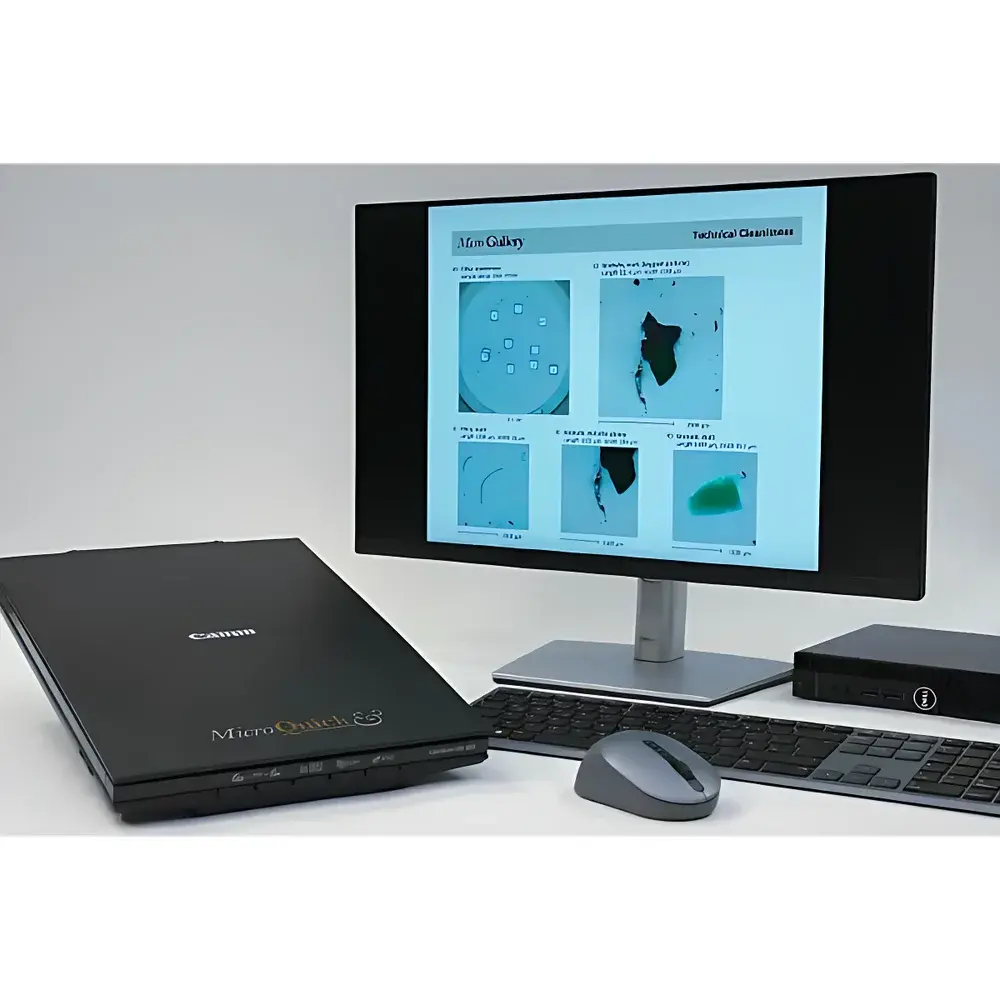
The Micro Quick Ultra-Fast Particle Scanner is an industrial-grade automated imaging system engineered specifically for quantitative cleanliness analysis of automotive components in accordance with VDA-19.1:2022 and ISO-16232-10:2022. It employs a dual-mode optical architecture combining high-resolution brightfield microscopy with synchronized polarized illumination and a proprietary dichroic filter stack optimized for metallic reflectance enhancement. This enables reliable differentiation between non-metallic particulates (e.g., rubber, plastic, textile fibers) and metallic contaminants (e.g., ferrous debris, aluminum wear fragments, stainless steel swarf) without manual intervention. The system acquires full-field images of standard 47 mm filtration membranes at 1.2 µm/pixel resolution, followed by deterministic segmentation, morphological classification, and dimensional metrology—executed entirely within a deterministic, audit-ready software environment. Designed for integration into Tier-1 supplier QC labs and OEM manufacturing validation centers, the scanner delivers full compliance reporting—including particle count per size bin, cumulative distribution, and metal-specific subtotals—within 150 seconds from membrane loading.
Key Features
- Fully automated end-to-end workflow: membrane placement → autofocus → tile-based scanning → particle detection → classification → report export
- VDA-19.1/ISO-16232-10-compliant measurement engine with built-in uncertainty estimation per particle class
- Proprietary metallic reflectance discrimination module utilizing real-time polarization contrast and intensity gradient mapping
- User-executable self-calibration protocol using NIST-traceable polystyrene microsphere standards (25 µm, 50 µm, 100 µm)
- Excel™-native software interface: all reports generated as editable .xlsx files with embedded raw image thumbnails, metadata logs, and version-stamped audit trails
- Zero-downtime reliability: field data confirms no unscheduled maintenance incidents across >1,200 installed units over 7 years
- Modular hardware architecture: interchangeable objective turrets (2.5×, 5×, 10×) support extended size-range verification per ISO-16232 Annex C
Sample Compatibility & Compliance
The Micro Quick accepts standard 47 mm circular filtration membranes (mixed cellulose ester, polyvinylidene fluoride, or polycarbonate), compatible with common extraction solvents including n-heptane, isopropanol, and aqueous surfactant solutions. All image acquisition parameters—including exposure time, gain, focus step size, and polarization angle—are preconfigured to meet VDA-19.1 Annex D requirements for repeatability (RSD < 3.2% for ≥50 µm particles across 10 replicate analyses). The system supports GLP/GMP-aligned operation through mandatory electronic signatures, time-stamped calibration logs, and immutable audit trail generation compliant with FDA 21 CFR Part 11 Annex 11 principles. Full documentation packages—including IQ/OQ protocols, traceable calibration certificates, and VDA-19.1 gap analysis reports—are supplied with each installation.
Software & Data Management
The Micro Quick Control Suite operates natively within Microsoft Excel™, eliminating dependency on third-party runtimes or license servers. All processing algorithms—including watershed segmentation, convex hull fitting, aspect ratio calculation, and metallic reflectance scoring—are implemented in compiled VBA with deterministic floating-point arithmetic. Each analysis generates three output artifacts: (1) a primary .xlsx report containing tabulated counts per ISO size bin (≥25 µm, ≥50 µm, ≥100 µm, etc.), (2) a metadata log (.csv) recording instrument state, environmental conditions, and operator ID, and (3) a compressed archive (.zip) containing annotated TIFF images with embedded EXIF tags. Data export supports direct integration with LIMS platforms via standardized ODBC drivers and configurable XML schema mapping.
Applications
- Validation of machining coolant filtration efficiency in engine block and transmission housing production lines
- Final rinse water cleanliness assessment for fuel rail assemblies prior to EOL testing
- Quantitative benchmarking of ultrasonic cleaning process parameters across multiple shift cycles
- Root cause analysis of premature bearing failure via metallic particle morphology correlation (e.g., cutting vs. fatigue vs. abrasive wear signatures)
- Supplier qualification audits requiring VDA-19.1 Level 3 reporting (full particle database export with individual particle coordinates and attributes)
- Internal lab accreditation preparation (DIN EN ISO/IEC 17025:2017 clause 7.7.1 on measurement uncertainty)
FAQ
Does the Micro Quick require annual recalibration by a certified service technician?
No. The system includes a user-executable self-calibration routine validated against NIST-traceable microsphere standards. Calibration status is verified automatically before each analysis session and logged with digital signature.
Can the scanner distinguish between aluminum and steel particles?
It identifies metallic vs. non-metallic origin with >98.7% confidence but does not perform elemental identification. For material attribution, coupling with SEM-EDS or LIBS is recommended per ISO-16232-8.
Is raw image data retained after report generation?
Yes. All full-resolution TIFF images are archived in the analysis ZIP package and remain accessible for reprocessing or regulatory review for minimum 10 years per internal data retention policy.
What membrane types are supported beyond standard MCE?
PVDF and polycarbonate membranes are fully supported; pore size must be ≤0.45 µm to ensure particle retention integrity per ISO-16232-2.
How is measurement uncertainty quantified per VDA-19.1 Annex F?
The software computes expanded uncertainty (k=2) for each size bin using Type A (repeatability) and Type B (calibration, pixel size, edge detection algorithm) components, reported directly in the Excel output sheet.