
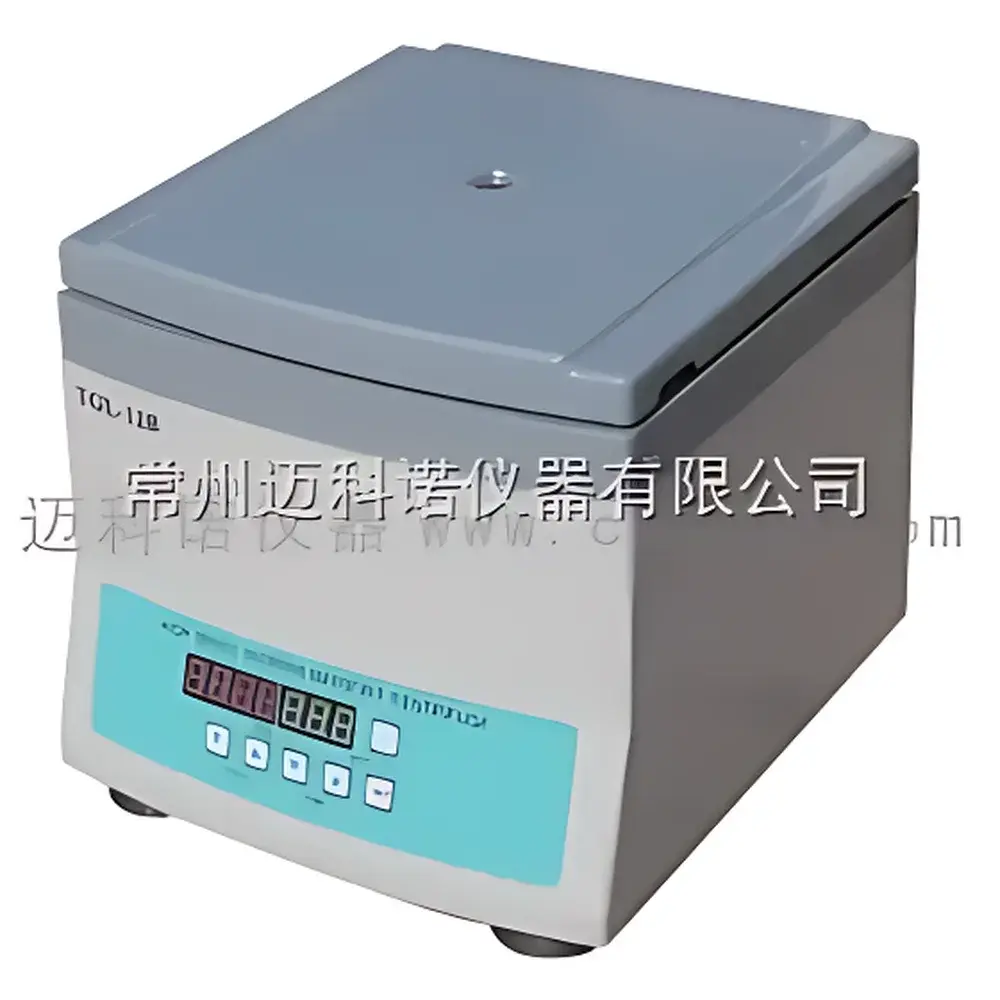
MicroBlood Mini Hematocrit Centrifuge Model MB-2
| Key | Power Supply: 110 V / 60 Hz & 220 V / 50–60 Hz |
|---|---|
| Max Speed | 12,000 rpm (infinitely variable) |
| RCF | 13,500 × g |
| Capacity | 24 × capillary tubes (Φ1.5 mm × 75 mm) |
| Acceleration Time | <60 s |
| Deceleration Time | <120 s |
| Timer Range | 0–30 min (non-continuous operation) |
| Dimensions | 280 × 310 × 265 mm (L×W×H) |
| Net Weight | 10 kg |
| Input Power | 230 VA |
| Output Power | 100 W |
Overview
The MicroBlood Mini Hematocrit Centrifuge Model MB-2 is a compact, benchtop-capable centrifugal instrument engineered specifically for rapid hematocrit determination and micro-volume blood phase separation in clinical laboratories, point-of-care settings, and field-deployable diagnostic workflows. It operates on the principle of sedimentation under controlled relative centrifugal force (RCF), enabling precise stratification of whole blood into packed red blood cells (RBCs), buffy coat, and plasma within capillary tubes. Designed for use with minimally invasive capillary blood samples—such as those obtained from fingertip or earlobe punctures—the MB-2 eliminates reliance on venous draws while maintaining analytical integrity required for hematocrit quantification per CLSI H26-A3 and ISO 15189-compliant protocols. Its rotor architecture ensures mechanical balance at high rotational speeds, minimizing vibration and thermal drift during short-duration runs (<30 min), thereby supporting reproducible hematocrit readings across sequential assays.
Key Features
- Infinitely variable speed control (0–12,000 rpm) with digital touch interface for precise RCF optimization per sample viscosity and tube geometry
- Dual-voltage compatibility (110 V / 60 Hz and 220 V / 50–60 Hz) enables global deployment without external transformers
- High-efficiency brushless DC motor delivering stable torque output up to 13,500 × g, with thermal overload protection and automatic shutdown upon imbalance detection
- Compact footprint (280 × 310 × 265 mm) and lightweight chassis (10 kg net weight) facilitate integration into mobile labs, emergency carts, or space-constrained clinical stations
- Capillary-specific rotor accommodating 24 standardized hematocrit tubes (1.5 mm diameter × 75 mm length), pre-aligned for symmetrical loading and minimal run-time imbalance
- Programmable timer (0–30 min) with audible end-of-run alert and automatic brake engagement; non-continuous operation design complies with IEC 61010-1 safety requirements for Class II laboratory equipment
Sample Compatibility & Compliance
The MB-2 is validated for use with heparinized or EDTA-coated glass or plastic capillary tubes conforming to ASTM D7279 and ISO 8655-5 dimensional tolerances. It supports both native whole blood and anticoagulated specimens without modification to tube orientation or rotor configuration. The instrument meets essential safety and electromagnetic compatibility standards including IEC 61010-1 (Safety Requirements for Electrical Equipment for Measurement, Control, and Laboratory Use) and IEC 61326-1 (EMC for Laboratory Equipment). While not FDA-cleared as an IVD device, its operational parameters align with CLIA-waived testing criteria when used in conjunction with analytically verified hematocrit reference methods. Routine calibration verification can be performed using certified tachometer probes traceable to NIST standards.
Software & Data Management
The MB-2 operates as a standalone electromechanical system with no embedded firmware or data logging capability—consistent with regulatory expectations for Class A hematocrit centrifuges under ISO 15197 and EU IVDR Annex I general safety requirements. All operational parameters (speed, time, RCF) are set manually via tactile controls; no software validation, audit trail, or electronic record retention is required. This architecture simplifies qualification under GLP environments where instrument functionality must remain deterministic and unaffected by software updates or cybersecurity vulnerabilities. For laboratories subject to 21 CFR Part 11, the absence of electronic records renders the MB-2 exempt from electronic signature or system validation mandates—reducing compliance overhead without compromising measurement fidelity.
Applications
- Routine hematocrit measurement in outpatient clinics, rural health centers, and military field hospitals
- Quality control verification of blood component separation prior to transfusion or biobanking
- Supporting microfluidic assay development where capillary-scale sample partitioning is required
- Educational use in biomedical training programs for teaching sedimentation kinetics and centrifugal force principles
- Pre-analytical processing for downstream hemoglobin analysis, blood gas testing, or viscometry studies
FAQ
What capillary tube dimensions are supported?
The MB-2 accepts standard hematocrit capillaries measuring 1.5 mm outer diameter and 75 mm total length, compatible with both glass and polymer-coated variants.
Is continuous operation permitted?
No. The instrument is rated for intermittent use only, with a maximum runtime of 30 minutes per cycle and mandatory cooldown intervals between consecutive runs.
Does the MB-2 require routine calibration?
Yes—annual verification of rotational speed accuracy using a NIST-traceable handheld tachometer is recommended per ISO/IEC 17025 clause 6.5.2.
Can it be used with anticoagulated blood samples?
Yes. EDTA-K2, heparin, and citrate-anticoagulated whole blood yield consistent hematocrit values when processed per CLSI H26-A3 guidelines.
Is the rotor autoclavable?
No. The aluminum rotor assembly is not designed for steam sterilization; cleaning is limited to 70% ethanol wipe-down and dry-air drying.



