
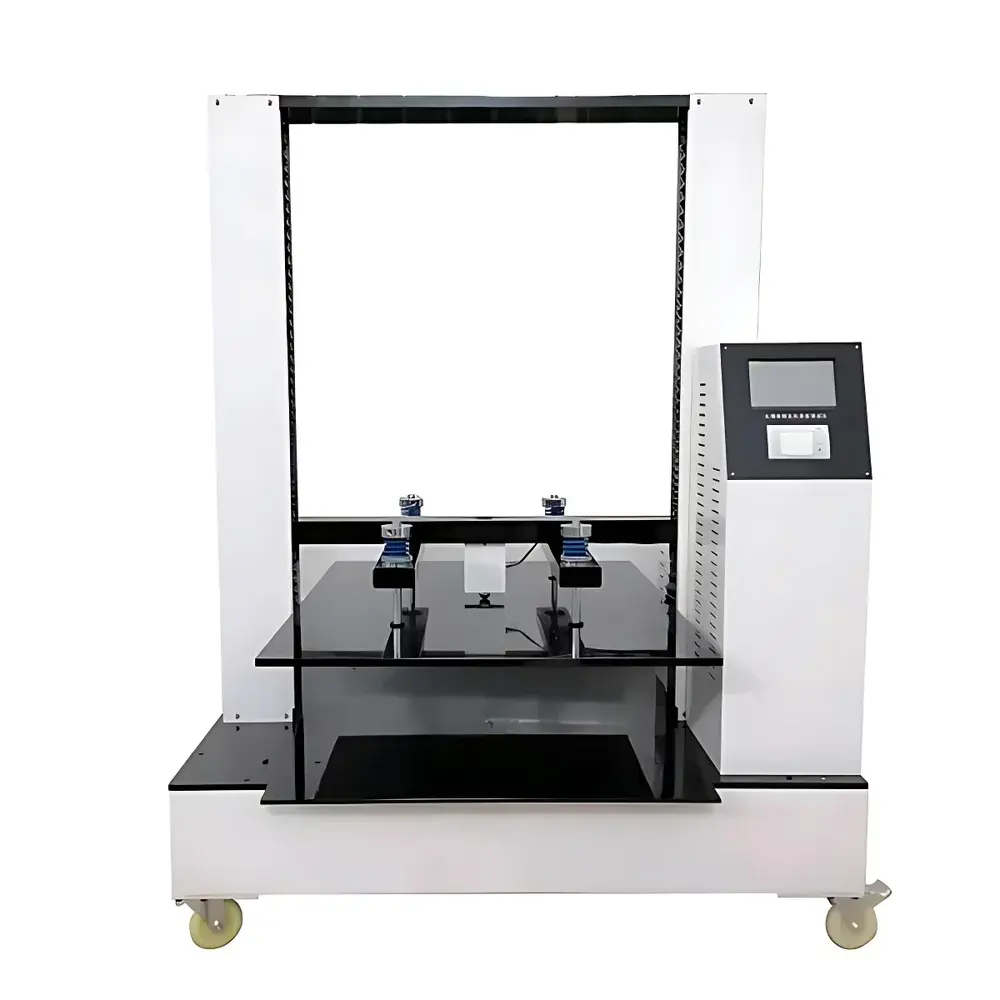
Microcomputer-Controlled Compression Tester PW-6609A
| Brand | Yuelian / PW |
|---|---|
| Origin | Guangdong, China |
| Manufacturer Type | Authorized Distributor |
| Country of Manufacture | China |
| Model | PW-6609A |
| Price | Upon Request |
| Max. Load Capacity | 10 kN |
| Force Resolution | 1 N |
| Force Accuracy | ±2% FS (indicated value error), ≤2% repeatability, ±0.2% FS return-to-zero error |
| Deformation Measurement Accuracy | ±1 mm |
| Preload Stability in Stack Test | ±4% |
| Compression Speed Range | 5–90 mm/min (±3% accuracy within range) |
| Standard Compression Speed | 12 mm/min |
| Stack Tracking Speed | 5 mm/min |
| Upper Platen Travel | 800 mm |
| Test Chamber Dimensions (W×D×H) | 600 × 800 × 800 mm |
| Parallelism Between Platens | ≤1 mm |
| Communication Interface | RS-232 (software optional) |
| Overall Dimensions (L×W×H) | 800 × 1000 × 1350 mm |
| Net Weight | ~250 kg |
| Compliant Standards | GB/T 4857.3, GB/T 4857.4, QB/T 1048, ISO 2872, ISO 2874 |
Overview
The Microcomputer-Controlled Compression Tester PW-6609A is a precision-engineered static compression testing system designed for evaluating the structural integrity and load-bearing performance of corrugated fiberboard packaging—particularly full-size shipping containers, cartons, and transport packaging units. It operates on the principle of controlled uniaxial compressive loading applied between two parallel platens, with force and displacement measured in real time to determine peak compressive strength, deformation behavior, and stack-load endurance. Engineered for routine quality control laboratories, packaging R&D facilities, and third-party certification labs, the PW-6609A delivers repeatable, traceable results aligned with internationally recognized packaging test standards including ISO 2872 (compression testing of full, loaded transport packages), ISO 2874 (stacking tests using compression testers), GB/T 4857.4 (compressive and stacking tests using compression testers), and QB/T 1048 (performance specifications for paperboard and box compression testers). Its 10 kN maximum capacity supports evaluation of medium-duty packaging used across food & beverage (e.g., instant noodle cases, beer carriers), cosmetics, household goods, and agricultural commodity packaging.
Key Features
- Microprocessor-based closed-loop control system with real-time digital display of load, displacement, and test duration
- Programmable compression speed ranging from 5 to 90 mm/min, with standard default set at 12 mm/min per ISO 2874 and GB/T 4857.4
- Dual-function operation: static compressive strength testing and dynamic stack-load simulation with automatic load tracking at 5 mm/min
- High-precision load cell with 1 N resolution and ±2% full-scale accuracy; verified repeatability ≤2% and zero-return error ≤±0.2% FS
- Integrated deformation measurement with ±1 mm positional accuracy across 800 mm platen travel
- Self-diagnostic firmware and auto-reset functionality to minimize operator intervention and downtime
- Test chamber dimensions (600 × 800 × 800 mm) accommodate standard international shipping boxes, including RSC, HSC, and die-cut displays
- RS-232 serial interface for external data logging or integration with LIMS; optional software enables report generation, statistical analysis (mean, SD, CV), and graphical plotting of load–displacement curves
Sample Compatibility & Compliance
The PW-6609A is validated for use with single- and double-wall corrugated board containers, solid fiberboard trays, and composite packaging structures exhibiting compressive strengths up to 10 kN. It accommodates common case formats used in FMCG supply chains—including 12-pack beverage carriers, 24-can shrink-wrapped bundles, multi-layer cereal cartons, and palletized consumer electronics packaging. All mechanical and metrological performance criteria conform to ISO/IEC 17025-relevant verification practices. The system supports GLP-aligned documentation when paired with compliant data acquisition software, including audit-trail-enabled test records, user authentication logs, and electronic signatures compatible with FDA 21 CFR Part 11 requirements (when implemented with validated software).
Software & Data Management
While the base unit includes embedded firmware for local operation and numeric readout, optional PC-based software extends analytical capability significantly. This application supports automated test sequencing, configurable pass/fail thresholds, batch-wise statistical summarization (including mean compressive strength, coefficient of variation, and outlier detection), and export of raw data in CSV or Excel format. Reports comply with ISO 17025 clause 7.8.2 for result reporting—featuring instrument ID, calibration status, environmental conditions (if externally logged), operator ID, and timestamped test metadata. Data encryption and role-based access control are available in enterprise-grade versions to meet internal QA/QC governance frameworks.
Applications
- Evaluation of short-term compressive resistance for ISTA 3A/3E-compliant packaging designs
- Validation of palletized load stability under simulated warehouse storage conditions (per ASTM D642)
- Comparative assessment of board grade substitutions (e.g., E-flute vs. B-flute) on container rigidity
- Correlation studies between edge crush test (ECT) values and actual box compression strength (BCT)
- Pre-shipment qualification testing for e-commerce fulfillment centers handling mixed SKU cartons
- Root-cause analysis of field failures linked to compression-induced collapse or bulging
FAQ
What is the maximum allowable sample height for testing?
The upper platen has 800 mm of vertical travel, and the usable test zone is defined by internal chamber dimensions of 600 × 800 × 800 mm (W × D × H); samples exceeding 800 mm in height cannot be fully enclosed but may be tested with partial constraint if structurally justified.
Does the system support automatic calibration verification?
Yes—the firmware includes a built-in zero-balance and span-check routine using internal reference signals; however, traceable physical calibration requires NIST-traceable deadweight standards applied annually or per ISO/IEC 17025 calibration intervals.
Can the PW-6609A perform creep testing or long-duration hold tests?
No—it is configured for static and quasi-static compression only; dwell-time functionality beyond 5 minutes is not supported without external controller integration.
Is thermal or humidity conditioning integrated into the test chamber?
No—environmental preconditioning must be performed externally in climate-controlled rooms per ASTM D685 or ISO 187 prior to testing.
What documentation is provided for regulatory submissions?
Standard delivery includes a factory calibration certificate, mechanical verification report, conformance statement to listed standards (GB/T 4857.3, ISO 2872, etc.), and electrical safety compliance documentation (CE-marked power supply module).






