
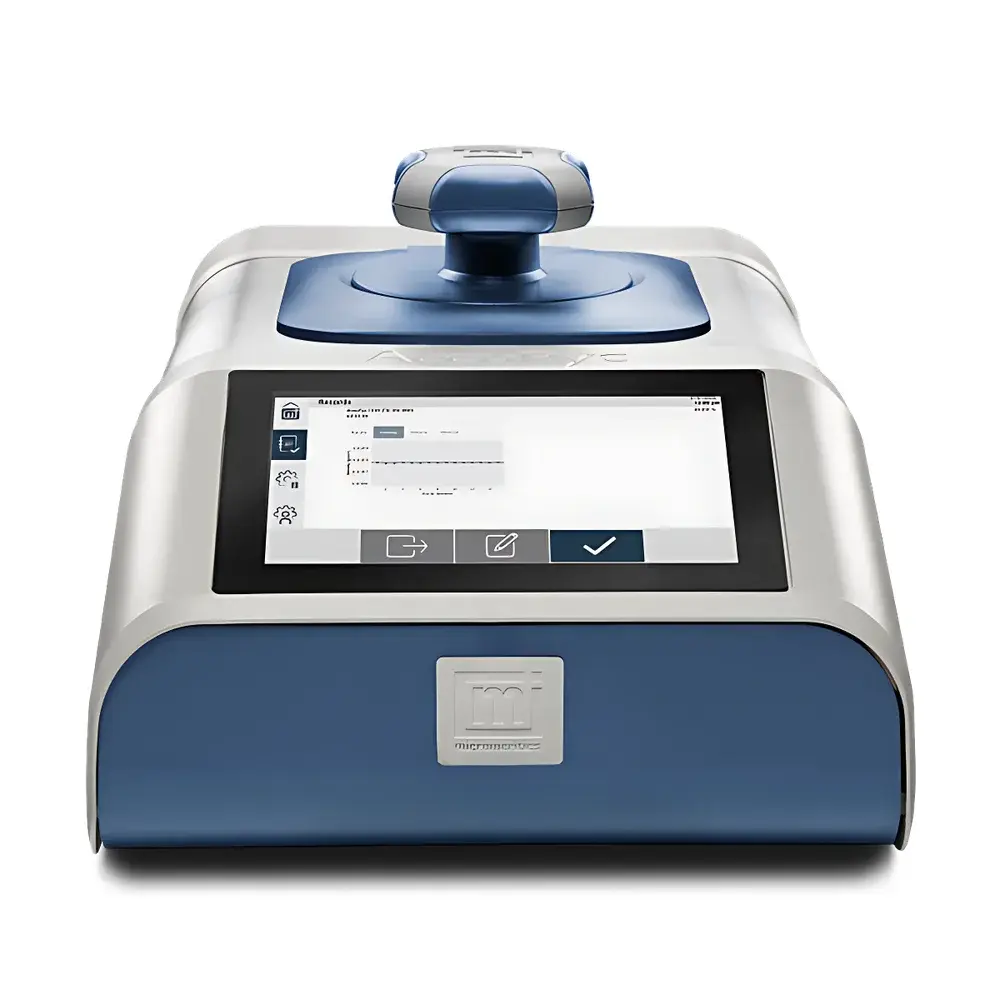
Micromeritics AccuPyc III 1350 Automated Gas Pycnometer for True Density Measurement
| Brand | Malvern Panalytical |
|---|---|
| Origin | USA |
| Manufacturer | Micromeritics Instrument Corporation |
| Model | AccuPyc III 1350 |
| Instrument Type | True Density Analyzer |
| Form Factor | Benchtop Laboratory System |
| Sample Type | Solid Materials |
| Density Range | 0.1–100 cm³ (sample volume) |
| Density Accuracy | ±0.02% |
| Temperature Control Range | 4 °C to 60 °C, stability ±0.025 °C |
| Repeatability | ±0.01% |
| Minimum Sample Volume | 0.1 cm³ |
Overview
The Micromeritics AccuPyc III 1350 is an automated gas pycnometer engineered for high-precision true density determination of solid materials using the gas displacement principle—specifically helium or alternative inert gases—based on Boyle’s Law and ideal gas behavior. Unlike bulk or apparent density measurements, true density reflects the intrinsic mass-to-volume ratio of a material excluding all interstitial voids and closed pores, making it critical for quality control in pharmaceutical excipient characterization, catalyst development, battery electrode formulation, ceramic sintering validation, and advanced powder metallurgy. The instrument employs a dual-chamber, constant-volume gas expansion methodology with real-time pressure transduction and thermally stabilized measurement cycles. Its core architecture integrates a sealed sample chamber, reference chamber, precision solenoid valves, and a high-resolution capacitance manometer calibrated per ISO 12156-1 and ASTM D5550 standards.
Key Features
- AccuTemp™ thermoelectric temperature control system delivering ±0.025 °C stability across a broad operational range of 4 °C to 60 °C—enabling process-relevant density measurements under refrigerated storage (e.g., biopharmaceutical lyophilized powders) or elevated thermal conditions (e.g., polymer melt compaction studies).
- Advanced gas modeling algorithm compliant with van der Waals corrections, permitting seamless gas substitution (He, N₂, Ar, air) without recalibration—reducing method transfer time and eliminating systematic bias from compressibility deviations.
- Patented hinge-assisted, self-aligning lid mechanism ensuring repeatable chamber sealing geometry and invariant dead volume—critical for minimizing systematic drift in volumetric calibration and meeting GLP audit requirements for instrument qualification (IQ/OQ/PQ).
- Integrated Breeze™ touchscreen interface with role-based user access control, audit-trail-enabled session logging, and FDA 21 CFR Part 11–compliant electronic signature support for regulated environments.
- 30% faster analysis cycle versus prior-generation pycnometers, achieved through optimized gas equilibration protocols, adaptive pressure ramping, and reduced thermal settling time—typical measurement duration: <90 seconds per run.
Sample Compatibility & Compliance
The AccuPyc III 1350 accommodates dry, non-volatile, non-reactive solid samples—including powders, granules, monoliths, foams, and sintered ceramics—with minimum volumes as low as 0.1 cm³. It is not suitable for hygroscopic, volatile, or chemically reactive substances unless preconditioned in inert atmospheres. The system complies with ISO 12156-1 (determination of true density of solids by gas pycnometry), ASTM D5550 (standard test method for true density of calcined petroleum coke), USP <699> (density of pharmaceutical solids), and supports GMP documentation workflows via exportable PDF reports containing raw pressure/temperature/time traces, calibration certificates, and operator metadata.
Software & Data Management
Control and data acquisition are managed through Micromeritics’ proprietary Breeze software, deployed locally on the instrument’s embedded industrial PC. The platform supports customizable method templates, automated pass/fail criteria against specification limits, batch reporting with statistical summaries (mean, SD, RSD, confidence intervals), and direct export to LIMS via CSV, XML, or OPC UA interfaces. All analytical sessions generate immutable audit trails including timestamped parameter changes, gas type selection, calibration history, and user login events—fully traceable for regulatory inspections. Raw sensor data (pressure vs. time, temperature vs. time) is retained at 10 Hz resolution for post-acquisition reprocessing and uncertainty budgeting per GUM (JCGM 100:2008).
Applications
- Pharmaceutical: Excipient density verification for tablet compression modeling; active pharmaceutical ingredient (API) polymorph screening; lyophilized cake density mapping.
- Materials Science: Porosity calculation (via skeletal density input into mercury intrusion or BET surface area models); sintered metal density monitoring; additive manufacturing powder bed packing analysis.
- Energy: Anode/cathode material density in Li-ion battery R&D; graphite flake density grading; fuel cell catalyst support characterization.
- Geoscience & Mining: Mineralogical density fingerprinting; ore grade estimation via bulk-to-skeletal density ratios; tailings characterization.
- Quality Assurance: Incoming raw material release testing; batch-to-batch consistency evaluation; stability-indicating density trends over shelf life.
FAQ
What gases can be used for analysis besides helium?
Nitrogen, argon, and dried compressed air are supported without hardware modification or recalibration, thanks to the built-in real-gas equation-of-state correction model.
Is the instrument compliant with 21 CFR Part 11 requirements?
Yes—the Breeze software includes electronic signatures, audit trail generation, user authentication, and data integrity safeguards aligned with FDA expectations for computerized systems in regulated laboratories.
How is temperature calibration verified?
Each unit ships with NIST-traceable thermistor calibration data; users may perform periodic verification using certified PT100 reference probes inserted into the chamber port per ASTM E74.
Can the AccuPyc III 1350 measure closed-pore density?
No—it measures only skeletal (true) density. Closed-pore volume remains inaccessible to gas penetration; complementary techniques such as mercury intrusion porosimetry or X-ray microtomography are required for total porosity decomposition.
What maintenance is required to sustain accuracy?
Routine checks include leak verification (per ISO 12156-2), pressure transducer zero calibration, and annual verification of temperature controller linearity using external metrology-grade references.



