
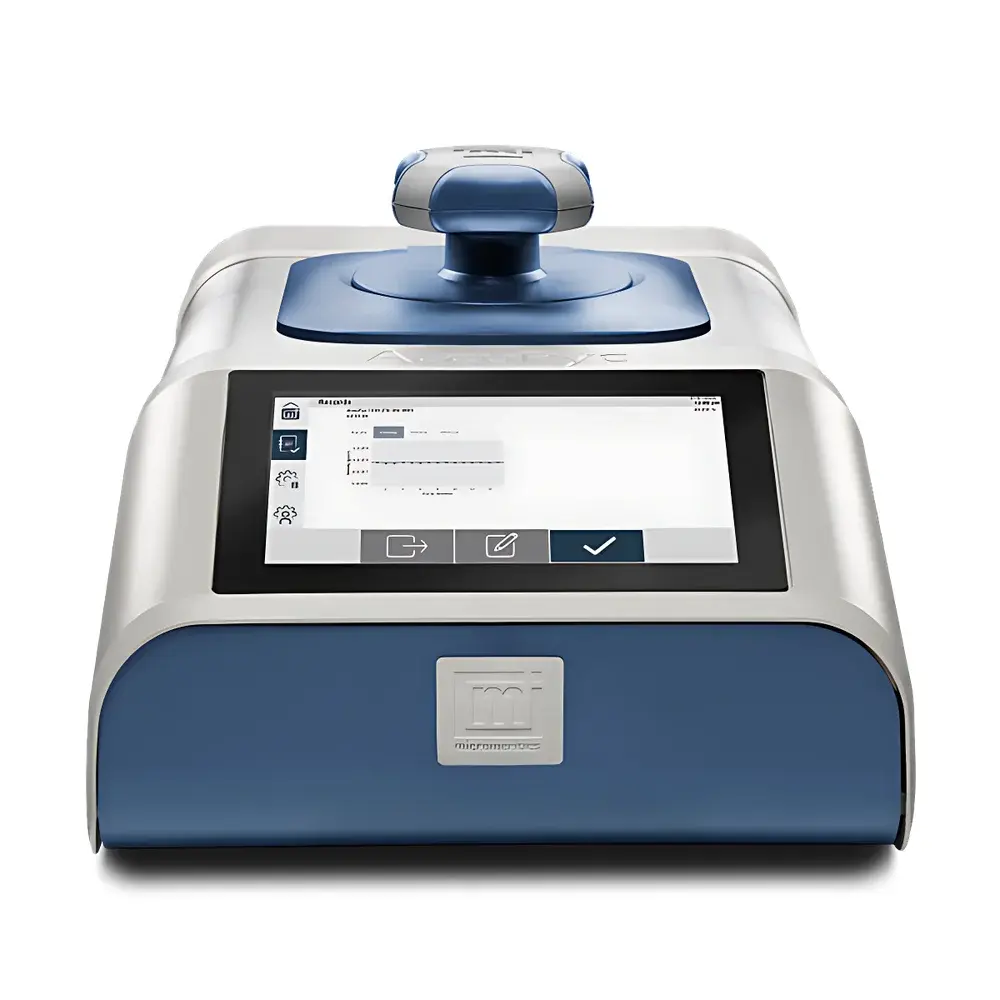
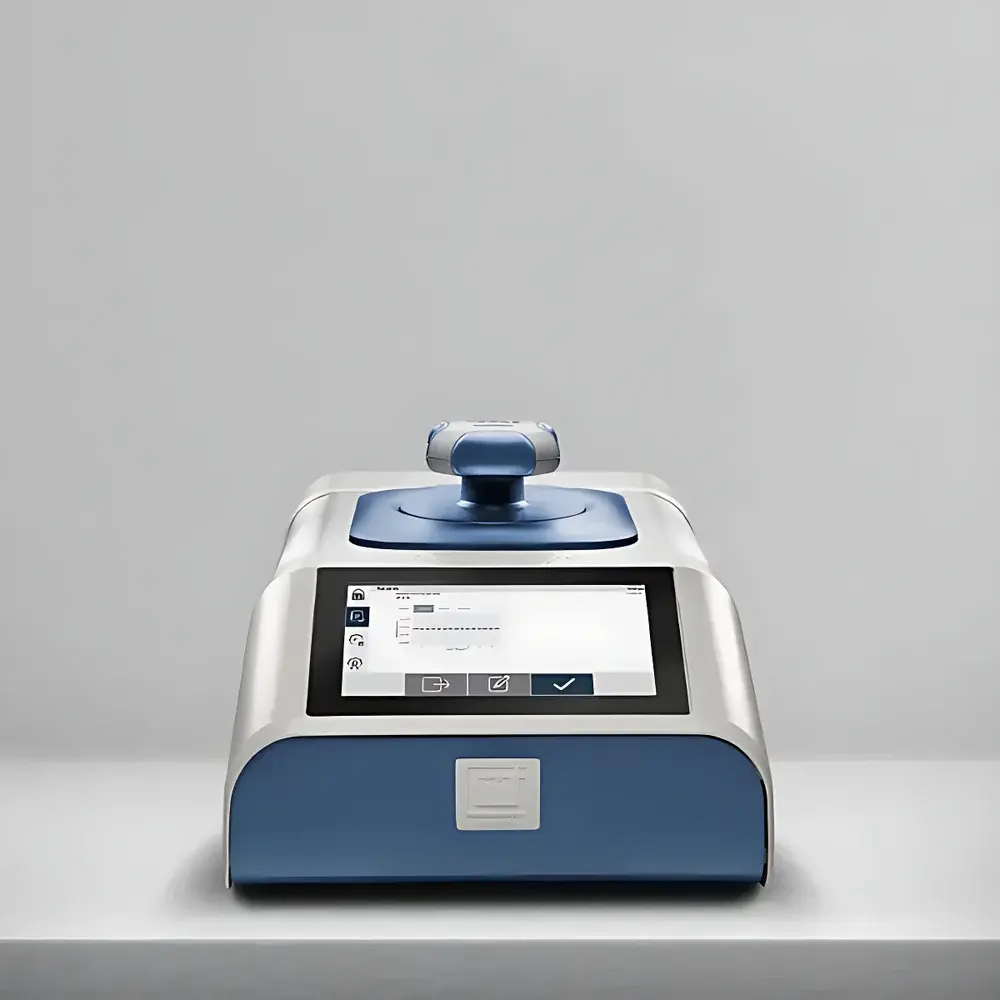
Micromeritics AccuPyc III 1350 Automated Gas Pycnometer for True Density Measurement
| Brand | Micromeritics |
|---|---|
| Origin | USA |
| Model | AccuPyc III 1350 |
| Instrument Type | True Density Analyzer |
| Configuration | Benchtop Laboratory System |
| Sample Form | Solid Powders, Granules, Monoliths |
| Measurement Principle | Gas Displacement (Helium/Nitrogen/Air) |
| Density Range | 0.1–100 cm³ (Sample Volume Capacity) |
| Accuracy | ±0.02% |
| Repeatability | ±0.01% |
| Temperature Control Range | 4 °C to 60 °C |
| Temperature Stability | ±0.025 °C |
| Minimum Sample Volume | 0.1 cm³ |
| Compliance | ASTM D5550, ISO 12154, USP <699>, GLP/GMP-ready audit trail support |
Overview
The Micromeritics AccuPyc III 1350 is an automated gas pycnometer engineered for high-precision true density determination of solid materials using the gas displacement principle. Based on Boyle’s law and ideal gas behavior, the instrument measures the volume occupied by a solid sample by quantifying the pressure change induced when a known quantity of inert gas—typically helium—is introduced into a calibrated reference chamber and then expanded into a sample chamber of fixed geometry. True density (ρ = m/V) is calculated from the measured displaced volume and the user-input sample mass. Unlike bulk or apparent density methods, this technique eliminates interstitial voids and closed pores, delivering intrinsic material density values critical for quality control, formulation development, and regulatory submissions in pharmaceuticals, advanced ceramics, battery electrode materials, catalysts, and metal powders.
Key Features
- AccuTemp™ thermoelectric temperature control system maintains chamber stability within ±0.025 °C across the full 4 °C to 60 °C operating range—enabling density measurements under physiologically relevant (e.g., 4–8 °C refrigerated storage) or process-relevant (e.g., 50–60 °C sintering simulation) conditions.
- Advanced gas modeling algorithm compensates for real-gas deviations and compressibility factors, permitting seamless switching between helium, nitrogen, dry air, or other non-reactive gases without recalibration—reducing method transfer time and supporting safety-driven helium conservation strategies.
- Motorized hinge-and-latch lid with auto-alignment mechanism ensures repeatable chamber sealing and constant dead volume, eliminating operator-induced variability in headspace geometry—a leading source of systematic error in legacy pycnometers.
- Breeze™ touchscreen interface provides guided workflow navigation, real-time pressure/temperature monitoring, and context-sensitive help—designed for both novice technicians and experienced analysts without requiring scripting or external software training.
- Optimized pneumatic architecture reduces analysis cycle time by up to 30% versus prior-generation instruments while maintaining metrological integrity—typical measurement duration is under 90 seconds per run, including thermal equilibration and multi-point pressure averaging.
Sample Compatibility & Compliance
The AccuPyc III 1350 accommodates a broad spectrum of solid-phase samples: free-flowing powders (e.g., lactose, microcrystalline cellulose), cohesive granules, sintered compacts, foams, monolithic ceramics, and coated particles. Its 0.1 cm³ minimum sample volume supports high-value or limited-availability materials such as clinical trial API batches or novel MOF synthesis products. The system conforms to internationally recognized standards including ASTM D5550 (Standard Test Method for True Density of Calcined Petroleum Coke), ISO 12154 (Determination of True Density of Solids by Gas Pycnometry), and USP (Density of Solids). Audit trail functionality, electronic signature support, and configurable user access levels align with FDA 21 CFR Part 11 and EU Annex 11 requirements for regulated environments.
Software & Data Management
Instrument control, data acquisition, and reporting are managed through the embedded Breeze software platform. Each measurement generates a timestamped record containing raw pressure transients, temperature logs, gas type, calibration history, operator ID, and environmental metadata. Data export options include CSV, PDF, and XML formats compatible with LIMS integration. Optional IQ/OQ/PQ documentation packages are available for laboratory validation, and the system supports periodic performance verification via certified reference materials (e.g., NIST-traceable fused quartz standards). All data modifications are logged with immutable timestamps and user attribution—ensuring full traceability for GLP and GMP audits.
Applications
- Pharmaceutical development: Quantifying true density of active pharmaceutical ingredients (APIs) and excipients to predict tablet compactibility, dissolution rate, and blend uniformity.
- Battery R&D: Characterizing cathode/anode powder density to correlate with electrode porosity, volumetric energy density, and calendering response.
- Materials science: Validating theoretical crystallographic density calculations for newly synthesized inorganic frameworks or doped semiconductors.
- Quality assurance: Routine release testing of metal injection molding (MIM) feedstocks, ceramic green bodies, or polymer composites against specification limits.
- Regulatory filing: Generating ICH Q5C-compliant density data for biopharmaceutical container-closure system characterization (e.g., vial glass density stability under thermal cycling).
FAQ
What gases can be used with the AccuPyc III 1350?
Helium is recommended for highest accuracy due to its low molecular weight and minimal adsorption; however, nitrogen, dry air, argon, and other non-condensable gases may be selected via software configuration without hardware modification or recalibration.
Is temperature calibration required before each analysis?
No—AccuTemp™ provides continuous, closed-loop thermal regulation. A single annual NIST-traceable temperature sensor verification is sufficient per ISO/IEC 17025 requirements.
Can the instrument measure closed-pore density?
No—the AccuPyc III measures only *true* (skeletal) density. It does not penetrate closed pores; for total (apparent) density including closed porosity, mercury intrusion porosimetry or liquid displacement methods are appropriate.
How is repeatability verified during routine operation?
Users perform daily system suitability tests using a certified reference standard (e.g., fused quartz sphere); results are automatically compared against stored acceptance criteria and flagged if %RSD exceeds 0.01%.
Does the system support network connectivity for remote monitoring?
Yes—Ethernet port enables integration into lab-wide networks for centralized data archiving, remote diagnostics, and scheduled maintenance alerts via SNMP or HTTP protocols.



