
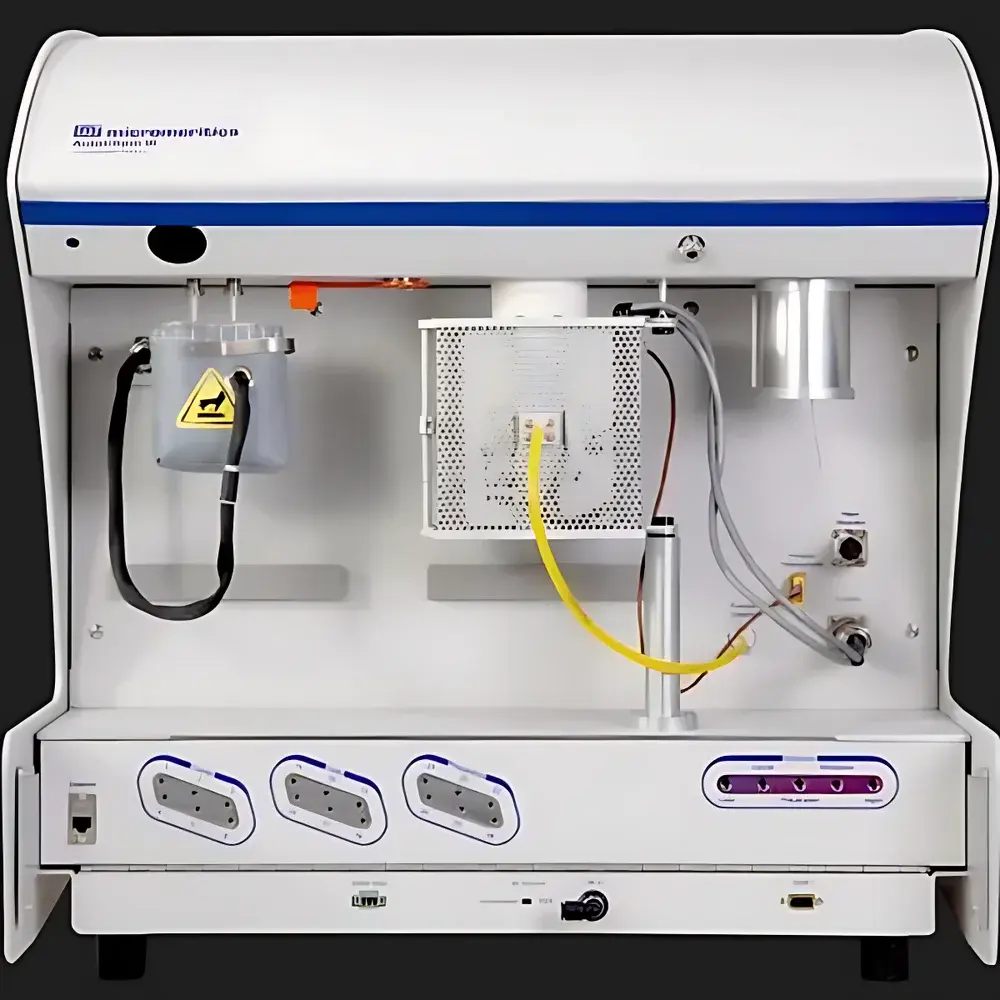
Micromeritics AutoChem III Chemisorption Analyzer
| Brand | Malvern Panalytical |
|---|---|
| Origin | USA |
| Manufacturer | Micromeritics Instrument Corp. |
| Model | AutoChem III |
| Gas Inlet Ports | 18 |
| Temperature Range | Ambient to 1200 °C |
| Ramp Rate | Up to 100 °C/min from –100 °C to 800 °C |
| Core Functions | Pulse Chemisorption, Temperature-Programmed Reduction (TPR), Single-Point BET Surface Area Analysis |
| Compliance | Designed for GLP/GMP environments with audit-trail-ready software architecture |
Overview
The Micromeritics AutoChem III Chemisorption Analyzer is a fully automated, high-precision surface characterization system engineered for quantitative analysis of catalyst active sites, metal dispersion, reducibility, and surface area. It operates on the fundamental principles of gas–solid heterogeneous reactions under controlled thermal and atmospheric conditions—specifically leveraging pulse chemisorption kinetics, temperature-programmed desorption/reduction/oxidation (TPD/TPR/TPO), and static volumetric gas uptake for single-point BET estimation. As a successor to the widely cited AutoChem II platform, the AutoChem III integrates patented hardware innovations and refined thermal management protocols to deliver enhanced measurement reproducibility, reduced operator intervention, and accelerated experimental throughput—critical for R&D laboratories advancing next-generation catalytic materials in carbon capture and utilization (CCU), green hydrogen production, ammonia synthesis, and low-carbon fuel processing.
Key Features
- Patented AutoCool Air-Cooling System: Eliminates dependence on liquid nitrogen or external chiller units; achieves rapid cooldown from 1200 °C to ambient in ≤30 minutes, reducing cycle time without compromising thermal stability or baseline integrity.
- AutoTrap Water Removal Technology: Integrates a proprietary condensate trap with real-time vapor-phase monitoring, enabling robust water removal during TPR experiments—removing the need for manual preparation of isopropanol–liquid nitrogen slurries and minimizing operator exposure risks.
- KwikConnect Sample Tube Interface (US Pat #11,105,825 B2): A spring-loaded, zero-torque bayonet-style coupling ensures leak-tight sealing at the reactor interface, eliminating thread wear, cross-threading, and helium leak rates <1×10⁻⁹ mbar·L/s—essential for trace-level H2 or CO chemisorption quantification.
- 18-Channel Gas Manifold: Supports complex multi-gas sequences (e.g., He purge → H2 reduction → O2 titration → Ar backflush) with independent mass flow control and real-time pressure compensation, enabling full automation of multi-step catalyst activation protocols.
- Extended Thermal Range & Precision Ramp Control: Capable of operation from –100 °C to 1200 °C with programmable ramp rates up to 100 °C/min (–100 °C to 800 °C), validated per ASTM E1142 and ISO 11357-3 for thermal calibration traceability.
Sample Compatibility & Compliance
The AutoChem III accommodates standard 6-mm and 9-mm quartz sample tubes and supports powders, extrudates, monoliths, and supported metal nanoparticles. Its modular furnace design allows for optional integration with optional humidity-controlled gas lines (for moisture-sensitive catalysts) and reactive gas modules (e.g., NH3, SO2, NOx). The system complies with regulatory expectations for analytical instrument qualification (AIQ) under FDA 21 CFR Part 11 when deployed with optional Secure Software Mode, which enforces electronic signatures, user role-based access control, and immutable audit trails for all method parameters, raw data files, and report generations. All hardware components meet IEC 61010-1 safety standards for laboratory electrical equipment.
Software & Data Management
The AutoChem III runs on Micromeritics’ proprietary TriStar™ v4.0 software suite—a Windows-based application supporting method templating, real-time signal visualization (TCD/FID outputs), peak deconvolution via derivative analysis, and ISO/ASTM-compliant reporting (e.g., ASTM D3663 for metal dispersion, ISO 9277 for BET surface area). Raw data are stored in vendor-neutral .csv and .tdf formats; metadata—including instrument configuration, calibration history, and environmental logs—is embedded in each dataset. Optional LIMS connectivity enables direct data ingestion into enterprise systems via ASTM E1703-compliant XML export.
Applications
- Quantification of Pt, Pd, Ni, Ru, and Co dispersion in automotive three-way catalysts and PEM electrolyzer anodes
- Determination of reducible oxide species (e.g., CuO→Cu⁰, Fe2O3→Fe3O4) in Fischer–Tropsch and methanol synthesis catalysts
- Surface acidity profiling of zeolites and sulfated zirconia via NH3-TPD
- Single-point BET surface area validation for MOFs and mesoporous silica prior to pore size distribution analysis
- Accelerated aging studies involving cyclic redox treatments under simulated exhaust or syngas atmospheres
FAQ
Can the AutoChem III perform full multipoint BET analysis?
No—this model supports only single-point BET surface area estimation using N2 or Kr adsorption at 77 K or 77 K-equivalent conditions. Full BET isomorph analysis requires the Micromeritics ASAP series instruments.
Is remote operation supported?
Yes—TriStar™ v4.0 includes secure remote desktop capability and scheduled run initiation via authenticated network login, compliant with corporate IT security policies.
What calibration standards are recommended for TPR quantification?
Certified reference materials including CuO/Al2O3 (NIST SRM 2976) and α-Fe2O3/SiO2 are routinely used for H2 consumption calibration; all calibrations are documented per ISO/IEC 17025 requirements.
Does the system support reactive gases like H2S or Cl2?
Only with optional corrosion-resistant manifold upgrades (Hastelloy C-276 wetted parts) and dedicated gas purification train configurations—contact application engineering for compatibility assessment prior to installation.



