
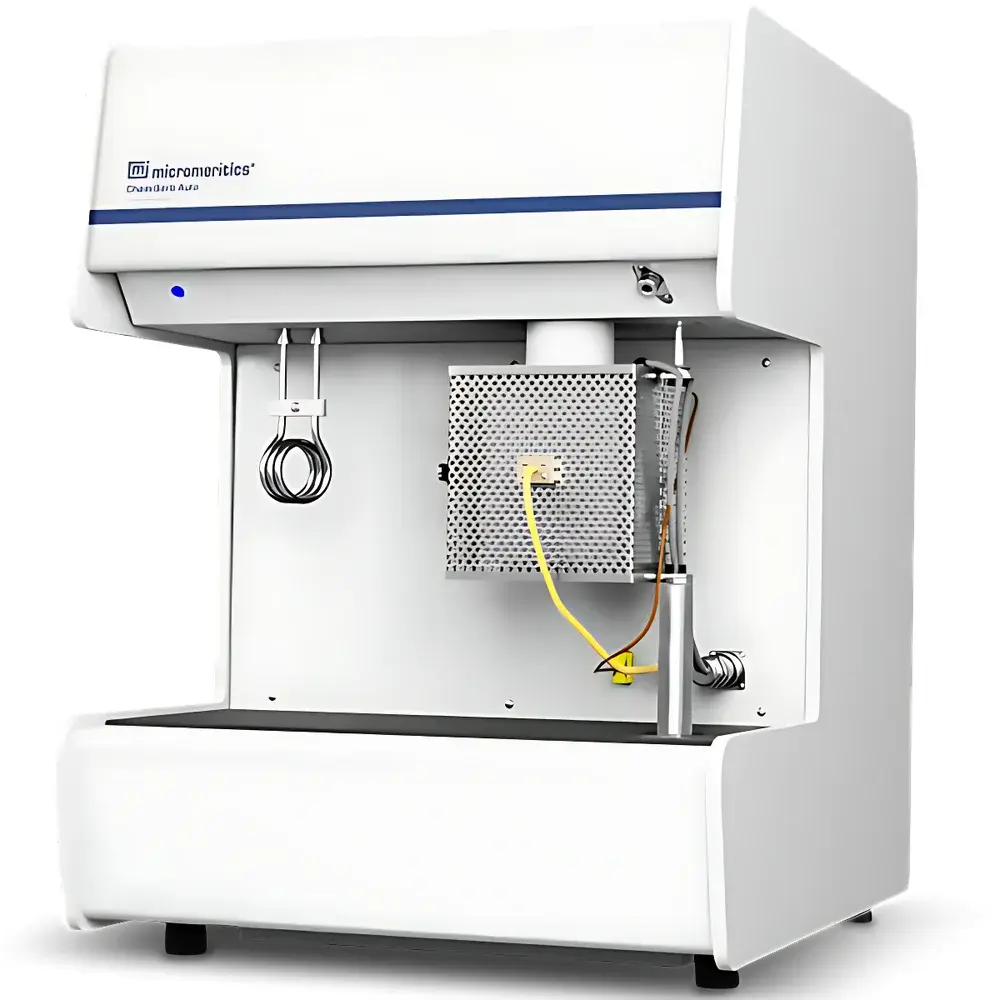
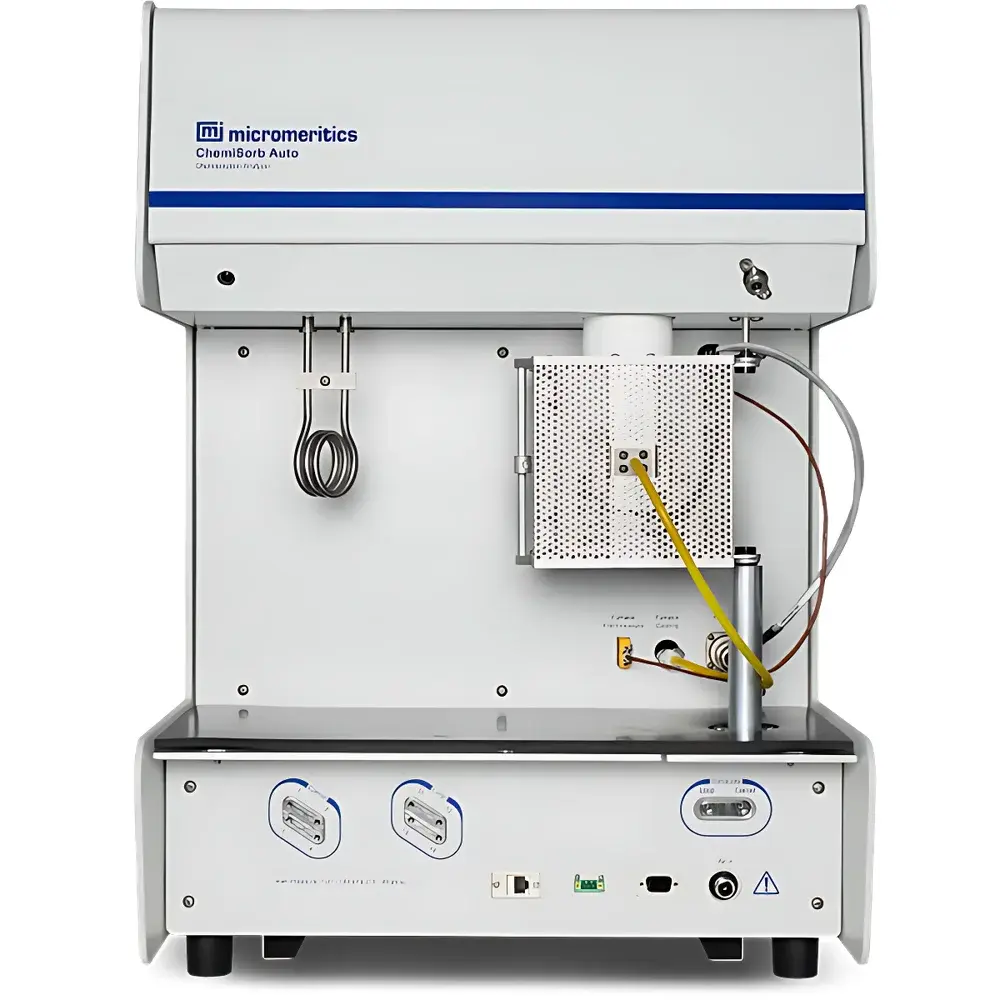
Micromeritics ChemiSorb Auto Compact Fully Automated Chemisorption Analyzer
| Brand | Malvern Panalytical |
|---|---|
| Origin | USA |
| Manufacturer | Micromeritics Instrument Corp. |
| Model | Micromeritics ChemiSorb Auto |
| Instrument Type | Chemisorption Analyzer |
| Measurement Principle | Flow Method |
| Number of Gas Inlets | 8 (4 Carrier + 4 Loop) |
| Maximum Heating Temperature | 1000 °C |
| Programmable Heating Rate | 1–50 °C/min (with CryoCooler option enabling -100 °C to 1000 °C range) |
| Supported Techniques | Temperature-Programmed Reduction (TPR), Temperature-Programmed Oxidation (TPO), Temperature-Programmed Desorption (TPD), Pulse Chemisorption, TPSR, Strong Metal-Support Interaction (SMSI) analysis, Acid Site Strength Distribution (Lewis/Brønsted), BET Surface Area |
Overview
The Micromeritics ChemiSorb Auto Compact Fully Automated Chemisorption Analyzer is an engineered solution for quantitative surface characterization of heterogeneous catalysts and functional materials. Based on the flow method principle—where reactive gases are precisely metered across a heated sample bed while thermal and compositional responses are monitored in real time—the instrument delivers high-fidelity data for active site quantification, surface reactivity mapping, and mechanistic insight into adsorption/desorption/redox processes. Designed and manufactured by Micromeritics Instrument Corporation (a Malvern Panalytical company) in the United States, the ChemiSorb Auto integrates robust thermal control, low-dead-volume gas handling, and high-sensitivity thermal conductivity detection (TCD) to ensure measurement reproducibility within ±1% RSD across repeated analyses. Its compact benchtop footprint and modular architecture make it suitable for both academic catalysis labs and industrial QC/QA environments where space, reliability, and regulatory traceability are critical.
Key Features
- Fully automated operation: Sample loading, gas selection, temperature ramping, data acquisition, and post-run purge cycles execute without manual intervention—enabling unattended overnight runs.
- Precision thermal management: Dual-zone furnace with independent control over sample and detector zones; optional CryoCooler extends operational range from -100 °C to 1000 °C with segmented heating rate profiles (up to 100 °C/min below 400 °C, down to 5 °C/min above 900 °C).
- Eight independently controlled gas inlets (four carrier + four loop lines), supporting He, H₂, CO, O₂, Ar, H₂/Ar, N₂O, NH₃/He, and other reactive or inert mixtures—enabling sequential or simultaneous multi-gas experiments.
- Low-dead-volume manifold design minimizes band broadening and ensures rapid detector response (<100 ms TCD settling time), essential for accurate pulse chemisorption quantification and sharp TPD peak resolution.
- Integrated MicroActive software platform with embedded ASTM E1763-compliant peak integration algorithms, baseline correction tools, and kinetic modeling modules (first-order desorption, Arrhenius activation energy, Redhead analysis).
Sample Compatibility & Compliance
The ChemiSorb Auto accommodates powdered, pelletized, or supported catalyst samples (typically 50–500 mg) in standard quartz U-tube or micro-reactor configurations. It supports compliance-critical workflows through audit-trail-enabled software logging (21 CFR Part 11 ready when deployed with validated IT infrastructure), GLP/GMP-aligned reporting templates, and ISO 18852:2020-compatible calibration protocols for TCD sensitivity and temperature uniformity verification. All gas delivery subsystems meet ISO 8573-1 Class 2 purity standards for compressed air and carrier gases. The system is routinely employed in catalyst development per ASTM D3907 (TPR of supported metal catalysts) and ASTM D7215 (pulse chemisorption for metal dispersion).
Software & Data Management
MicroActive software provides a unified interface for method development, real-time monitoring, and advanced post-processing. Users can define multi-step temperature programs with conditional triggers (e.g., hold until signal stabilization), configure gas switching sequences synchronized with thermal ramps, and apply interactive baseline subtraction and peak deconvolution to overlapping TPD features. Built-in models calculate metal dispersion, active surface area, particle size (via stoichiometric H₂ or CO uptake), acid site density (NH₃ or pyridine chemisorption), and apparent activation energies. Raw data exports support CSV, XML, and HDF5 formats; graphical reports include customizable overlays, derivative plots, and annotated peak tables. Optional MS integration enables real-time mass spectrometric confirmation of evolved species during TPR/TPO/TPD.
Applications
- Quantification of active metal surface area and dispersion in Pt/Al₂O₃, Ni/SiO₂, Cu/ZnO/Al₂O₃, and other transition-metal catalysts via H₂ or CO pulse chemisorption.
- Redox behavior analysis of oxide catalysts (e.g., V₂O₅/TiO₂, Co₃O₄) using TPR and TPO to identify reduction/oxidation onset temperatures and stoichiometric oxygen uptake/release.
- Surface acidity profiling of zeolites and solid acids via NH₃-TPD or pyridine-FTIR coupling, distinguishing Lewis vs. Brønsted site distributions.
- Thermal stability assessment of supported nanoparticles under simulated reaction conditions (e.g., sintering onset via isothermal H₂ uptake decay).
- BET surface area determination using krypton at -196 °C (when equipped with optional cryogenic accessories).
FAQ
What temperature accuracy and uniformity does the ChemiSorb Auto achieve across its 1000 °C range?
The system maintains ±1 °C absolute accuracy from ambient to 1000 °C, verified per ASTM E220, with axial uniformity of ±2 °C over a 25 mm sample zone.
Can the instrument perform simultaneous TPD and mass spectrometry?
Yes—when integrated with a compatible quadrupole mass spectrometer via analog/digital I/O and time-synchronized triggering, the ChemiSorb Auto supports parallel TPD-MS acquisition with sub-second temporal resolution.
Is method validation documentation available for regulated environments?
Micromeritics provides IQ/OQ documentation packages, including sensor calibration certificates, gas flow linearity reports, and software validation summaries aligned with ISO/IEC 17025 and FDA guidance for analytical instrument qualification.
How is dead volume minimized in the gas path?
All internal manifolds use 1/16″ stainless-steel tubing with zero-dead-volume Swagelok fittings; the sample cell volume is typically <0.1 mL, and total system dead volume (excluding detector) is <0.3 mL.
Does the software support custom kinetic model scripting?
MicroActive includes Python API access for user-defined fitting routines, enabling implementation of Langmuir-Hinshelwood, Mars-van Krevelen, or multi-site adsorption models beyond the built-in library.



