
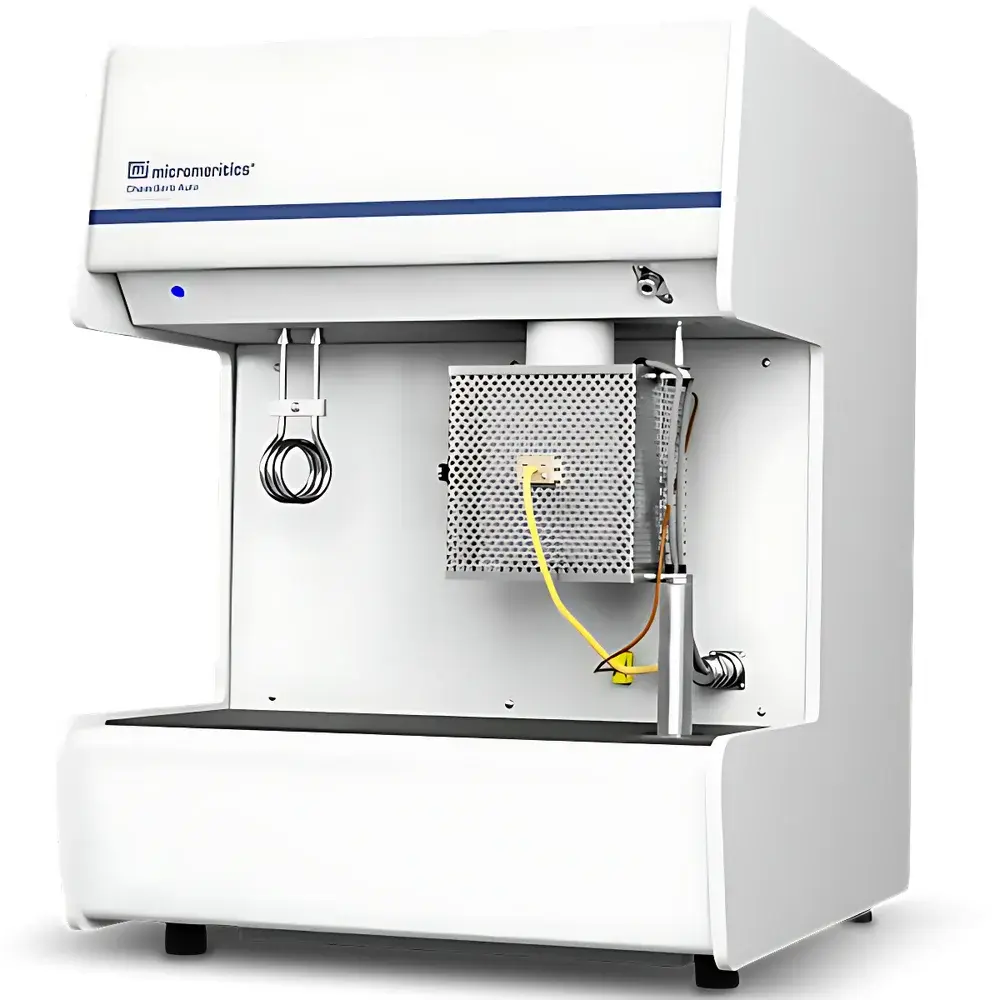
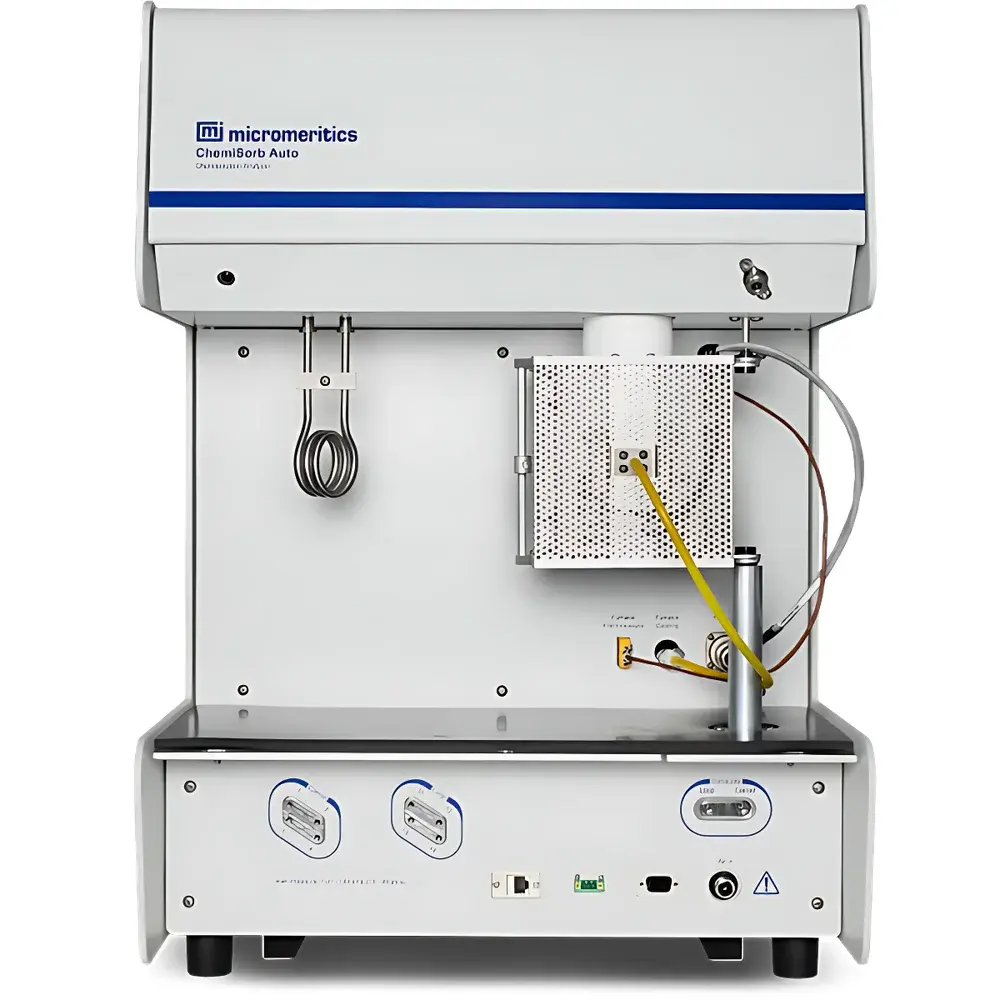
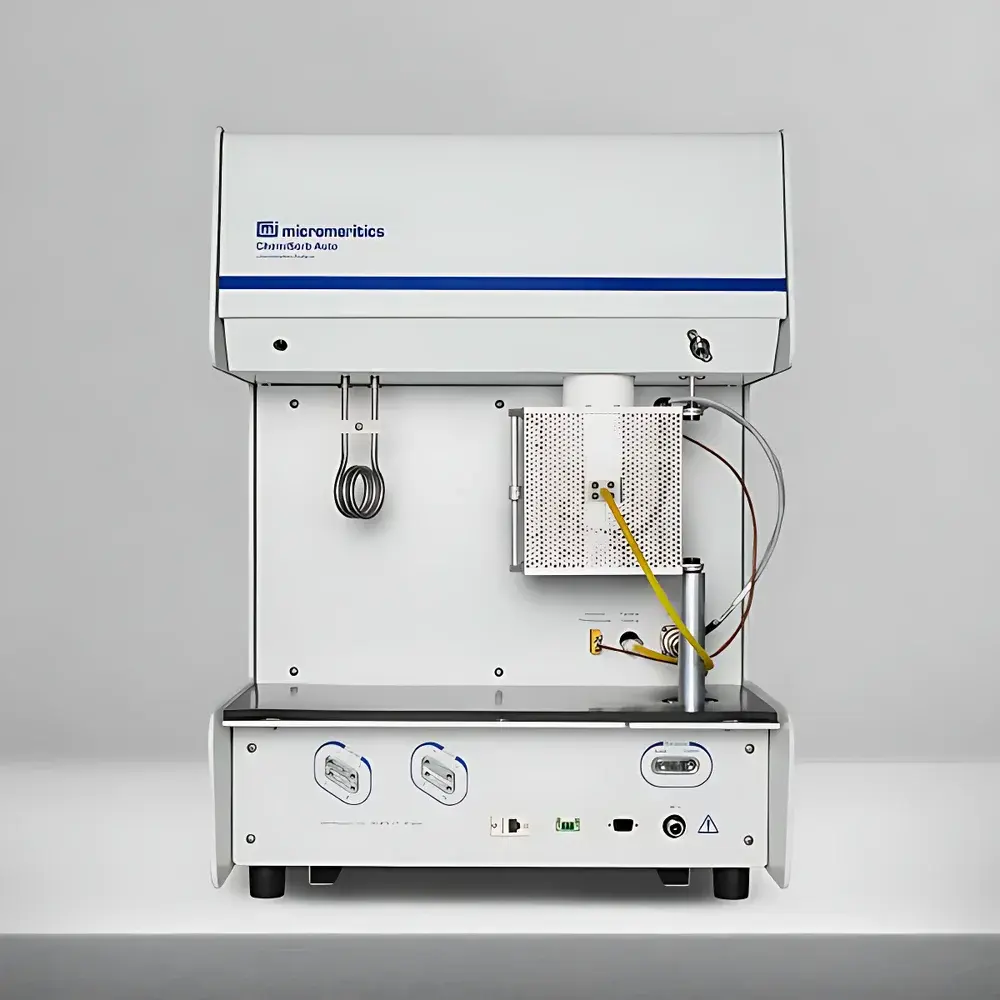
Micromeritics ChemiSorb Auto Compact Fully Automated Chemisorption Analyzer
| Brand | Micromeritics |
|---|---|
| Origin | USA |
| Model | ChemiSorb Auto |
| Instrument Type | Chemisorption Analyzer |
| Measurement Principle | Flow Method |
| Gas Inlet Ports | 8 |
| Maximum Heating Temperature | 1000 °C |
| Heating Rate | 1–50 °C/min |
| Analytical Capabilities | TPR, TPO, TPD, Pulse Chemisorption |
| Optional CryoCooler Range | −100 °C to 1000 °C |
| Carrier Gas Ports | 4 |
| Loop Gas Ports | 4 |
| Detector | Thermal Conductivity Detector (TCD), optional Mass Spectrometer (MS) integration |
Overview
The Micromeritics ChemiSorb Auto Compact Fully Automated Chemisorption Analyzer is an engineered solution for quantitative surface characterization of heterogeneous catalysts and functional materials. Based on the flow method principle, it measures gas–solid interactions—including adsorption, desorption, reduction, oxidation, and reaction—under precisely controlled temperature and gas composition conditions. The system employs thermal conductivity detection (TCD) as its primary sensing mechanism, with optional integration of a quadrupole mass spectrometer (QMS) for evolved gas analysis and speciation. Designed for routine and research-grade chemisorption studies, the ChemiSorb Auto delivers high reproducibility (±1% RSD for repeated pulse injections) through minimized dead volume, fast detector response time, and thermally stable furnace architecture. Its compact benchtop footprint supports seamless deployment in academic labs, QC environments, and industrial R&D facilities where space, reliability, and regulatory compliance are critical.
Key Features
- Fully automated operation: Load sample, select method, initiate run—system executes heating profiles, gas switching, data acquisition, and baseline stabilization without manual intervention.
- Programmable temperature control: Precise ramping from ambient to 1000 °C; optional CryoCooler extends low-temperature capability to −100 °C for cryo-adsorption or low-T desorption studies.
- Eight independent gas inlet ports: Four dedicated to carrier gases (e.g., He, H₂, CO, O₂, Ar, H₂/Ar, N₂O, NH₃/He) and four to loop gases—enabling complex multi-step protocols including sequential pretreatment, dosing, and purge sequences.
- Multi-stage heating rate optimization: Ramp rates dynamically adjusted across temperature zones (e.g., up to 100 °C/min below 400 °C; 5–25 °C/min above 900 °C) to balance thermal inertia, kinetic resolution, and furnace longevity.
- Robust TCD detector with real-time signal conditioning: Low-noise electronics, digital filtering, and automatic zero tracking ensure stable baselines during extended TPR/TPO experiments.
- Modular hardware design: Facilitates field-upgradeable components—including MS interface kits, additional gas manifolds, and high-temperature reactor tubes rated for corrosive atmospheres (e.g., NH₃, Cl₂).
Sample Compatibility & Compliance
The ChemiSorb Auto accommodates powdered, pelletized, or supported catalyst samples (typically 0.05–0.5 g) in standard quartz or ceramic microreactors. It supports ASTM D7215 (TPR of supported metal catalysts), ISO 18382 (surface area and dispersion of transition metals), and USP (residual metal quantification via chemisorptive titration). Data integrity meets FDA 21 CFR Part 11 requirements when configured with MicroActive software’s audit trail, electronic signatures, and secure user access controls. All firmware and calibration routines are traceable to NIST-certified reference standards, and system qualification includes IQ/OQ documentation packages compliant with GLP and GMP laboratory practices.
Software & Data Management
MicroActive software provides an integrated platform for instrument control, real-time visualization, and advanced post-processing. Its intuitive workflow guides users—from novice technicians to senior scientists—through method setup, calibration, and report generation. Key analytical tools include interactive peak deconvolution, customizable baseline correction, and automated integration of TPR/TPO/TPD peaks using first-derivative inflection point detection. Built-in models calculate metal dispersion, active surface area, particle size (via stoichiometric H₂ or CO uptake), activation energy (Arrhenius analysis), adsorption enthalpy (van’t Hoff plots), and acid site distribution (NH₃-TPD with dual-Lewis/Brønsted deconvolution). Raw and processed data export seamlessly to CSV, PDF, or XML formats; batch reporting supports automated template-driven summaries aligned with internal SOPs or journal submission guidelines.
Applications
- Quantification of active metal surface area and dispersion in Pt/Al₂O₃, Ni/SiO₂, Cu/ZnO, and other supported catalysts.
- Redox behavior mapping via H₂-TPR and O₂-TPO for ceria-zirconia mixed oxides, perovskites, and spinels.
- Acid–base site characterization using NH₃-TPD (Brønsted/Lewis differentiation) and CO₂-TPD for zeolites, alumina, and sulfated metal oxides.
- Kinetic parameter extraction (Eₐ, pre-exponential factor) from multiple-heating-rate TPD experiments.
- Stability assessment under cyclic redox conditions—monitoring sintering, phase segregation, or coke formation via repeated TPR–TPO sequences.
- Support for BET surface area determination when coupled with optional krypton or nitrogen dosing modules (not included in base configuration).
FAQ
What types of gases can be used for carrier and loop functions?
Helium, hydrogen, carbon monoxide, oxygen, argon, nitrogen, nitrous oxide, ammonia/helium mixtures, and hydrogen/argon blends are supported across both carrier and loop gas manifolds.
Is mass spectrometry detection available as a factory option?
Yes—QMS integration is offered as a configurable upgrade, enabling real-time m/z-resolved detection of desorbed species (e.g., H₂O, CO₂, NOₓ, NH₃) during TPD or reactive pulses.
How does the system ensure repeatability in pulse chemisorption measurements?
Through fixed-volume loop injection, temperature-stabilized detector housing, and automated baseline re-zeroing between pulses—achieving ±1% relative standard deviation across replicate analyses.
Can the ChemiSorb Auto perform simultaneous multi-gas analysis?
No—it operates sequentially via programmable valve sequencing; however, rapid gas switching (<100 ms) enables quasi-simultaneous multi-analyte monitoring when paired with a fast-response MS detector.
Does the software support custom kinetic modeling beyond built-in templates?
Yes—MicroActive allows user-defined equations and Python-based script integration for advanced fitting of non-linear kinetic models, including Langmuir–Hinshelwood mechanisms and distributed activation energy distributions.



