
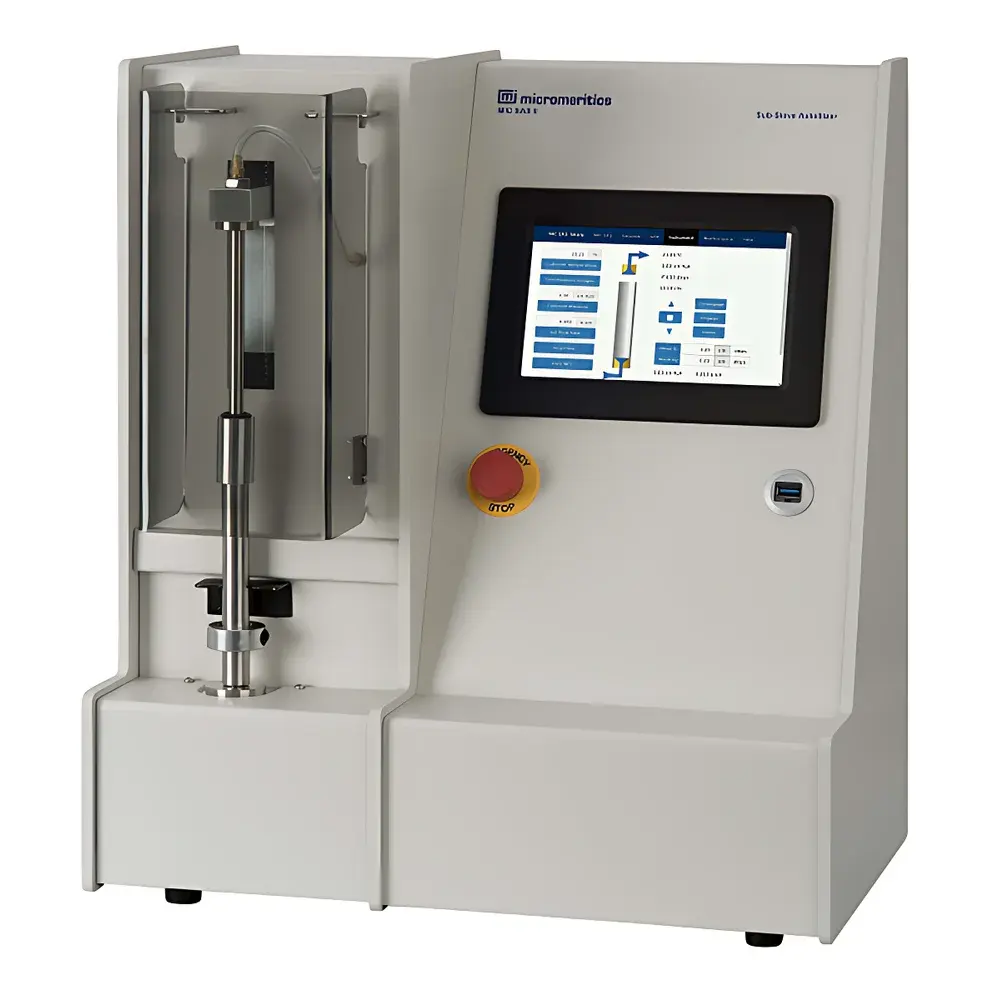
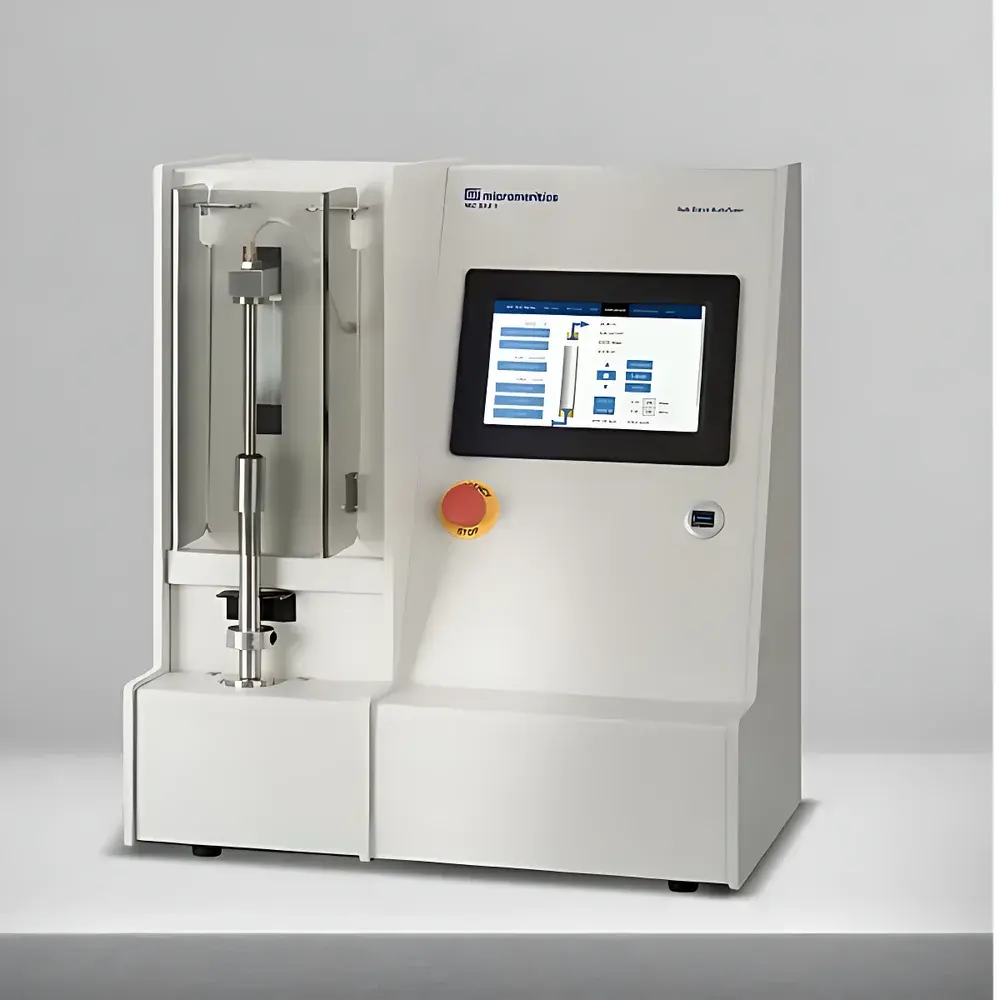
Micromeritics SAS II 5800 Automated Air Permeability Particle Size Analyzer
| Brand | Micromeritics |
|---|---|
| Origin | USA |
| Model | SAS II 5800 |
| Measurement Range | 0.2–75 µm |
| Repeatability | ±1% RSD |
| Porosity Range | 0.2–0.9 |
| Compliance | ASTM B330-12, ASTM C721-14 |
| Display | Integrated Touchscreen Interface |
| Control Software | SAS Control Suite v5.x |
| Dimensions (H×W×L) | 55 × 50 × 38 cm |
| Weight | 28 kg |
Overview
The Micromeritics SAS II 5800 Automated Air Permeability Particle Size Analyzer is an engineering-grade instrument designed to determine the average particle size of fine powders via standardized air permeability methodology. It represents the direct evolutionary successor to the Fisher Sub-Sieve Sizer (FSSS) Model 95, retaining full data continuity with legacy Fisher Number outputs while introducing full automation, digital data capture, and enhanced metrological traceability. The instrument operates on the fundamental principle of laminar airflow through a consolidated powder bed, where pressure differential (ΔP) across the bed—measured simultaneously by two high-stability pressure transducers—is correlated to specific surface area (SSA) using the Kozeny-Carman equation. From SSA, the equivalent spherical diameter—reported as the Fisher Number—is calculated under defined porosity and bed height constraints. This method remains the globally recognized reference technique for quality control in metallurgy, additive manufacturing feedstock qualification, catalyst production, ceramic raw materials, and refractory powders, particularly where historical specification limits are anchored to decades of FSSS-derived data.
Key Features
- Fully automated sample compaction, flow regulation, and pressure acquisition—eliminating operator-dependent variability in bed preparation and measurement execution.
- Dual independent pressure sensors (upstream and downstream of the powder bed) enable real-time, high-fidelity ΔP monitoring with temperature-compensated drift correction.
- Integrated touchscreen interface with intuitive workflow navigation, supporting rapid SOP creation, parameter validation, and on-the-fly method adjustment without external PC dependency.
- Password-protected user authentication system enforces role-based access control (e.g., operator, supervisor, administrator), ensuring audit-compliant parameter locking and test record attribution.
- Real-time graphical display of pressure decay curves, flow rate stability, and intermediate SSA calculation during analysis—facilitating immediate assessment of bed integrity and measurement validity.
- Compliance-ready architecture: All instrument actions, parameter changes, and result exports are timestamped and logged with user ID, supporting GLP/GMP-aligned data integrity requirements.
Sample Compatibility & Compliance
The SAS II 5800 is validated for use with free-flowing, non-cohesive, dry particulate materials exhibiting particle sizes between 0.2 µm and 75 µm. Typical applications include aluminum, titanium, nickel, and stainless-steel powders; fused silica and alumina ceramics; pigment-grade iron oxides; and sintered metal filter media. The instrument meets the procedural and reporting requirements of ASTM B330-12 (Standard Test Method for Fisher Number of Metal Powders) and ASTM C721-14 (Standard Test Method for Fisher Number of Silica and Related Compounds). These standards define strict criteria for specimen height, porosity range (0.2–0.9), air viscosity correction, and calibration traceability to NIST-certified reference materials. Data output conforms to ISO/IEC 17025 documentation expectations when operated within a validated laboratory information management system (LIMS) environment.
Software & Data Management
The SAS Control Software Suite provides a unified platform for instrument orchestration, data acquisition, statistical processing, and report generation. It supports 21 CFR Part 11-compliant electronic signatures, audit trail logging (including all parameter edits, calibration events, and result reprocessing), and secure PDF export with embedded metadata (sample ID, operator, date/time, instrument serial number, firmware version). Customizable report templates allow integration of corporate branding, regulatory statement footers, and multi-language support. Raw pressure vs. time datasets are stored in open CSV format for third-party statistical analysis or integration into enterprise QA databases. Firmware updates are delivered via encrypted USB import with cryptographic signature verification.
Applications
- Quality assurance of metal powders for powder metallurgy and laser powder bed fusion (LPBF) additive manufacturing processes.
- Batch release testing of catalyst supports and porous ceramic substrates where SSA correlates directly with catalytic activity and gas diffusion efficiency.
- Raw material acceptance testing in refractory and abrasive manufacturing, where particle packing density governs green strength and sintering behavior.
- Regulatory submission support for pharmaceutical excipients where air permeability-derived particle size serves as a surrogate for dissolution performance in certain monographs.
- Longitudinal process monitoring in pigment production, enabling correlation of Fisher Number shifts with milling energy input and dispersion stability.
FAQ
Does the SAS II 5800 require recalibration when switching between different powder types?
No—calibration is performed using certified reference materials per ASTM B330; once verified, the instrument maintains accuracy across material classes provided porosity and bed height fall within specified operational bounds.
Can historical FSSS data be directly compared to SAS II 5800 results?
Yes—the SAS II 5800 preserves the original Fisher Number calculation algorithm and measurement geometry, ensuring statistical equivalence and regulatory acceptability for legacy specification alignment.
Is the Kozeny-Carman equation applied in real time during analysis?
Yes—SSA and Fisher Number are computed continuously from live pressure and flow data, with intermediate values displayed and logged at 100-ms intervals.
What level of IT infrastructure is required for 21 CFR Part 11 compliance?
The SAS Control Software includes built-in electronic signature workflows, audit trail encryption, and password policy enforcement; network integration with domain-authenticated LIMS or ELN systems is optional but recommended for enterprise-scale deployment.
How is sample porosity controlled during analysis?
Porosity is determined gravimetrically from measured bed height and known sample mass and true density; the software validates that the resulting value falls within the 0.2–0.9 range prior to final result calculation.
Related Products



