
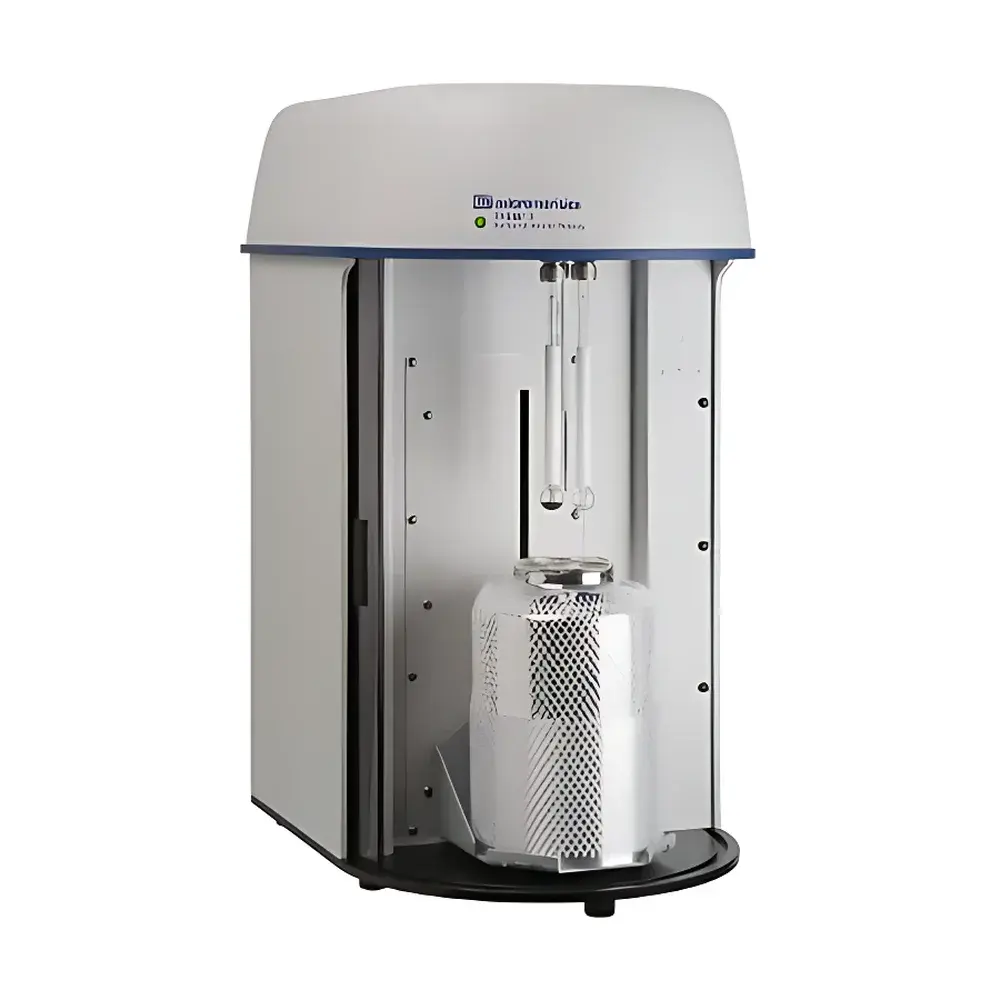
Micromeritics TriStar II Plus Specific Surface Area and Pore Size Analyzer
| Brand | Malvern Panalytical |
|---|---|
| Origin | USA |
| Manufacturer | Micromeritics Instrument Corporation |
| Instrument Type | Specific Surface Area and Pore Size Analyzer |
| Number of Analysis Stations | 1–3 |
| Gas Options | N₂, Kr, Ar, CO₂, CH₄, C₄H₁₀ (non-corrosive) |
| Minimum Surface Area (N₂) | 0.01 m²/g |
| Minimum Surface Area (Kr) | 0.001 m²/g |
| Minimum Pore Volume | 4 × 10⁻⁶ cm³/g |
| Dewar Capacity | 2.75 L (optional 4 L) |
| Continuous Analysis Duration | up to 40 h |
| Data Points per Isotherm | up to 1000 |
| P₀ Measurement | integrated, continuous or manual input |
| Free Space Determination | measured, calculated, or user-defined |
Overview
The Micromeritics TriStar II Plus is a fully automated, high-precision gas sorption analyzer engineered for quantitative characterization of specific surface area, pore size distribution, pore volume, and adsorption isotherms in solid and porous materials. Based on the principle of physical gas adsorption—primarily nitrogen at 77 K, but extendable to krypton (for ultra-low-surface-area materials), argon (at 87 K), carbon dioxide (at 273 K), and other non-corrosive gases—the instrument applies the Brunauer–Emmett–Teller (BET), Langmuir, t-plot, DFT, and NLDFT theoretical frameworks to extract structural parameters with metrological rigor. Its tri-station architecture enables concurrent yet independent analyses, supporting both routine QC workflows and advanced research applications across catalysis, battery materials, pharmaceuticals, MOFs, ceramics, and geochemical samples.
Key Features
- Three independent analysis stations—each equipped with dedicated pressure transducers, temperature-controlled manifolds, and calibrated dosing valves—allow parallel BET surface area measurements completed in under 20 minutes per station.
- Integrated P₀ port enables real-time, continuous saturation pressure monitoring during isotherm acquisition, eliminating manual intervention and improving reproducibility across multi-day runs.
- Flexible free space determination: users may measure it experimentally via helium pycnometry mode, calculate it from sample density and geometry, or manually input values—critical for irregular, low-density, or composite samples.
- High-resolution isotherm acquisition: up to 1000 data points per adsorption–desorption branch ensures fine-grained resolution of micropore filling, mesopore condensation hysteresis, and surface heterogeneity.
- Extended operational autonomy: standard 2.75 L Dewar flask supports up to 40 hours of unattended operation; optional 4 L flask further extends runtime for full isotherm collection without liquid nitrogen replenishment.
- Enhanced connectivity and diagnostics: built-in Ethernet interface, barcode scanner support, embedded self-test diagnostics, remote web-based troubleshooting, and cross-platform data compatibility with legacy Gemini and earlier TriStar systems.
Sample Compatibility & Compliance
The TriStar II Plus accommodates powders, granules, monoliths, and thin films in standard 6 mm or 9 mm glass sample tubes. It supports thermal pretreatment via programmable heating under dynamic vacuum or flowing inert gas (up to 400 °C), enabling removal of physisorbed water, solvents, and weakly bound contaminants prior to analysis. The system complies with ASTM D3663 (BET surface area), ISO 9277 (surface area by gas adsorption), and ISO 15901 (pore size distribution by gas adsorption). Data integrity is maintained through audit-trail-enabled software meeting GLP/GMP documentation requirements and aligning with FDA 21 CFR Part 11 principles for electronic records and signatures.
Software & Data Management
The Windows-based TriStar software provides intuitive instrument control, real-time isotherm visualization, and comprehensive post-processing. It includes SPC (Statistical Process Control) reporting tools, customizable report templates, and batch processing for multi-sample datasets. Advanced modeling modules support DFT/NLDFT kernel selection for carbon, silica, alumina, and metal–organic frameworks; thickness curve libraries (Harkins–Jura, Halsey, HK); isosteric heat of adsorption calculation via the Clausius–Clapeyron method; and t-plot and αs-plot analysis for micropore/mesopore deconvolution. All raw isotherm data, parameter settings, calibration logs, and user annotations are stored in a structured SQLite database with versioned backups and network-accessible archive options.
Applications
- Catalyst development: quantifying active surface area, dispersion, and pore accessibility in supported metals and zeolites.
- Battery electrode materials: evaluating specific surface area and pore structure evolution before/after cycling in Li-ion, Na-ion, and solid-state systems.
- Pharmaceutical excipients: characterizing surface energetics and porosity impact on dissolution rate and tablet compaction behavior.
- Carbon capture materials: assessing CO₂ uptake capacity, isosteric heat, and narrow micropore distribution in activated carbons and amine-functionalized adsorbents.
- Quality control labs: rapid, standardized BET verification for incoming raw materials, lot-to-lot consistency checks, and stability-indicating assays.
FAQ
What gases can be used for analysis on the TriStar II Plus?
Nitrogen (77 K), krypton (77 K), argon (87 K), carbon dioxide (273 K), methane (112 K), and butane (273 K) are supported—all requiring appropriate cryogenic or ambient-temperature measurement configurations.
Can the instrument perform both adsorption and desorption isotherms?
Yes—fully automated, stepwise adsorption–desorption cycles are executed with user-defined pressure increments, dwell times, and equilibration criteria.
Is helium pycnometry included for skeletal density measurement?
Helium pycnometry is implemented as a dedicated free-space determination mode, using helium’s non-adsorbing nature to quantify sample envelope volume and derive true density.
How does the system ensure long-term calibration stability?
Each station features dual-range pressure transducers with daily auto-zero routines, factory-calibrated reference volumes, and traceable gas dose validation protocols aligned with NIST SRM standards.
Can historical data from older TriStar or Gemini instruments be imported and reprocessed?
Yes—the software natively reads legacy .tsd and .gem files, allowing direct comparison, re-fitting with updated models, and unified reporting across instrument generations.



