
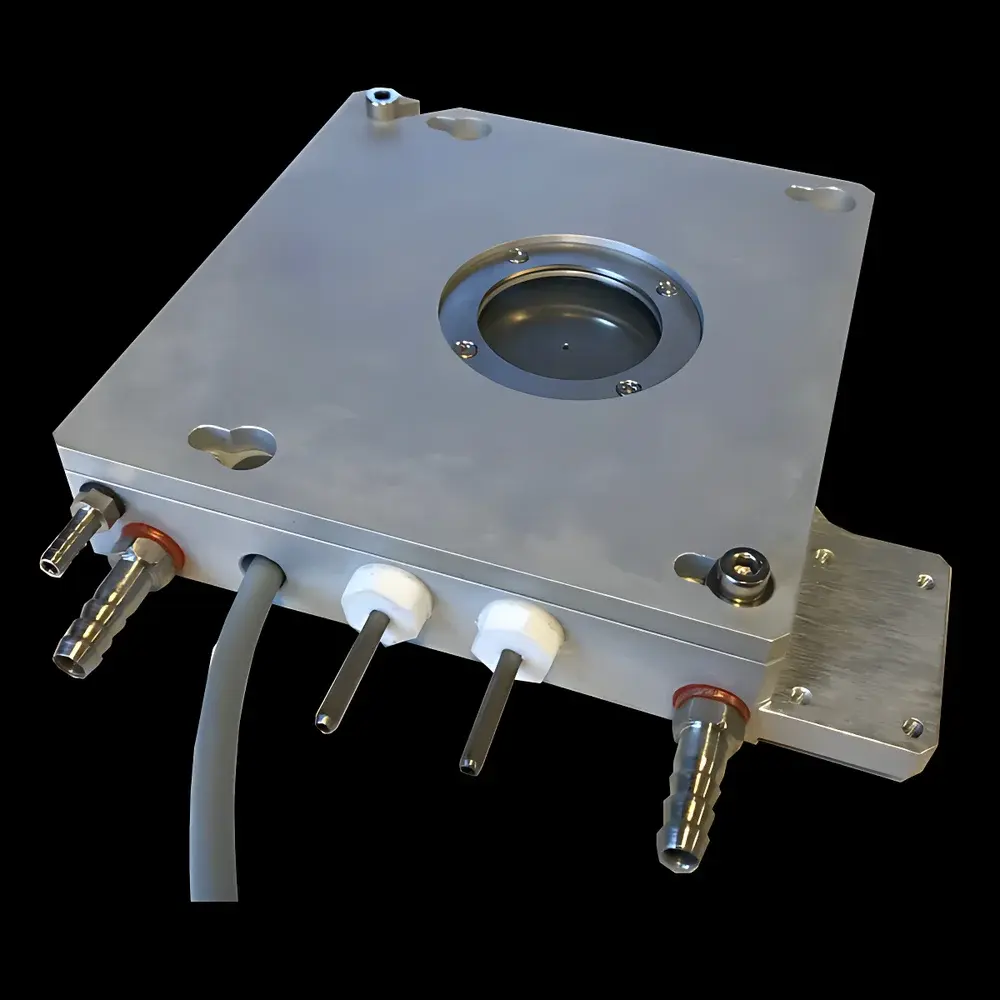
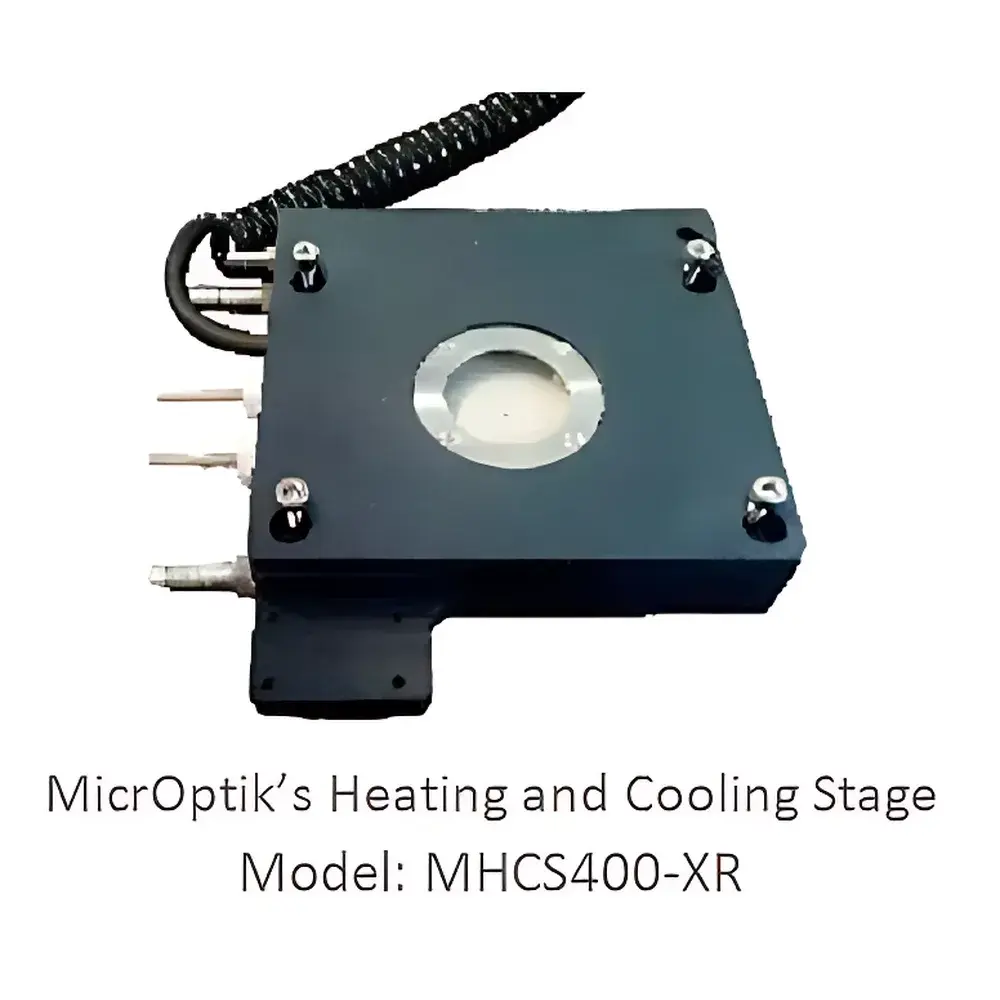
MicrOptik MHCS400–XR High- and Low-Temperature Stage for Metallographic Microscopy
| Brand | MicrOptik |
|---|---|
| Origin | Netherlands |
| Manufacturer Type | Authorized Distributor |
| Origin Category | Imported |
| Model | MHCS400–XR |
| Temperature Range | –190 °C to +400 °C (optional up to +600 °C) |
| Temperature Resolution | 0.1 °C |
| Control Method | PID/PID-Switching |
| Sensor Type | RTD (Pt100) |
| Sample Area | 40 mm × 40 mm |
| Chamber Height | 5 mm (customizable) |
| Observation Aperture | 32 mm (transmission light path: 1.5–7 mm, configurable) |
| Working Distance | 6 mm (reduced WD options available) |
| Controller | MTDC600 Programmable Temperature Controller |
| Optional Accessories | LN2-SYS Liquid Nitrogen Cooling System, Water-Cooled Mount, Gas Purge Enclosure, Probing XY Micropositioner (±12.5 mm travel, 0.1 µm resolution), Removable Lid, Thermal Shield Housing |
Overview
The MicrOptik MHCS400–XR High- and Low-Temperature Stage is an engineered thermal platform designed specifically for in situ optical characterization under extreme thermal conditions. Built upon a robust, vacuum-compatible mechanical architecture with integrated thermal shielding, it enables precise, stable, and reproducible temperature control across a broad operational range—from cryogenic –190 °C (achievable via optional LN2-SYS liquid nitrogen cooling) to high-temperature +400 °C (extendable to +600 °C with specialized heater modules). Unlike conventional heated stages, the MHCS400–XR maintains exceptional thermal homogeneity (< ±0.3 °C spatial gradient over the 40 mm × 40 mm sample area) and temporal stability (±0.05 °C over 2 hours at steady state), critical for quantitative metallographic analysis, phase transition studies, and thermally induced microstructural evolution monitoring. Its design supports both upright and inverted metallographic microscopes, as well as confocal Raman systems, FTIR microspectroscopy setups, and synchrotron-based X-ray diffraction stations—making it a cross-platform solution for materials science laboratories operating under ASTM E112, ISO 643, and USP instrument qualification frameworks.
Key Features
- Wide operational temperature range: –190 °C to +400 °C (standard); optional extension to +600 °C with ceramic-heater upgrade
- High-resolution temperature control: 0.1 °C resolution with dual-mode PID/PID-switching algorithm for rapid ramping and fine-tuned dwell stability
- RTD-based sensing (Pt100, Class A tolerance) embedded directly beneath the sample plane for minimal thermal lag and traceable calibration
- Thermally isolated chamber with multi-layer passive shielding and active thermal shrouding to suppress ambient drift and convective interference
- Standard 32 mm observation aperture optimized for Köhler illumination; transmission path height configurable from 1.5 mm to 7 mm per application requirements
- Modular integration: compatible with standard DIN 25 mm × 75 mm microscope slides as sample carriers; accepts custom substrates up to 40 mm × 40 mm
- Optional motorized XY micropositioner (±12.5 mm range, 0.1 µm step resolution) with closed-loop feedback for automated thermal mapping workflows
- Gas-purge ready enclosure (N₂, Ar, or forming gas) with sealed feedthroughs for oxidation-sensitive or reactive material studies
Sample Compatibility & Compliance
The MHCS400–XR accommodates diverse specimen geometries and material classes—including bulk metallurgical samples, thin-film semiconductor wafers, photovoltaic absorber layers, fluid inclusion mounts, and live-cell culture chambers on glass or quartz substrates. Its atmospheric operation eliminates vacuum-related constraints while maintaining compatibility with common metallographic preparation protocols (e.g., electropolishing, colloidal silica polishing per ASTM E3, etching per ASTM E407). The stage conforms to IEC 61000-6-3 (EMC emissions) and IEC 61010-1 (safety for laboratory equipment). Full documentation—including factory calibration certificates (traceable to NIST standards), temperature uniformity maps, and controller firmware revision logs—is provided to support GLP/GMP-compliant environments and FDA 21 CFR Part 11 audit readiness.
Software & Data Management
The MTDC600 programmable controller supports both manual front-panel operation and remote software control via USB or Ethernet (TCP/IP). Native drivers are supplied for LabVIEW™, MATLAB®, and Python (PyVISA-compatible). Temperature profiles—including multi-segment ramps, holds, and cyclic sequences—can be defined, saved, and recalled with timestamped logging of setpoint, actual temperature, power output, and sensor status. All data streams are exportable in CSV/TSV format with metadata headers compliant with MIAME and ISA-TAB conventions. Audit trails record user login, parameter changes, and system events with immutable timestamps—enabling full traceability for regulated QC/QA applications.
Applications
- In situ observation of solid-state phase transformations (e.g., martensitic start temperature determination in shape-memory alloys)
- Thermal expansion coefficient (CTE) measurement via digital image correlation (DIC) coupled with high-magnification optics
- Failure analysis of solder joints and interconnects under thermal cycling stress (JEDEC JESD22-A104)
- Characterization of grain boundary mobility and recrystallization kinetics in aluminum and titanium alloys
- Real-time monitoring of oxide scale growth on high-temperature superalloys under controlled atmospheres
- Correlative thermal microscopy of perovskite solar cell degradation mechanisms
FAQ
What is the maximum heating/cooling rate achievable with the MHCS400–XR?
Heating rates up to 10 °C/min and cooling rates up to 5 °C/min (with LN2-SYS) are attainable within the central 25 mm × 25 mm region; rates decrease near chamber edges due to thermal mass gradients.
Can the stage be used under inert gas or reduced pressure?
Yes—the optional gas purge enclosure supports continuous N₂ or Ar flow; vacuum operation down to 10⁻² mbar is possible with modified sealing and feedthroughs (quoted separately).
Is the MTDC600 controller validated for 21 CFR Part 11 compliance?
The controller’s firmware includes electronic signature capability, role-based access control, and permanent audit log storage—fully configurable to meet Part 11 requirements when deployed with validated IT infrastructure.
Does the stage support simultaneous electrical probing?
Yes—optional electrical feedthroughs (up to 8 channels, 50 V / 1 A rating) can be integrated into the baseplate for resistivity or Seebeck coefficient measurements during thermal cycling.
How is temperature uniformity verified and documented?
Each unit undergoes factory mapping using a 5-point RTD array; a certified uniformity report (±0.3 °C max deviation over 40 mm × 40 mm at 200 °C) is included with shipment.





