
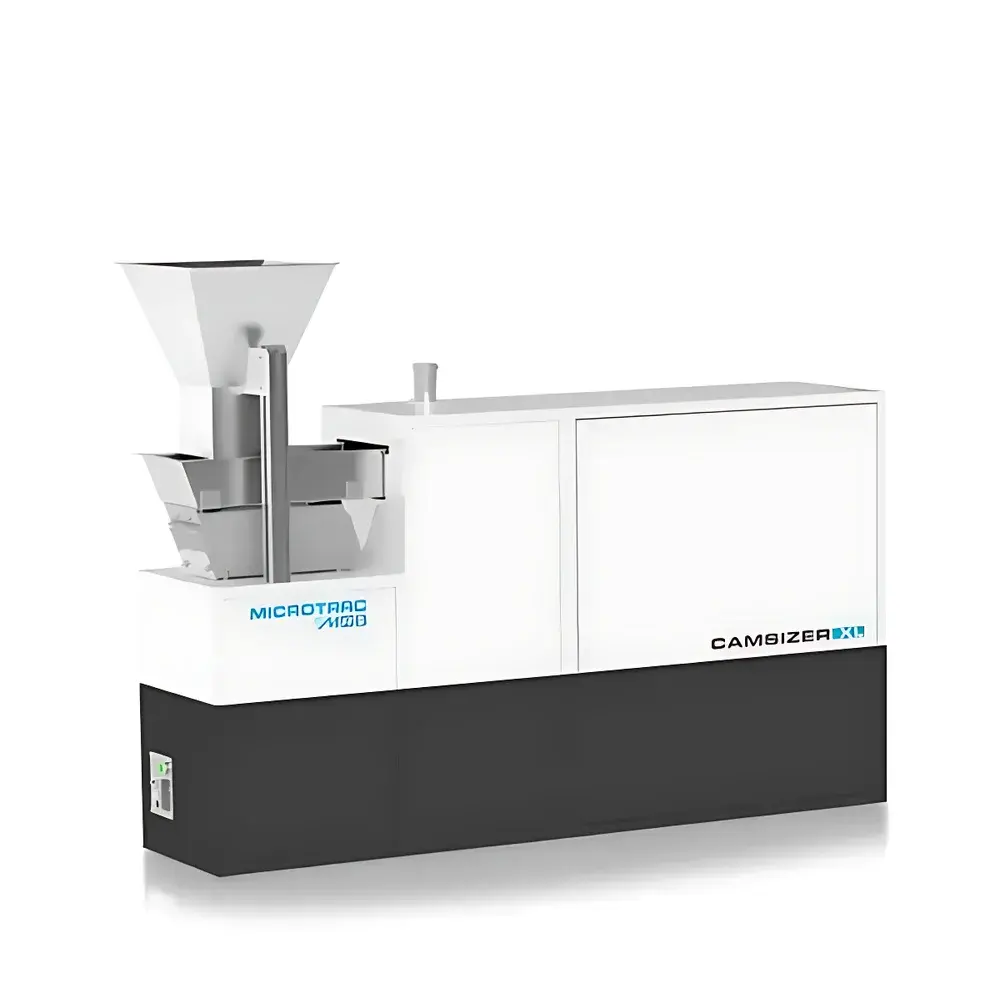
Microtrac MRB CAMSIZER XL Image-Based Particle Size and Shape Analyzer
| Brand | Microtrac MRB |
|---|---|
| Origin | Germany |
| Manufacturer Type | Authorized Distributor |
| Product Origin | Imported |
| Model | CAMSIZER XL |
| Application Field | Pharmaceutical |
| Instrument Type | Dynamic |
| Measurement Range | 160 µm – 135 mm |
| Camera Resolution | 2560 × 2048 pixels, up to 62 frames per second at maximum resolution |
| Measured Parameters | Dimensional parameters (15), Shape/Shape Factor parameters (13), Surface Roughness (3), Density, Transparency, and 3D Morphology |
Overview
The Microtrac MRB CAMSIZER XL is a high-performance, dynamic image-based particle size and shape analyzer engineered for industrial-scale characterization of dry, free-flowing particulates. Unlike static or laser diffraction systems, the CAMSIZER XL employs patented dual-camera stereoscopic imaging combined with advanced 3D reconstruction algorithms compliant with ISO 13322-2:2013 (“Particle size analysis — Image analysis methods — Part 2: Dynamic image analysis”). This enables true volumetric and morphological quantification of individual particles as they pass through a precisely controlled measurement zone. Designed for robust operation in QC laboratories and production environments, the system delivers traceable, reproducible data across an exceptional size range—from coarse granules (160 µm) up to large agglomerates and irregular fragments (135 mm)—making it uniquely suited for pharmaceutical excipients, catalyst supports, mineral aggregates, and battery electrode materials.
Key Features
- Patented dual-camera 3D imaging architecture enabling simultaneous top-view and side-view acquisition for accurate volume estimation and aspect ratio derivation
- Dynamic measurement mode with real-time particle tracking, supporting throughput of up to 100 images per second under standard operating conditions
- Closed optical chamber design minimizes dust ingress and eliminates routine optical alignment—reducing scheduled maintenance intervals by >40% compared to open-path systems
- Automated air-jet cleaning mechanism integrated into the sample dispersion module, significantly decreasing manual intervention between runs
- Modular sample introduction system: configurable for gravity-fed chutes, vibratory feeders, or pneumatic transport—validated for GMP-compliant handling of API powders and sterile-grade carriers
- Compliance-ready firmware architecture supporting audit trails, user access levels, and electronic signatures per FDA 21 CFR Part 11 requirements
Sample Compatibility & Compliance
The CAMSIZER XL is optimized for non-contact, dry-powder analysis without dilution or solvent use—eliminating risks of particle aggregation, dissolution, or surface modification. It accommodates a broad spectrum of industrial materials including crystalline APIs, milled lactose blends, spray-dried silica, metal shot, ceramic granules, and recycled polymer flakes. All measurement protocols adhere to ISO 13322-2 and are compatible with internal SOP development aligned with ICH Q5A, USP , and EP 2.9.19. System validation documentation—including IQ/OQ/PQ templates—is provided to support GLP and GMP audits. Calibration verification is performed using NIST-traceable glass sphere standards (100–100,000 µm) and certified irregular reference particles.
Software & Data Management
CAMSIZER Control Software v6.x provides a validated, multi-user environment for method setup, real-time visualization, statistical reporting, and raw image archiving. Each measurement session automatically logs metadata (operator ID, timestamp, environmental conditions, instrument status), generating immutable records compliant with ALCOA+ principles. The software computes over 40 morphological descriptors—including 15 dimensional metrics (e.g., Feret max/min, Martin diameter, projected area diameter), 13 shape factors (e.g., circularity, convexity, solidity, aspect ratio), 3 surface roughness indices derived from edge gradient analysis, plus density estimation via shadow-area correlation and transparency classification based on grayscale histogram skewness. Export formats include CSV, PDF reports, and HDF5 for integration with LIMS or MES platforms.
Applications
- Pharmaceutical: Quantifying granule sphericity and surface texture to predict flowability and compressibility during tablet formulation; monitoring crystallization endpoint via real-time morphology shifts
- Materials Science: Characterizing fracture patterns in refractory ceramics; assessing spherical vs. angular morphology in additive manufacturing metal powders
- Mining & Aggregates: Classifying crushed rock fractions by elongation and flatness for ASTM D4791 compliance
- Battery Manufacturing: Evaluating cathode/anode powder morphology impact on electrode coating uniformity and porosity
- Food & Feed: Monitoring pellet integrity, friability, and surface cracking in extruded pet food products
FAQ
What regulatory standards does the CAMSIZER XL support for pharmaceutical use?
It complies with ISO 13322-2, supports 21 CFR Part 11 functionality, and includes documentation packages for IQ/OQ/PQ execution under GMP environments.
Can the system analyze wet or suspended samples?
No—the CAMSIZER XL is designed exclusively for dry, dynamic particle analysis. For liquid suspensions, Microtrac MRB recommends the S3500 or Sync™ series laser diffraction analyzers.
How is calibration verified and maintained?
Calibration is traceable to NIST-certified reference spheres and irregular particle standards; annual verification is supported by Microtrac MRB’s global service network.
Is remote diagnostics and software update capability available?
Yes—via secure TLS-encrypted connection, authorized service engineers can perform remote health checks and deploy validated firmware updates without onsite visits.
What is the typical turnaround time for method development and validation support?
Standard SOP development takes 3–5 business days; full GMP validation package delivery requires 10–15 working days post-installation, contingent on client-provided material specifications.



