
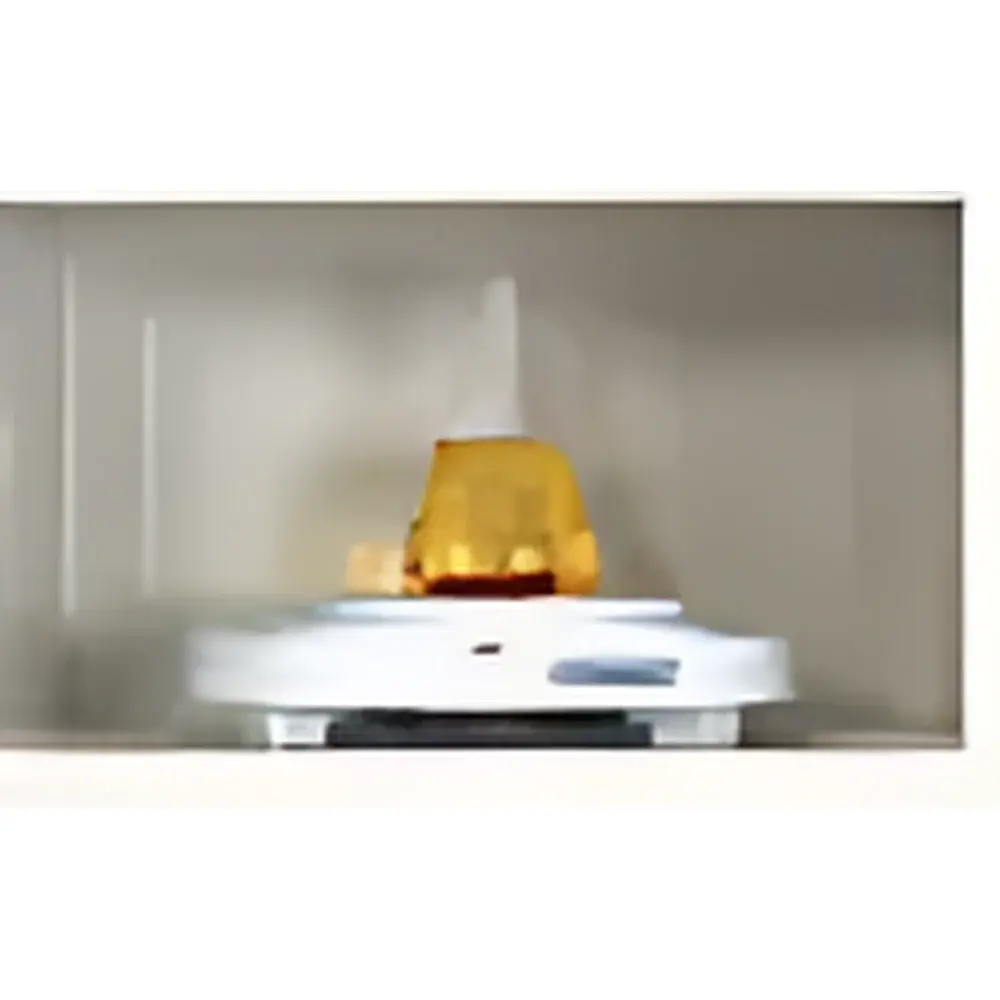
Microwave Stirrer for Integrated Heating and Magnetic Stirring
| Brand | EMS (Electron Microscopy Sciences) |
|---|---|
| Origin | USA |
| Model | Stirrer |
| Regulatory Status | Import |
| Distribution Type | Authorized Distributor |
| Pricing | Available Upon Request |
Overview
The EMS Microwave Stirrer is an engineered accessory designed to enable simultaneous microwave heating and magnetic stirring within compatible microwave digestion or synthesis systems. Unlike conventional workflows requiring sequential heating and post-heating agitation—often leading to thermal gradients, localized overheating, or incomplete dissolution—the Stirrer integrates a chemically inert, temperature-resistant stirring bar drive mechanism directly into the microwave cavity environment. It operates on the principle of electromagnetic coupling: the rotating magnetic field generated by the external stirrer base transmits torque through the microwave-transparent cavity floor to a PTFE- or glass-coated stir bar placed inside the reaction vessel. This design maintains full microwave transparency while ensuring uniform mixing under elevated temperature and pressure conditions—critical for reproducible sample preparation in materials science, pharmaceutical development, and inorganic synthesis.
Key Features
- Seamless integration with commercially available microwave systems equipped with a mechanical drive shaft port (e.g., CEM MARS, Milestone ETHOS, Anton Paar Multiwave series)
- Chemically resistant drive coupling assembly rated for continuous operation up to 300 °C and 20 bar internal vessel pressure
- Adjustable rotational speed range (0–1,200 rpm) with digital feedback control for precise agitation intensity modulation
- Non-metallic, low-dielectric-loss housing constructed from high-purity quartz-reinforced polyetherimide (PEI), minimizing microwave energy absorption and reflection
- Interlock-compatible interface supporting safe operation protocols required under ISO/IEC 17025-accredited laboratory environments
Sample Compatibility & Compliance
The Stirrer accommodates standard microwave reaction vessels—including 10–100 mL quartz, PTFE-lined, or reinforced glass vessels—with diameters ranging from 16 to 45 mm. Its drive geometry ensures stable coupling across variable vessel wall thicknesses and dielectric properties. The system complies with IEC 61000-6-3 (EMC emission limits) and meets UL 61010-1 safety requirements for laboratory equipment. While not a standalone analytical instrument, its use supports method validation in accordance with USP , ASTM E2912 (Standard Guide for Microwave-Assisted Sample Preparation), and GLP-compliant documentation workflows where traceable agitation parameters are essential for audit readiness.
Software & Data Management
When paired with OEM microwave platforms featuring digital control interfaces, the Stirrer enables synchronized logging of rotational speed, real-time temperature (via fiber-optic probe input), and microwave power output. All operational parameters—including start/stop timestamps, speed ramp profiles, and error codes—are recorded in vendor-specific .csv or .xml formats compliant with FDA 21 CFR Part 11 requirements when deployed with validated electronic lab notebook (ELN) systems. No proprietary software is bundled; instead, EMS provides technical integration guidelines and API-ready communication protocols (RS-232/Modbus RTU) for third-party LIMS or process automation frameworks.
Applications
- Rapid thawing and homogenization of cryopreserved biological matrices without thermal shock-induced denaturation
- Accelerated solid-phase extraction (SPE) conditioning and elution steps under controlled thermal agitation
- Crystallization screening of APIs via controlled supersaturation generation in saturated solution reprocessing
- Digestion of refractory environmental samples (e.g., coal fly ash, soil sediments) with enhanced acid–matrix contact efficiency
- In situ polymerization monitoring where viscosity evolution must be tracked under dynamic thermal–mechanical stress
FAQ
Is the Stirrer compatible with domestic countertop microwave ovens?
No. It requires a scientific-grade microwave system with a dedicated mechanical drive shaft port and programmable power control—not consumer-grade units.
Can the stir bar be used inside sealed high-pressure vessels?
Yes, provided the vessel is rated for concurrent pressure, temperature, and magnetic field exposure per manufacturer specifications.
Does EMS provide calibration certificates or metrological traceability?
The Stirrer is classified as a process accessory, not a measurement device; therefore, no NIST-traceable calibration is issued. However, rotational speed accuracy is verified per ISO 17025-accredited test reports upon request.
What maintenance is required for long-term reliability?
Annual inspection of the drive coupling O-ring integrity and cleaning of the quartz window surface with IPA is recommended. No lubrication or firmware updates are necessary.
Is the unit suitable for use with corrosive reagents such as HF or aqua regia?
Only when housed within chemically compatible vessels and using HF-rated stir bars (e.g., PTFE-coated ceramic); direct exposure of the drive assembly to such reagents is strictly prohibited.



