
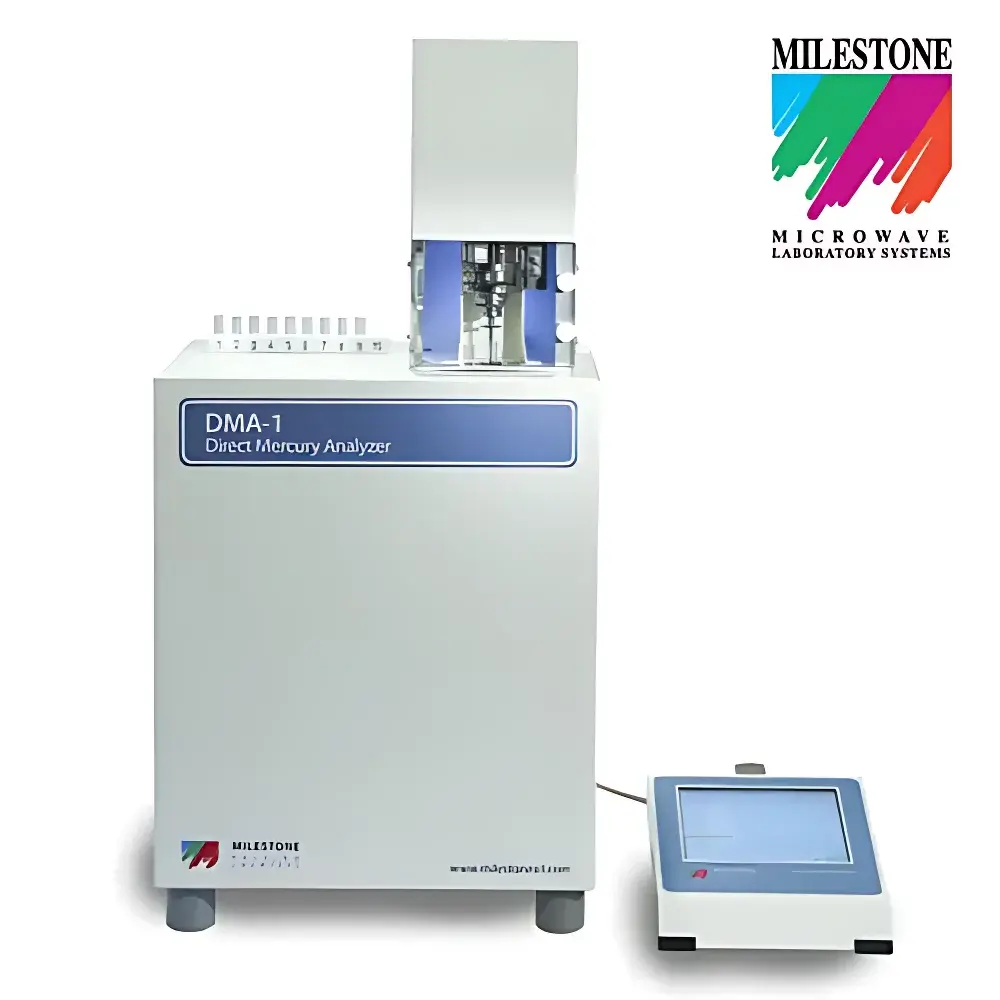
MILESTONE DMA-1 Direct Mercury Analyzer
| Brand | MILESTONE |
|---|---|
| Origin | Italy |
| Model | DMA-1 |
| Instrument Type | Portable |
| Measurement Principle | Catalytic Thermal Decomposition – Gold Amalgamation – Cold Vapor Atomic Absorption Spectrometry (CVAAS) |
| Detection Limit | ≤0.1 ng |
| Linear Range | 0–1500 ng |
| Repeatability (RSD) | ≤1.0% |
| Linearity Error | ±10% |
| Sample Throughput | 2–5 min per analysis |
| Regulatory Compliance | EPA Method 7473, HJ 923–2017, GB 5009.17–2021 |
Overview
The MILESTONE DMA-1 Direct Mercury Analyzer is a benchtop-portable instrument engineered for the rapid, accurate, and reagent-free quantification of total mercury in solid, liquid, and gaseous samples. It operates on the well-established principle of catalytic thermal decomposition followed by gold amalgamation and cold vapor atomic absorption spectrometry (CVAAS). Unlike conventional wet-digestion-based mercury analyzers, the DMA-1 eliminates all acid digestion, distillation, or chemical reduction steps—thereby removing critical sources of mercury loss, memory effect, and cross-contamination. The sample is introduced directly into a high-efficiency quartz combustion tube, where it undergoes controlled pyrolysis at programmable temperatures (up to 950 °C) in an oxygen-rich atmosphere. Released elemental mercury vapor is swept through a halogen-based catalyst bed to ensure complete oxidation–reduction conversion, then trapped and concentrated on a gold-coated quartz trap. Subsequent thermal desorption delivers a sharp, reproducible mercury vapor pulse to the CVAAS detection cell, where absorbance at 253.65 nm is measured against a calibrated reference. This closed-system, carrier-gas-purged architecture ensures trace-level sensitivity and long-term baseline stability.
Key Features
- True direct analysis: No sample digestion, no chemical reagents, no catalysts—only sample weighing and automated injection.
- Multi-matrix capability: Validated for soils, sediments, biological tissues, foodstuffs, water, fuels, flue gases, and airborne particulates (with optional gas sampling module).
- Ultra-low detection limit: ≤0.1 ng absolute mercury mass, enabling compliance with stringent environmental and food safety thresholds (e.g., EU Commission Regulation (EC) No 1881/2006).
- High precision and robustness: RSD ≤1.0% across repeated analyses; linear dynamic range spans 0–1500 ng without dilution or range switching.
- Minimal maintenance footprint: Solid-state quartz furnace, passive gold trap regeneration, and sealed optical path reduce calibration frequency to once every 3–6 months under routine use.
- Integrated safety design: Onboard mercury scrubber, real-time pressure monitoring, and fail-safe gas flow control meet IEC 61010-1 requirements for laboratory instrumentation.
Sample Compatibility & Compliance
The DMA-1 supports certified workflows across regulatory frameworks requiring validated mercury measurement. It is explicitly cited in EPA Method 7473 (for solids and liquids), China’s HJ 923–2017 (soil and sediment), and GB 5009.17–2021 (food safety). Its methodology satisfies ISO/IEC 17025:2017 requirements for method validation, including specificity, limit of detection (LOD), limit of quantitation (LOQ), linearity, accuracy (spike recovery 95–105%), and intermediate precision. The system is compatible with GLP- and GMP-aligned laboratories through optional audit-trail-enabled software (see Software & Data Management). All hardware components—including the quartz combustion tube, gold trap, and UV absorption cell—are traceably calibrated using NIST-traceable mercury standards (SRM 3133, SRM 2670a).
Software & Data Management
The DMA-1 is operated via MILESTONE’s Mercury Control Software v4.x—a Windows-based application compliant with FDA 21 CFR Part 11 for electronic records and signatures. It provides full instrument control, real-time spectral visualization, automatic peak integration, and multi-point calibration curve generation (linear, quadratic, or cubic fit). Raw absorbance data, temperature profiles, gas flow logs, and trap desorption thermograms are stored in vendor-neutral .csv and .xml formats. Audit trail functionality logs all user actions—including method edits, calibration events, and result overrides—with timestamps, operator IDs, and IP addresses. Data export supports LIMS integration via ASTM E1384-compliant HL7 messaging or direct ODBC connectivity.
Applications
- Environmental monitoring: Total mercury in contaminated soils, dredged sediments, fly ash, and wastewater sludge per EPA SW-846 7473.
- Food safety testing: Quantification in fish, rice, infant formula, and dietary supplements per GB 5009.17–2021 and EU 2023/1365.
- Clinical & biomonitoring: Hair, blood, and urine analysis for occupational exposure assessment (NIOSH Method 6009).
- Industrial QA/QC: Mercury screening in petrochemical feedstocks, catalysts, and pharmaceutical excipients.
- Research applications: Mercury speciation support (when coupled with HPLC-CVAFS), isotopic ratio studies (with optional MC-ICP-MS interface), and kinetic release profiling of mercury-bound matrices.
FAQ
Does the DMA-1 require daily recalibration?
No. Under standard operating conditions, calibration verification is required only every 3–6 months. Daily system suitability checks (SSC) using a 5-ng mercury standard are recommended.
Can the DMA-1 analyze gaseous samples such as ambient air or stack emissions?
Yes—when equipped with the optional DMA-Gas Module, which integrates a certified sorbent trap, flow-controlled sampling pump, and thermal desorption interface compliant with EN 13256 and EPA Method 29.
Is the instrument compliant with ISO/IEC 17025 method validation requirements?
Yes. Full validation documentation—including LOD/LOQ determination, spike recovery data, matrix interference studies, and ruggedness testing—is provided in the Instrument Qualification Package (IQP) supplied with each unit.
What maintenance intervals are recommended for the gold trap and quartz furnace?
The gold trap is regenerated automatically during each analysis cycle; replacement is typically required after ≥10,000 injections. The quartz combustion tube has a service life exceeding 2 years under routine use and is field-replaceable without tools.
How is memory effect mitigated in the DMA-1?
Through a dual-stage purge strategy: (1) inert gas flush of the entire sample pathway post-analysis, and (2) high-temperature bake-out (950 °C) of the quartz tube between runs—both fully automated and programmable within the method editor.






