
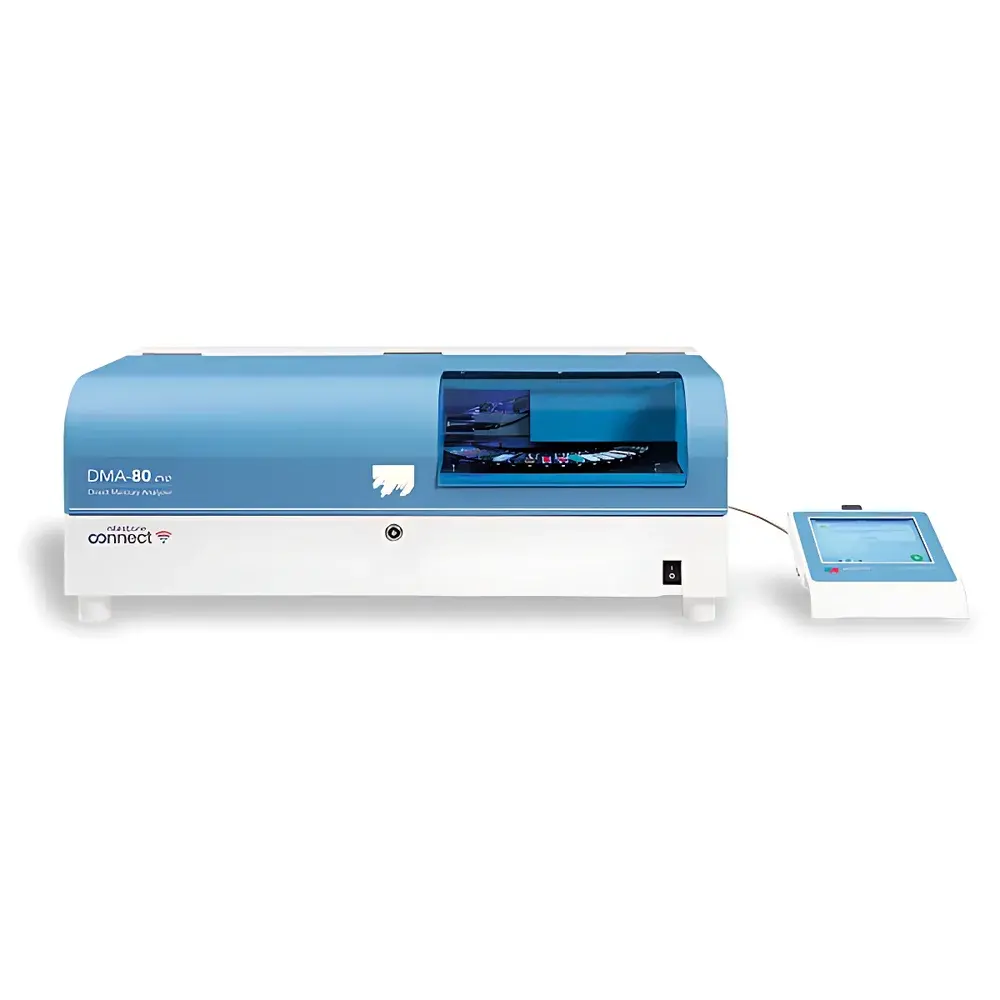
Milestone DMA-80 evo Direct Mercury Analyzer
| Brand | Milestone |
|---|---|
| Origin | Italy |
| Model | DMA-80 evo |
| Principle | Catalytic Thermal Decomposition – Gold Amalgamation – Cold Vapor Atomic Absorption Spectrometry (CVAAS) |
| Detection Limit | 0.0002 ng |
| Linear Range | 0–30,000 ng |
| Repeatability (RSD) | ≤1.0% |
| Recovery Rate | >98.5% at 1000 ng |
| Compliance | EPA Method 7473, HJ 923–2017, GB 5009.17–2021 |
Overview
The Milestone DMA-80 evo Direct Mercury Analyzer is a fully automated, solid/liquid/gas-compatible mercury quantification system engineered for precision, speed, and regulatory compliance in environmental, food safety, clinical, and industrial laboratories. It operates on the well-established principle of catalytic thermal decomposition followed by gold amalgamation and cold vapor atomic absorption spectrometry (CVAAS). Unlike traditional wet-chemistry mercury analyzers requiring acid digestion, distillation, or chemical reduction, the DMA-80 evo thermally decomposes samples in a controlled oxygen-rich quartz tube at up to 950 °C, converting all mercury species—elemental, inorganic, and organomercurials—into elemental mercury vapor. The liberated mercury is then trapped on a gold-coated quartz trap, thermally desorbed, and swept into a dedicated CVAAS cell where absorbance at 253.65 nm is measured. This closed-system, reagent-free methodology eliminates sample preparation artifacts—including volatilization loss, incomplete recovery, and memory effects—common in conventional mercury analysis workflows.
Key Features
- True direct analysis: No acid digestion, no oxidants, no reducing agents—eliminates reagent costs, waste generation, and operator exposure risk.
- Multi-matrix capability: Validated for solids (soil, tissue, filter media), liquids (water, blood, urine, oils), and gases (ambient air, stack emissions via sorbent traps).
- Ultra-low detection limit: 0.0002 ng absolute mercury mass, enabling trace-level monitoring in compliance with stringent regulatory thresholds (e.g., WHO drinking water guideline: 6 ng/L).
- Wide dynamic range: Linear response from 0 to 30,000 ng per analysis—covers applications from ultra-trace environmental screening to high-concentration industrial waste testing.
- High reproducibility: Relative standard deviation (RSD) ≤1.0% across repeated analyses, supported by internal calibration verification and automatic baseline correction.
- Minimal maintenance architecture: Quartz furnace and gold trap are lifetime components under normal use; no consumable catalysts or membranes required.
- Regulatory-ready operation: Built-in audit trail, user access levels, electronic signatures, and data integrity features aligned with FDA 21 CFR Part 11 and GLP/GMP requirements.
Sample Compatibility & Compliance
The DMA-80 evo accepts sample masses ranging from 0.01 g (for high-Hg matrices like coal fly ash) to 1.0 g (for low-Hg soils or biological tissues), and liquid volumes from 10 µL to 2 mL. Gas-phase analysis is enabled via integration with certified sorbent tubes (e.g., gold-coated carbon), followed by thermal desorption directly into the analyzer. Method validation adheres to internationally recognized protocols including U.S. EPA Method 7473 (for solids and liquids), Chinese standard HJ 923–2017 (for soil and sediment), and GB 5009.17–2021 (for food and biological materials). All performance specifications—including accuracy, precision, spike recovery (>98.5% at 1000 ng), and method detection limits—are verified per ISO/IEC 17025:2017 guidelines during factory certification and user qualification.
Software & Data Management
The DMA-80 evo is controlled via Milestone’s MercurySoft™ v5.x software, a Windows-based platform compliant with FDA 21 CFR Part 11 for electronic records and signatures. It provides real-time spectral visualization, automatic peak integration, multi-point calibration curve generation (linear or quadratic), and built-in QC checks (blank monitoring, drift correction, duplicate analysis flagging). All raw spectra, method parameters, calibration logs, and audit trails are stored in encrypted SQLite databases with configurable backup intervals. Data export supports CSV, PDF analytical reports, and LIMS-compatible XML formats. Software updates are delivered through secure firmware update packages validated per IEC 62304 medical device software standards—ensuring long-term maintainability and cybersecurity resilience.
Applications
- Environmental monitoring: Mercury speciation screening in soils, sediments, sludge, and airborne particulate matter (PM2.5/PM10).
- Food & feed safety: Routine compliance testing of fish, rice, dairy, infant formula, and animal feed per EU Commission Regulation (EU) No 2023/1355 and Codex Alimentarius STAN 193–1995.
- Clinical & toxicology labs: Quantification of total mercury in whole blood, urine, and hair for occupational exposure assessment and chelation therapy monitoring.
- Industrial QA/QC: Process control in chlor-alkali plants, fluorescent lamp recycling facilities, and dental amalgam manufacturing.
- Research & method development: Reference instrument for validating new extraction techniques, inter-laboratory comparison studies, and CRM certification programs.
FAQ
Does the DMA-80 evo require carrier gas or external calibration standards for routine operation?
No—helium or argon carrier gas is optional for enhanced sensitivity in ultra-trace applications; the system performs quantitative analysis using internal calibration via certified mercury-coated quartz standards traceable to NIST SRM 3133.
How often must the gold trap be regenerated or replaced?
The gold trap is designed for ≥10,000 analyses under typical operating conditions; regeneration is performed automatically during each run via resistive heating to 850 °C—no manual intervention or consumables required.
Can the instrument be integrated into an existing LIMS environment?
Yes—MercurySoft supports ASTM E1482-compliant data exchange and offers ODBC connectivity, RESTful API endpoints, and configurable HL7 message templates for seamless LIMS synchronization.
Is method validation support available for laboratory accreditation (e.g., ISO/IEC 17025)?
Milestone provides comprehensive IQ/OQ/PQ documentation packages, uncertainty budget templates, and on-site validation assistance aligned with ILAC-G8:2022 and EURACHEM/CITAC Guide CG4.
What sample throughput can be expected in high-volume labs?
With autosampler configuration (up to 60 positions), average cycle time is 2.5–4.5 minutes per sample—including weighing, thermal decomposition, amalgamation, measurement, and cleaning—enabling >200 samples per 24-hour shift.
Related Products




