
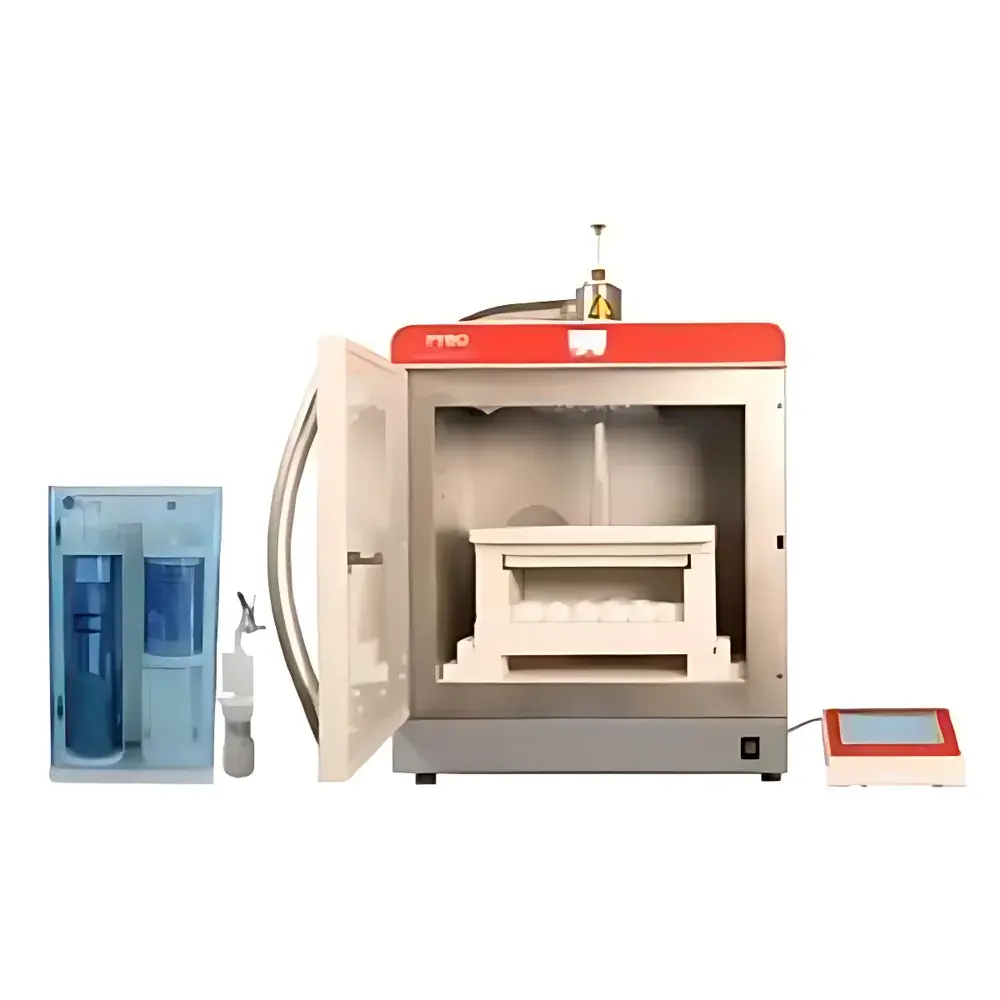
MILESTONE PYRO SA Microwave Ashing and Sulfonation System
| Brand | MILESTONE |
|---|---|
| Origin | Italy |
| Model | PYRO SA |
| Instrument Type | Crucible Furnace |
| Max Temperature | 1200 °C |
| Temperature Control | PID-based dual-stage thermocouple system with DKD-traceable calibration |
| Max Power | 1200 W |
| Time to Max Temperature | ≤20 min |
| Heating Elements | Resistance wire, SiC rods, MoSi₂ rods |
| Internal Chamber Dimensions | 480 mm (W) × 550 mm (D) × 560 mm (H) |
| Acid Management System | Quartz-lined chamber, quartz condenser, PTFE/PFA acid traps, NaOH neutralization stage, corrosion-resistant PTFE vacuum pump (20 mbar, 40 L/min) |
| Airflow Design | Perforated honeycomb alumina ceramic wall for continuous oxidative airflow over crucibles |
Overview
The MILESTONE PYRO SA Microwave Ashing and Sulfonation System is an engineered solution for rapid, controlled, and chemically safe sample preparation in regulated analytical laboratories. Unlike conventional muffle furnaces relying solely on resistive heating, the PYRO SA integrates microwave energy delivery with forced oxidative airflow and integrated acid vapor management—enabling direct sulfonation-aided ashing without pre-carbonization. Its core principle leverages microwave coupling with high-purity alumina ceramic insulation and optimized cavity geometry to achieve uniform, rapid thermal ramping (≤20 min to 1200 °C), while simultaneous oxygen-enriched convection ensures complete organic matrix oxidation. This hybrid thermal–aerodynamic approach reduces typical ashing durations from 8–12 hours to under 30 minutes for many pharmaceutical, polymer, and food matrices—without compromising residue integrity or elemental recovery fidelity.
Key Features
- Triple-heating-element architecture: Interchangeable or concurrent use of resistance wire, silicon carbide (SiC), and molybdenum disilicide (MoSi₂) rods for broad thermal stability across low-, mid-, and high-temperature regimes (up to 1200 °C)
- DKD-traceable dual thermocouple system: One thermocouple embedded within a composite alumina–silicon carbide sheath directly adjacent to the heating zone; second calibrated reference thermocouple mounted in the chamber wall—both independently verified per ISO/IEC 17025 and compliant with GLP temperature validation requirements
- Integrated acid vapor abatement: Quartz-lined reaction chamber, water-cooled PTFE condenser (>90% H₂SO₄ recovery), PFA particulate filter, NaOH scrubbing stage, and fully fluoropolymer (PTFE)-constructed vacuum pump (20 mbar ultimate pressure, 40 L/min flow rate)
- Oxidative airflow engineering: Honeycomb-patterned porous alumina ceramic side walls facilitate laminar, high-velocity air passage over crucibles—ensuring stoichiometric O₂ supply during sulfonation-assisted ashing and minimizing localized reducing zones
- PID-driven precision control: Real-time closed-loop regulation with programmable ramp/soak profiles, ±1 °C repeatability at 1000 °C, and automatic thermal derating upon detection of airflow or vacuum anomalies
Sample Compatibility & Compliance
The PYRO SA accommodates standard and custom crucibles (including Pt, quartz, and high-purity alumina) up to Ø90 mm × 70 mm height. It supports ICH Q2(R2)-aligned method development for residual ash determination in APIs, excipients, and biologics intermediates. The system complies with ASTM D5630 (ash content of plastics), USP (residue on ignition), and ISO 3591 (food ashing protocols). All acid-handling components meet FDA 21 CFR Part 11 data integrity prerequisites when paired with MILESTONE’s certified software suite. Full traceability documentation—including DKD-certified thermocouple calibration certificates, vacuum pump performance logs, and acid trap service records—is maintained in accordance with ISO 17025 internal audit requirements.
Software & Data Management
Controlled via MILESTONE’s proprietary PYRO Control Suite (v4.2+), the system provides secure user-level access (administrator/operator/auditor roles), electronic signature support, and automated audit trail generation compliant with 21 CFR Part 11 Annex 11. Temperature profiles, vacuum pressure logs, acid trap saturation indicators, and power consumption metrics are timestamped, encrypted, and exportable in CSV or PDF format. Optional integration with LIMS via ASTM E1384-compliant HL7 messaging enables seamless transfer of ashing metadata—including batch ID, operator ID, start/end timestamps, and final residue mass—to enterprise quality databases.
Applications
- Rapid sulfonation-aided ashing of sulfate-rich pharmaceuticals (e.g., heparin sodium, sulfonamide antibiotics) prior to ICP-MS or AAS analysis
- High-throughput ashing of polymer composites containing flame retardants (e.g., brominated epoxies) without halogen volatilization losses
- Residue-on-ignition testing of infant formula and dietary supplements per AOAC 990.12 and EU Commission Regulation (EU) No 609/2013
- Preparation of geological and environmental samples (soils, sediments) for XRF fusion, where sulfuric acid addition prevents volatile loss of As, Se, and Hg
- Method validation studies requiring documented thermal equivalence between microwave and conventional furnace ashing per ISO 11885
FAQ
Does the PYRO SA require external cooling water for the acid condenser?
No—the PTFE condenser uses ambient-air finned heat exchange; no recirculating chiller or tap-water connection is needed.
Can the system be validated for GMP production environments?
Yes—full IQ/OQ/PQ protocols, including thermocouple mapping, vacuum integrity tests, and acid trap breakthrough challenges, are available under MILESTONE’s GxP Validation Support Package.
What maintenance intervals are recommended for the PTFE vacuum pump?
The pump requires quarterly inspection of diaphragm integrity and annual replacement of PTFE valves and seals—log entries are auto-generated in the audit trail.
Is the quartz lining replaceable in the field?
Yes—quartz chamber liners are modular and user-replaceable using standard torx tools; replacement kits include DKD-certified revalidation templates.
How does the system ensure reproducibility when processing heterogeneous food matrices?
By combining microwave field homogenization (via mode stirrer and cavity tuning), real-time multi-point thermal feedback, and adaptive airflow modulation—each parameter logged and cross-correlated in the audit trail.



