
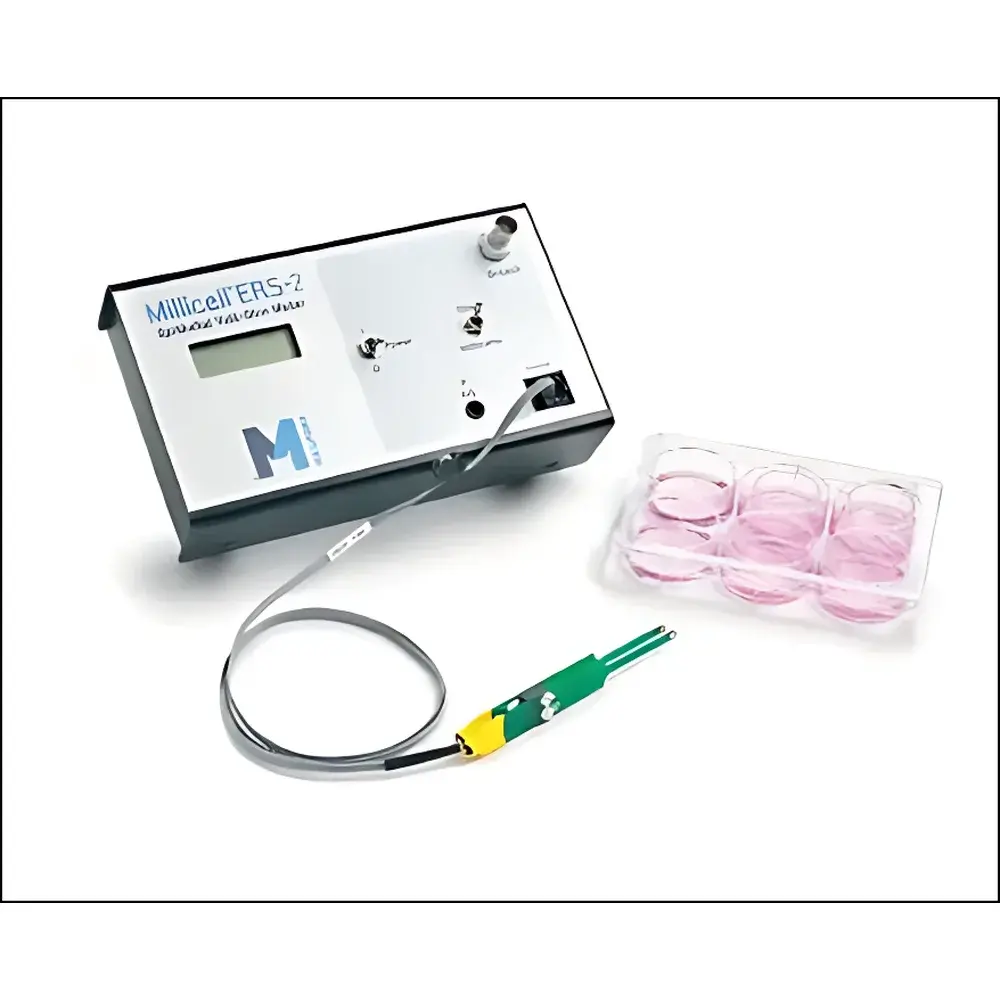
Millicell® ERS-2 Epithelial Volt-Ohmmeter
| Brand | Merck |
|---|---|
| Origin | USA |
| Manufacturer | Merck KGaA |
| Product Type | Epithelial Resistance & Voltage Measurement System |
| Model | Millicell® ERS-2 |
| Measurement Principle | AC-based impedance spectroscopy (12.5 Hz sinusoidal current) |
| Electrode Type | Dual Ag/AgCl miniaturized probe electrodes |
| Probe Tip Diameter | ≤1.0 mm |
| Voltage Range | ±100 mV |
| Resistance Range | 0–10,000 Ω |
| Resolution | 1 Ω (0–1,000 Ω), 10 Ω (1,000–10,000 Ω) |
| Accuracy | ±2% of reading |
| Power Supply | 9 V alkaline battery (included) |
| Compliance | Designed for GLP-compliant TEER monitoring in vitro |
Overview
The Millicell® ERS-2 Epithelial Volt-Ohmmeter is a precision-engineered, handheld instrument designed specifically for non-invasive, real-time assessment of transepithelial electrical resistance (TEER) and potential difference (PD) across confluent epithelial or endothelial monolayers cultured on permeable supports—such as Transwell® or Millicell® inserts. Operating on a fixed-frequency (12.5 Hz) alternating current (AC) excitation principle, the ERS-2 eliminates electrode polarization artifacts and DC-induced cellular stress commonly observed with direct-current systems. This AC-based measurement architecture ensures high reproducibility and physiological relevance by maintaining zero net charge transfer across the cell layer during interrogation. The device delivers quantitative, operator-independent resistance values critical for validating barrier integrity prior to drug permeability studies, toxicology screening, or host-pathogen interaction assays. Its compact, ergonomic design enables rapid point-of-use measurements directly inside biosafety cabinets or CO2 incubators without requiring system recalibration between uses.
Key Features
- Dual Ag/AgCl miniaturized probe electrodes (tip diameter ≤1.0 mm) optimized for precise insertion into standard 6-, 12-, and 24-well insert formats without membrane damage
- Fixed 12.5 Hz sinusoidal AC current source—minimizes electrochemical interference, prevents metal ion leaching, and avoids membrane depolarization effects associated with DC methods
- Auto-ranging resistance measurement (0–10,000 Ω) with dual-resolution display (1 Ω below 1 kΩ; 10 Ω above), enabling accurate detection of subtle barrier formation dynamics
- Simultaneous voltage (±100 mV) and resistance readout on a backlit LCD screen—no external software or PC connection required for routine TEER validation
- Battery-powered operation (9 V alkaline, included) ensures portability and uninterrupted use in controlled environments including Class II biosafety cabinets and humidified incubators
- Calibration traceable to NIST-certified standards; factory-calibrated with documented certificate of conformance supplied with each unit
Sample Compatibility & Compliance
The ERS-2 is validated for use with all standard porous membrane supports—including polyester (PET), polycarbonate (PC), and collagen-coated inserts—across common epithelial models such as Caco-2, MDCK, HT-29, Calu-3, and primary human bronchial/tracheal epithelial cells. It meets functional requirements outlined in ASTM F2971-14 (“Standard Guide for In Vitro Barrier Function Assays”) and supports regulatory documentation needs for GLP-compliant barrier integrity qualification. While not an FDA-cleared diagnostic device, its measurement methodology aligns with ICH M3(R2) and EMA CHMP reflection papers on in vitro permeability assessment for biopharmaceutical development. Data generated are suitable for inclusion in IND-enabling study reports when accompanied by appropriate SOPs and instrument logbook entries.
Software & Data Management
The ERS-2 operates as a standalone analog-digital hybrid instrument and does not require proprietary software for basic operation. However, raw TEER and PD values can be manually recorded into laboratory notebooks or electronic lab notebooks (ELNs) compliant with 21 CFR Part 11 when paired with validated data entry workflows. For laboratories implementing automated data capture, optional third-party serial interface adapters (RS-232 or USB-to-serial) enable integration with custom LabVIEW or Python-based acquisition scripts—provided calibration stability is verified per Merck’s Application Note AN-ERS2-01. Audit trails, user access controls, and electronic signatures must be managed at the ELN or LIMS level, as the ERS-2 itself does not store historical measurements or support user authentication.
Applications
- Quantitative validation of monolayer confluence and tight junction formation in intestinal, pulmonary, and blood-brain barrier models
- Time-resolved monitoring of barrier disruption induced by cytokines (e.g., TNF-α, IFN-γ), pathogens, or nanomaterials
- Quality control of differentiated stem-cell-derived epithelia prior to functional assays
- Supporting mechanistic studies of claudin/occludin modulation using siRNA or pharmacological inhibitors
- Pre-screening of formulation excipients for epithelial irritation potential in early-stage dermal or mucosal delivery programs
FAQ
Does the ERS-2 require electrode calibration before each use?
No—factory calibration remains stable for ≥12 months under normal handling conditions. A single-point verification using the supplied 1,000 Ω resistor is recommended before initiating a new experimental series.
Can the ERS-2 measure TEER in 96-well microplate inserts?
Not directly—the probe geometry is optimized for 6-, 12-, and 24-well formats. For high-throughput applications, Merck recommends the Millicell® ERS-2 ST (Sterile Tip) variant with interchangeable probes or complementary automated plate readers validated for TEER.
Is the AC measurement frequency adjustable?
No—the 12.5 Hz frequency is fixed and optimized to balance signal-to-noise ratio, electrode impedance minimization, and biological fidelity across diverse epithelial types.
How should probe hygiene be maintained between samples?
Rinse both electrodes sequentially with deionized water, followed by 70% ethanol, then air-dry vertically—avoid wiping or ultrasonic cleaning to preserve Ag/AgCl coating integrity.
Does TEER data from the ERS-2 satisfy regulatory submission requirements?
Yes—when collected under documented SOPs, with contemporaneous calibration records and environmental monitoring (e.g., temperature, CO2), TEER values are accepted by major regulatory agencies as part of in vitro barrier characterization packages.



