
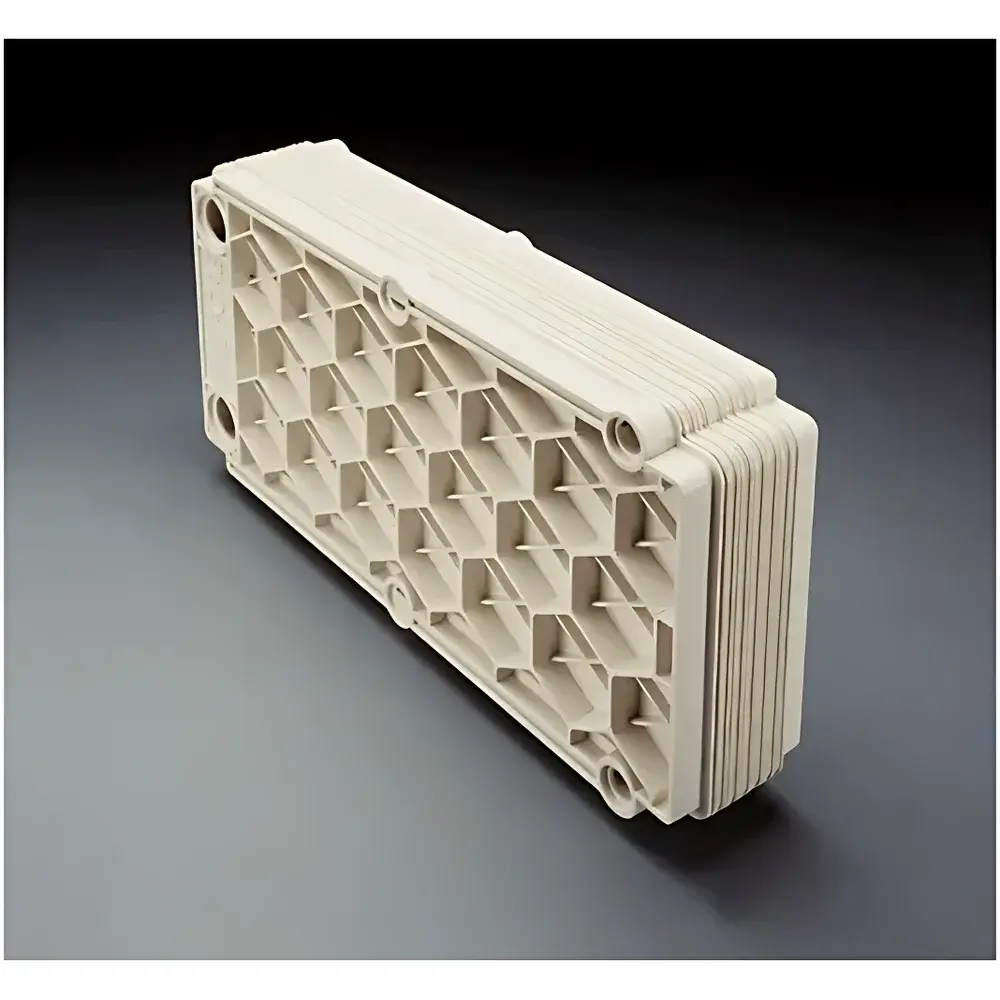
Millipore Prostak™ MF Microfiltration Stack
| Brand | Millipore |
|---|---|
| Origin | USA |
| Product Type | Sterilizable, Solvent-Resistant Microfiltration Stack |
| Construction | Heat-Fused PVDF Membrane on Polypropylene Support |
| Layers | 4-, 10-, or 20-Layer Configurations |
| Sterilization | Steam Autoclave at 126°C for 60 min, ≥20 cycles |
| Solvent Resistance | Compatible with Strong Organic Solvents (e.g., Acetone, THF, DMF, Ethanol) |
| Application Scope | Clarification of High-Solids Bioprocess Streams, Harvest of Mammalian Cells, Bacteria, Mycelia, Emulsions, Colloidal Suspensions, and Protein Precipitates |
Overview
The Millipore Prostak™ MF Microfiltration Stack is an engineered single-use filtration module designed for robust, scalable, and GMP-compliant bioprocessing applications. Unlike conventional membrane cassettes relying on adhesive bonding or gasket-based sealing, the Prostak™ MF stack employs a proprietary thermal fusion process that permanently bonds hydrophilic polyvinylidene fluoride (PVDF) membranes directly to a microporous polypropylene support layer—eliminating adhesives, extractables, and potential delamination pathways. This monolithic architecture enables reliable operation under high differential pressure (up to 3.5 bar), elevated temperatures, and aggressive solvent exposure—making it uniquely suited for demanding clarification steps in upstream and intermediate purification workflows. Its measurement principle is based on size-exclusion microfiltration (pore sizes typically ranging from 0.1 µm to 0.45 µm), providing consistent particle retention while maintaining high flux stability across repeated sterilization cycles.
Key Features
- Adhesive-free construction via thermal fusion ensures zero leachables and superior mechanical integrity during steam-in-place (SIP) and cleaning-in-place (CIP) protocols.
- Validated autoclave stability: withstands ≥20 cycles of saturated steam sterilization at 126°C for 60 minutes—fully compliant with ISO 13408-1 and USP requirements for sterile filtration system qualification.
- Broad chemical compatibility: resistant to polar aprotic solvents (e.g., dimethylformamide, tetrahydrofuran), alcohols (ethanol, isopropanol), and halogenated hydrocarbons—enabling use in downstream processing involving solvent-based precipitation or extraction.
- Configurable layer count (4, 10, or 20 layers) allows optimization of total membrane area (from 0.1 to 1.2 m² per stack) to match process scale—from lab-scale bioreactor harvest (5–50 L) to pilot-scale (200–2000 L) operations.
- Integrated polypropylene housing with standardized 1/2″ sanitary tri-clamp (DIN 11851) inlet/outlet ports ensures rapid, leak-tight connection to existing stainless-steel or single-use fluid paths.
- Low protein binding PVDF surface minimizes product loss during clarification of monoclonal antibodies, viral vectors, and other sensitive biologics.
Sample Compatibility & Compliance
The Prostak™ MF stack is validated for use with viscous, high-solids bioprocess streams including CHO and HEK293 cell culture harvests (up to 20 × 10⁶ cells/mL), bacterial fermentations (e.g., E. coli, Pseudomonas), fungal mycelial suspensions, oil-in-water emulsions, colloidal silica dispersions, and ammonium sulfate-precipitated protein fractions. It meets ASTM F838-20 criteria for bacterial retention (≥7-log reduction of Brevundimonas diminuta ATCC 19146) when operated within specified flow and pressure parameters. The device carries CE marking for in vitro diagnostic (IVD) use and conforms to ISO 10993-5 cytotoxicity and ISO 10993-10 sensitization testing. Documentation packages include full Certificate of Conformance, Extractables Profile (per USP ), and sterilization validation summary—supporting FDA 21 CFR Part 11–compliant batch records and regulatory submissions.
Software & Data Management
While the Prostak™ MF stack operates as a passive, non-electronic component, its integration into automated bioprocessing systems is supported via compatible control platforms (e.g., DeltaV, Siemens Desigo, Rockwell PlantPAx). Digital twin models are available through Millipore’s Process Solutions Portal for predictive flux decay modeling and lifetime estimation under defined operating conditions. All qualification data—including pre- and post-sterilization integrity test logs (forward flow or bubble point), pressure drop profiles, and throughput validation reports—are structured to align with ALCOA+ data integrity principles and support GLP/GMP audit readiness. Raw data export formats (CSV, PDF/A-2) comply with EMA Annex 11 and PIC/S PI 011-3 expectations for traceability.
Applications
- Primary harvest of mammalian cell cultures prior to depth filtration or centrifugation.
- Clarification of microbial fermentation broths containing shear-sensitive inclusion bodies or extracellular vesicles.
- Removal of mycelial fragments in antibiotic or enzyme production processes.
- Stabilization and concentration of nanoemulsions and liposomal suspensions during formulation development.
- Final polishing step for particulate removal in vaccine manufacturing (e.g., whole-virus or VLP preparations).
- In-process monitoring of protein precipitation clarity in downstream capture steps using inline turbidity sensors coupled with Prostak™ MF feed streams.
FAQ
Can Prostak™ MF stacks be reused after autoclaving?
No—they are designed for single-use, multi-cycle sterilization but not for repeated chemical cleaning or extended reuse beyond validated autoclave cycles.
Is integrity testing required before each use?
Yes. A pre-use forward flow or bubble point test must be performed per ASTM F3154-18 to verify membrane continuity and seal integrity.
What is the maximum recommended transmembrane pressure (TMP)?
The maximum TMP is 3.5 bar at 25°C; operation above this limit may compromise structural integrity, especially after multiple sterilization cycles.
Are Prostak™ MF stacks compatible with gamma irradiation?
No—gamma irradiation is not recommended, as it degrades PVDF crystallinity and reduces tensile strength; steam sterilization is the only validated method.
Do I need special connectors or adapters for integration?
Standard 1/2″ tri-clamp fittings are provided; no proprietary hardware is required for integration into ASME BPE-compliant fluid systems.
Related Products





