
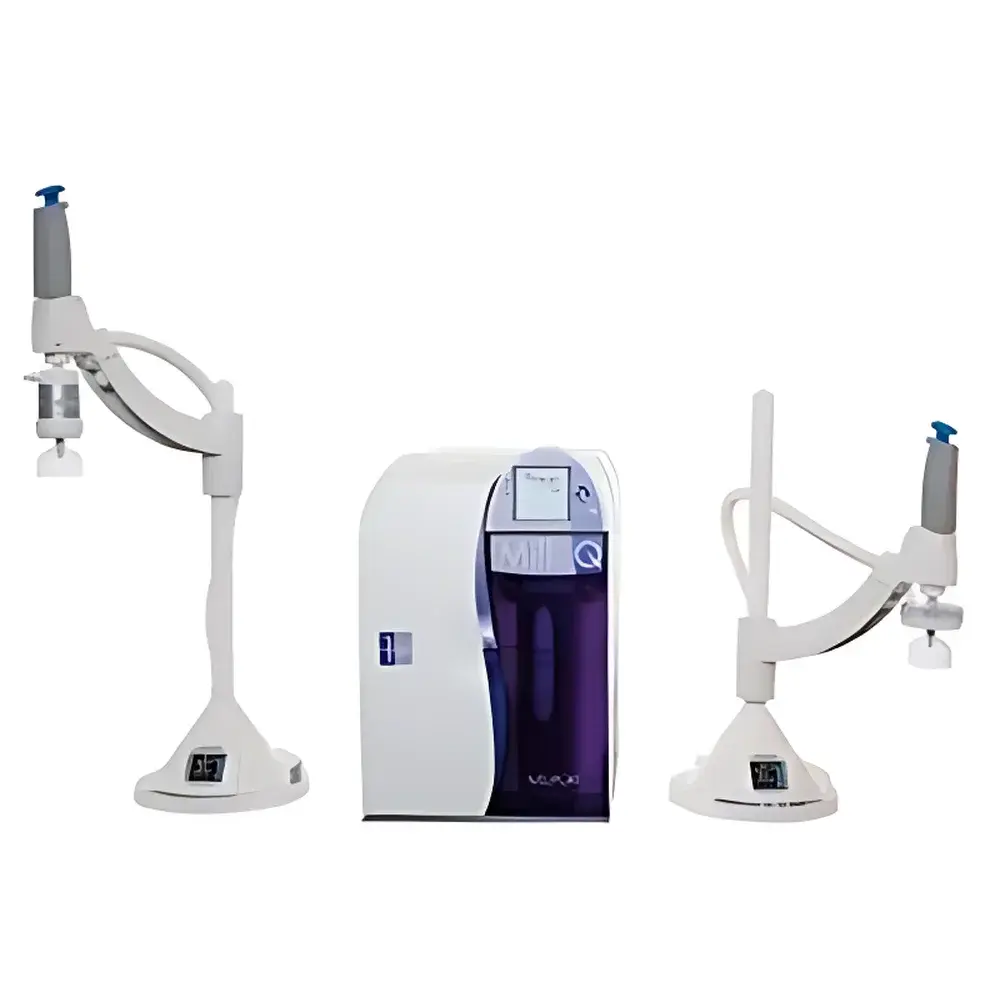
MilliporeSigma Milli-Q Integral Ultra Pure Water System
| Brand | MilliporeSigma |
|---|---|
| Origin | France |
| Model | Milli-Q Integral |
| Production Capacity | 3, 5, 10, or 15 L/h (Pure Water) / Up to 2 L/min (Ultrapure Water) |
| Resistivity (Ultrapure) | 18.2 MΩ·cm @ 25 °C (temperature-compensated) |
| TOC (Ultrapure) | 1–5 ppb |
| Bacterial Count (Ultrapure) | <0.1 CFU/mL |
| Particles >0.22 µm (Ultrapure) | <1/mL |
| Endotoxin (with UF module) | <0.001 EU/mL |
| Resistivity (Pure Water) | 5–15 MΩ·cm @ 25 °C |
| TOC (Pure Water) | <30 ppb |
| Silica Rejection | >99.9% |
| Microbial Load (Pure Water) | <10 CFU/mL |
| Integrated Online TOC Analyzer | Range 1–999 ppb, Accuracy ±1 ppb |
| Conductivity/Resistivity Sensors | Four independent cells, Cell Constant 0.01 cm⁻¹, Temp. Sensitivity ±0.1 °C |
| Water Tank | 30 L, Conical Bottom, Air Filter with 0.22 µm Hydrophobic Membrane, Overflow Protection, Level Accuracy ±5% |
| System Interface | Full-color graphical display, Chinese-language OS, Real-time水质 & Maintenance Status |
| Connectivity | RS232, Ethernet |
| Data Logging | 12-month integrated audit trail |
Overview
The MilliporeSigma Milli-Q Integral Ultra Pure Water System is a modular, high-reliability laboratory water purification platform engineered for consistent production of both Type II pure water and Type I ultrapure water per ISO 3696 and ASTM D1193 standards. It employs a multi-stage purification architecture: pretreatment (activated carbon + sediment filtration), reverse osmosis (RO), electrodeionization (EDI) with mixed-bed resin configuration, and final polishing via dual-wavelength UV oxidation (185/254 nm) and 0.22 µm membrane filtration. Optional ultrafiltration (UF) modules enable endotoxin-free water generation compliant with USP and EP 2.2.44 for cell culture and molecular biology applications. Designed for continuous operation in regulated environments, the system integrates real-time electrochemical monitoring at four critical process points—feedwater, RO permeate, EDI product, and final ultrapure output—ensuring traceable, reproducible water quality across daily operational cycles.
Key Features
- Four independent, temperature-compensated resistivity/conductivity sensors (cell constant 0.01 cm⁻¹) with NIST-traceable calibration certificates—enabling simultaneous monitoring of feedwater conductivity, RO rejection efficiency, EDI performance, and final ultrapure resistivity.
- Integrated online TOC analyzer (1–999 ppb range, ±1 ppb accuracy) with factory calibration verification, supporting routine compliance with pharmacopeial TOC limits for HPLC mobile phase preparation and analytical instrument rinsing.
- Long-life, antifouling EDI module utilizing electrically regenerated mixed-bed ion exchange resin—eliminating need for chemical regeneration, softening cartridges, or pre-treatment antiscalants.
- 30 L conical-bottom reservoir with sanitary air filter (0.22 µm hydrophobic PTFE), overflow protection, and ±5% level accuracy—designed for complete drainage and minimized biofilm retention.
- Modular dispensing architecture: single main unit supports up to three height-adjustable Q-POD® or E-POD® dispensers, each equipped with full-color graphical interface showing real-time resistivity, TOC, particle count, tank level, and maintenance alerts.
- Comprehensive data governance: 12-month internal logging of all water quality parameters, flow events, consumable usage, and system alarms; exportable via RS232 or Ethernet; compatible with GLP/GMP audit trail requirements under FDA 21 CFR Part 11 when paired with validated LIMS integration.
Sample Compatibility & Compliance
The Milli-Q Integral delivers water meeting or exceeding specifications required for critical laboratory workflows including HPLC, IC, AA, ICP-MS, LC-MS, TOC analysis, trace metal analysis, and molecular diagnostics. Its ultrapure output satisfies ISO 3696 Grade 1, ASTM D1193 Type I, CLSI EP23-A, and USP purified water monographs. With optional UF cartridge, it achieves endotoxin levels <0.001 EU/mL—validated for mammalian cell culture, transfection reagent preparation, and sterile filtration processes. All sensors and analyzers are supplied with manufacturer-issued calibration certificates traceable to NIST or equivalent national metrology institutes. System firmware supports user-defined alarm thresholds, password-protected configuration changes, and electronic signature capture for SOP-driven operation in regulated QC/QA laboratories.
Software & Data Management
The embedded operating system provides bilingual (English/Chinese) navigation and real-time visualization of key operational metrics—including resistivity trends, TOC drift, RO rejection rate, tank temperature, and consumable remaining life. Historical data is stored internally with time-stamped timestamps and operator ID fields. Export functionality supports CSV and PDF formats via USB or network connection. When connected to enterprise networks, the system can be remotely monitored using MilliporeSigma’s LabManager™ software suite, enabling centralized fleet management, predictive maintenance scheduling, and automated report generation aligned with ISO/IEC 17025 documentation requirements. Audit trail records include event type, timestamp, user action, and pre-/post-value changes—fully compliant with ALCOA+ principles for data integrity.
Applications
- HPLC and UHPLC mobile phase preparation and column equilibration
- ICP-MS and GF-AAS trace elemental analysis requiring sub-ppt metal contamination control
- Cell culture media formulation and sterile filtration support
- PCR, qRT-PCR, NGS library preparation, and CRISPR reagent dilution
- TOC instrument calibration and system suitability testing
- Pharmaceutical stability studies and dissolution testing per USP
- Calibration standard preparation for clinical chemistry analyzers
FAQ
What inlet water quality is required for optimal Milli-Q Integral performance?
Municipal tap water meeting local drinking water standards (e.g., EPA 600/R-90/005 or EU Directive 98/83/EC) is sufficient. Pre-filtration via the integrated activated carbon/sediment stage ensures robustness against chlorine, organics, and particulates.
Can the system be validated per GMP Annex 15 or IQ/OQ/PQ protocols?
Yes—the system supports third-party qualification with documented test scripts, calibration records, and performance verification reports. MilliporeSigma provides validation support packages including DQ/IQ/OQ templates and URS alignment assistance.
How often must consumables be replaced?
Typical service intervals: RO membrane (2–3 years), EDI stack (5+ years), UV lamp (1 year), UF cartridge (12 months with continuous use), and final 0.22 µm filter (6–12 months depending on usage). The system calculates remaining life based on runtime, flow volume, and sensor degradation trends.
Is remote diagnostics available?
Standard Ethernet connectivity enables secure remote access via MilliporeSigma’s certified support portal for firmware updates, log file retrieval, and troubleshooting—subject to customer IT security policy approval.
Does the system comply with FDA 21 CFR Part 11 for electronic records?
The hardware and firmware meet technical prerequisites (audit trail, electronic signatures, role-based access); full Part 11 compliance requires site-specific configuration, procedural controls, and validation documentation per organizational SOPs.



