
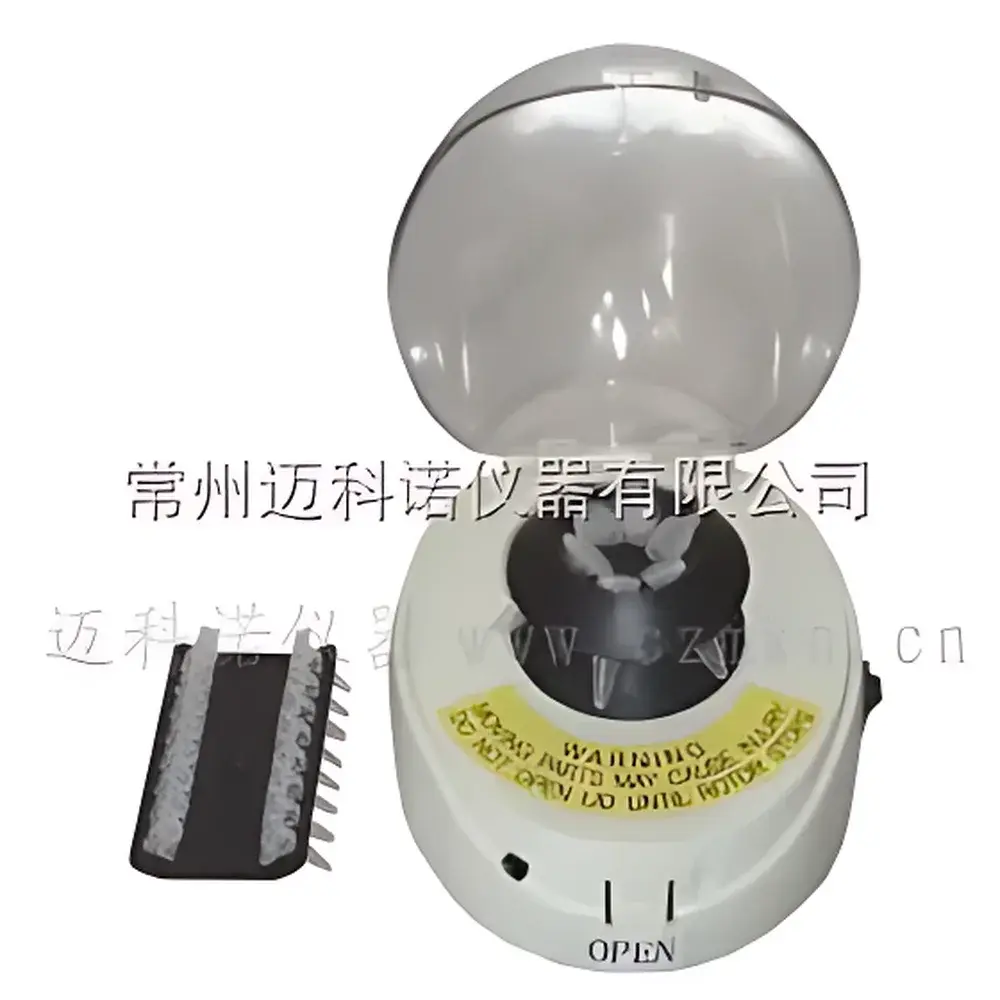
Mini-60 Portable Palm-Sized Centrifuge
| Origin | Zhejiang, China |
|---|---|
| Manufacturer Type | Authorized Distributor |
| Origin Category | Domestic (PRC) |
| Model | Mini-60 |
| Price Range | USD 0.15–750 (FOB) |
| RCF Max | 2000 × g |
| Capacity | 6 × 1.5/2.0 mL tubes + dual 8-position 0.2 mL strip rotors |
| Speed | 6000 rpm |
| Noise Level | <45 dB(A) |
| Dimensions | 125 × 125 × 120 mm (W×D×H) |
| Weight | 0.95 kg |
| Power Supply | DC 12 V / 2 A (external adapter included) |
| Motor Type | Brushless DC motor with carbon-fiber rotor assembly |
| Compliance | CE, RoHS, ISO 13485 (manufacturing system), IEC 61010-1 |
Overview
The Mini-60 Portable Palm-Sized Centrifuge is an ultra-compact, benchtop-ready centrifugal separation device engineered for rapid micro-volume sample processing in resource-constrained or high-throughput laboratory environments. Operating on the principle of radial acceleration-induced sedimentation, it delivers consistent relative centrifugal force (RCF) up to 2000 × g at 6000 rpm—sufficient for pelleting cellular debris, precipitating nucleic acids, concentrating proteins, and separating phase-separated reagents in low-volume formats. Its design prioritizes spatial efficiency and operational silence without compromising mechanical stability: the brushless DC motor, integrated carbon-fiber rotor assembly, and patented acoustic-damping housing collectively ensure vibration-free operation below 45 dB(A)—comparable to ambient office noise levels. Unlike conventional centrifuges requiring dedicated bench space and AC infrastructure, the Mini-60 draws power from a standardized 12 V DC input, enabling seamless deployment in field labs, mobile diagnostic units, biosafety cabinets, and teaching laboratories where electrical safety and portability are critical.
Key Features
- True palm-sized footprint (125 × 125 × 120 mm) with ergonomic, streamlined casing available in multiple industrial-grade polymer color options for visual identification and contamination control.
- Carbon-fiber composite rotor structure—lightweight yet dimensionally stable across repeated thermal cycles—ensures long-term rotational balance and eliminates metal fatigue concerns inherent in aluminum rotors.
- Dual-configuration rotor compatibility: fixed-angle 6-position rotor for 1.5/2.0 mL microcentrifuge tubes, plus interchangeable 8-position strip rotors for 0.2 mL PCR tubes (with optional 0.2 mL and 0.5 mL tube adapters).
- No-touch lid actuation with magnetic safety interlock—automatically halts rotation if lid is opened during operation, compliant with IEC 61010-1 Clause 11.3 for operator protection.
- Microprocessor-controlled speed regulation with ±20 rpm accuracy and soft-start/soft-stop ramp profiles to minimize sample resuspension and tube stress.
Sample Compatibility & Compliance
The Mini-60 accommodates standard polypropylene and polyethylene microtubes (1.5 mL, 2.0 mL), PCR strips (0.2 mL), and capillary tubes (0.5 mL) with validated performance under routine clinical and research workflows. It supports centrifugation of aqueous buffers, ethanol precipitations, enzyme reaction quenching, and post-PCR cleanup protocols per ISO 15189 Annex A.4 (pre-analytical sample handling). While not certified for Class II biosafety applications, its enclosed rotor chamber and absence of aerosol-generating vent paths align with CLSI GP26-A4 recommendations for low-risk specimen processing. Device firmware and mechanical design meet RoHS Directive 2011/65/EU and CE marking requirements under the Low Voltage Directive 2014/35/EU and EMC Directive 2014/30/EU.
Software & Data Management
The Mini-60 operates as a standalone instrument with no embedded software, firmware, or data logging capability—intentionally designed to eliminate validation overhead in regulated environments. All operational parameters (speed, time, RCF) are set via tactile rotary encoder and displayed on a 3-digit LED screen; no USB, Bluetooth, or network interfaces are present. This architecture satisfies FDA 21 CFR Part 11 “non-electronic record” exemption criteria and simplifies GLP/GMP audit readiness by removing electronic signature, audit trail, and change control dependencies. Maintenance logs and usage records are maintained manually per institutional SOPs.
Applications
- Routine microcentrifugation in molecular biology labs: spin-down of spin columns, brief pelleting of lysates prior to supernatant transfer, and quick removal of condensation from PCR tube lids.
- Point-of-care diagnostics: integration into portable nucleic acid extraction platforms for rapid sample clarification before lateral flow or fluorescence readout.
- Teaching laboratories: safe, low-voltage demonstration of centrifugal force principles without high-speed rotor hazards or complex calibration procedures.
- Cell culture support: brief sedimentation of adherent cells during passaging or removal of trypsin residue prior to media replacement.
- Quality control in reagent manufacturing: verification of suspension homogeneity and particulate settling behavior in small-batch formulations.
FAQ
Is the Mini-60 suitable for continuous operation?
Yes—it is rated for uninterrupted use up to 60 minutes at maximum speed, with thermal cut-off protection activating above 55°C internal housing temperature.
Can it accommodate 0.5 mL tubes without adapters?
No—0.5 mL tubes require the dedicated 6-position adapter; direct insertion is not mechanically supported.
Does it comply with ISO 13485 requirements?
The manufacturing quality management system of the original equipment manufacturer (OEM) is ISO 13485:2016 certified; final device labeling and distribution documentation follow ISO 15223-1:2021.
What is the expected service life of the brushless DC motor?
Rated for ≥20,000 hours of operation under nominal load conditions, equivalent to approximately 8 years at 8 h/day, 5 days/week usage.
Is rotor balancing required before each run?
No—the fixed-angle rotor is factory-balanced and symmetrically loaded by design; manual balancing is neither necessary nor supported.



