
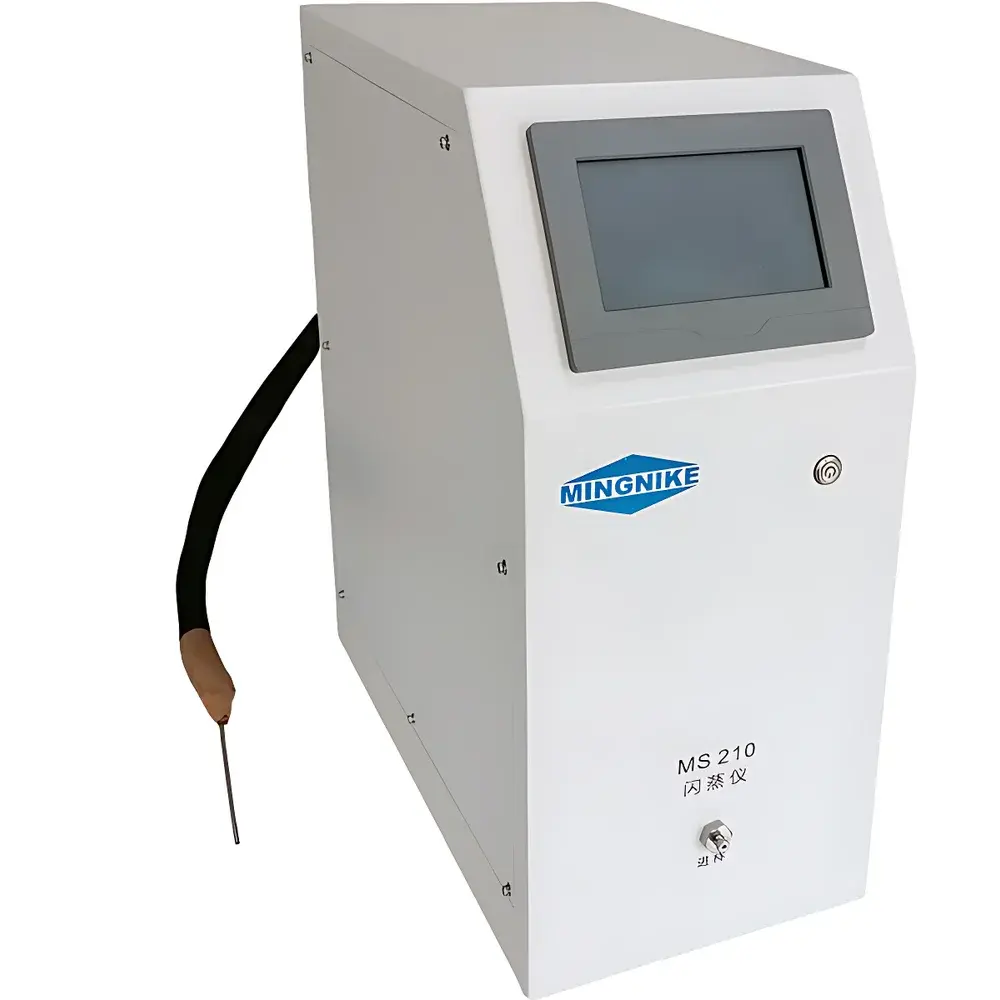
Minik MS210 Flash Vaporizer
| Brand | Minik |
|---|---|
| Model | MS210 |
| Origin | Beijing, China |
| Category | Other Chromatography Instruments |
| Application | Pre-analytical vaporization of liquid hydrocarbons for GC and coulometric Karl Fischer analysis |
| Compliance | GB/T 3727–2003, GB/T 6023–2008 |
| Liquid Inlet Pressure | 0.69–2.75 MPa |
| Output Flow Rate | 0–5 L/min (adjustable) |
| Vaporization Temperature Range | Up to 230 °C |
| Heating & Jacket Temperature Control Range | Ambient +5 °C to 230 °C |
| Temperature Control Accuracy | ±0.1 °C |
| Mass Flow Control Range | 0–100 mL/min |
| Flow Resolution | 0.1 mL/min |
| Sample Introduction | Liquid or gas phase |
Overview
The Minik MS210 Flash Vaporizer is an engineered pre-analytical interface designed specifically for the quantitative, composition-preserving phase transition of liquid hydrocarbon samples into stable, temperature- and pressure-controlled gaseous streams. It operates on the principle of rapid, isothermal flash vaporization under precisely regulated backpressure—ensuring complete volatilization without thermal degradation or fractionation. This enables direct coupling to downstream analytical systems including gas chromatographs (GC), coulometric Karl Fischer titrators, and trace gas analyzers for CO/CO₂ detection. Unlike simple heated injectors or uncontrolled evaporation modules, the MS210 maintains stoichiometric equivalence between liquid feed and vapor output across its full operational range, satisfying the fundamental requirement for quantitative hydrocarbon analysis per ISO 6425 and ASTM D2505. Its architecture is optimized for industrial petrochemical QC laboratories where repeatability, traceability, and compliance with national standards—including GB/T 3727–2003 (trace water in ethylene/propylene) and GB/T 6023–2008 (trace water in butadiene)—are mandatory.
Key Features
- Independent dual-zone thermal control: vaporization chamber and external transfer line are heated and regulated separately, eliminating cold spots and preventing condensation in sample pathways
- Mass flow meter–based output regulation with 0.1 mL/min resolution and linear 0–100 mL/min control range, enabling precise stoichiometric delivery to GC injectors or detector cells
- Robust pressure-rated liquid inlet (0.69–2.75 MPa) compatible with high-pressure liquefied petroleum gas (LPG), refinery off-gas, and polymer-grade olefin streams
- Automated system purge cycle with programmable duration and carrier gas flow, minimizing carryover between sequential analyses
- Integrated 7-inch capacitive touchscreen HMI with configurable setpoints, real-time PID status display, and event logging (temperature deviations, flow anomalies, purge activation)
- Modular construction with Swagelok®-compatible 1/8″ VCR fittings, facilitating integration into existing GC gas panels or custom analyzer manifolds
Sample Compatibility & Compliance
The MS210 supports liquid-phase introduction of C₂–C₅ hydrocarbons—including ethylene, propylene, butadiene, isobutane, and mixed LPG fractions—as well as selected polar co-feeds (e.g., methanol-doped streams for catalyst testing). Gas-phase introduction is supported for pre-vaporized or low-boiling-point feeds. All wetted materials comply with NACE MR0175/ISO 15156 for sour service environments. The instrument meets design and functional requirements outlined in GB/T 3727–2003 and GB/T 6023–2008 for trace moisture determination, and its thermal stability and flow consistency support method validation per USP and ICH Q2(R2) guidelines. Data integrity is reinforced by timestamped parameter logs stored internally (12-month retention), aligned with GLP audit expectations.
Software & Data Management
The embedded firmware supports RS-232 and optional Ethernet (Modbus TCP) communication for integration into LIMS or SCADA environments. Configuration files—including temperature ramps, purge schedules, and flow profiles—are exportable in CSV format. Audit trail functionality records all parameter changes, operator logins, and system events with immutable timestamps. While standalone operation requires no PC, optional Minik Analytical Suite v3.1 (Windows-based) provides remote monitoring, batch report generation (PDF/Excel), and deviation alerting via SMTP—fully compliant with FDA 21 CFR Part 11 when deployed with electronic signature modules and role-based access controls.
Applications
- Pre-GC conditioning of liquid olefin feeds for ASTM D2505-compliant hydrocarbon composition profiling
- Stable vapor generation for coulometric Karl Fischer water analysis in ethylene/propylene per GB/T 3727–2003
- Trace CO/CO₂ quantification in polymer-grade monomers using GC-TCD or GC-MS platforms
- Calibration gas standard generation from liquid-certified reference materials (CRMs)
- On-line process stream conditioning for refinery FCC or steam cracker off-gas monitoring
FAQ
What standards does the MS210 support for trace moisture analysis?
It is validated for use with GB/T 3727–2003 and GB/T 6023–2008, ensuring compatibility with coulometric Karl Fischer methods for hydrocarbon matrices.
Can the MS210 handle high-pressure liquefied feeds without external regulators?
Yes—the liquid inlet is rated to 2.75 MPa, permitting direct connection to pressurized cylinder sources or process taps without intermediate pressure reduction, provided upstream filtration is installed.
Is flow calibration traceable to national standards?
Mass flow sensors are factory-calibrated against NIST-traceable gravimetric standards; calibration certificates (including uncertainty budgets) are supplied with each unit.
How is cross-contamination mitigated between analyses?
The automated purge function uses inert carrier gas at user-defined flow and duration, combined with thermal soak cycles that eliminate residual condensate in the vapor path.
Does the system support 21 CFR Part 11 compliance?
When operated with the optional Minik Analytical Suite v3.1 and configured with electronic signatures, audit trails, and access controls, full Part 11 compliance is achievable.





