
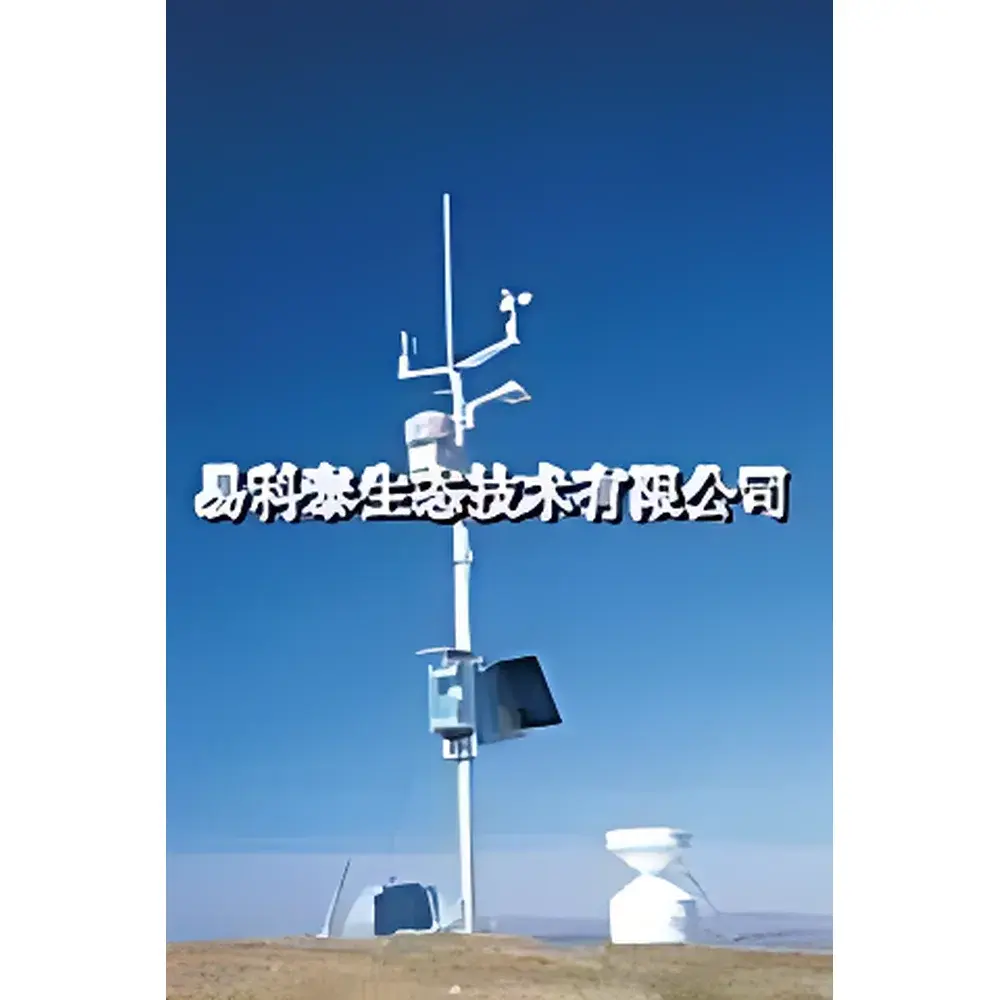
Minimet Automatic Weather Station
| Origin | UK |
|---|---|
| Manufacturer Type | Distributor |
| Origin Category | Imported |
| Model | Minimet Automatic Weather Station |
| Price | Upon Request |
Overview
The Minimet Automatic Weather Station is a modular, field-deployable environmental monitoring system engineered for long-term, unattended operation across diverse ecological and industrial settings. Built upon a robust Campbell Scientific-compatible architecture, it employs standardized analog and digital sensor interfaces to acquire high-fidelity meteorological and edaphic parameters via precision transducers and 15-bit analog-to-digital conversion. Its core measurement principle relies on calibrated physical transduction—capacitive humidity sensing, platinum resistance thermometry (PT100), ultrasonic or cup-and-vane anemometry, tipping-bucket precipitation detection, piezoresistive barometry, and tensiometric or capacitance-based soil water potential measurement. Designed for compliance with WMO observational guidelines and ISO 17025 traceability frameworks, the Minimet serves as a foundational node in distributed environmental telemetry networks, supporting regulatory monitoring, agronomic research, landfill gas dispersion modeling, and urban microclimate studies.
Key Features
- Modular data logger with selectable 6-, 7-, or 8-channel analog input capacity, supporting mixed-sensor configurations without external signal conditioning
- 1 MB non-volatile memory enabling storage of up to 27,000 timestamped records with configurable sampling intervals from 10 seconds to 12 hours
- Real-time clock with GPS- or NTP-synchronizable capability for inter-station temporal alignment in networked deployments
- Pre-terminated, IP67-rated quick-connect sensor interfaces eliminate field wiring errors and reduce installation time
- Multi-height mounting options (2 m, 3 m, and 10 m) compliant with FAO, WMO, and ASTM D5490 wind profile standards
- Flexible power architecture: primary battery operation (alkaline or lithium-thionyl chloride), optional solar panel integration with charge regulation, or AC mains backup
- Multi-mode communication: direct USB/RS232 laptop interface, PSTN modem support, GSM/GPRS telemetry, or Psion handheld terminal integration
Sample Compatibility & Compliance
The Minimet system accommodates industry-standard sensors for air temperature (−20 °C to +70 °C), relative humidity (0–100 % RH), global solar irradiance, wind speed (0.3–>75 m/s) and direction (>5 m/s threshold), rainfall (0.1/0.2/0.5 mm resolution), atmospheric pressure (500–1050 mbar), soil temperature (−20 °C to +60 °C), and soil water potential (0–850 hPa). All sensors meet IEC 60529 ingress protection requirements (IP67 minimum), and long-term drift specifications align with ISO 11464 for soil moisture instrumentation. Data integrity conforms to GLP principles; audit trails, calibration metadata tagging, and timestamp provenance are preserved in raw binary logs prior to export.
Software & Data Management
The included free standard software provides local configuration, real-time data visualization, and ASCII text export (CSV, TAB-delimited) compatible with MATLAB, R, Python pandas, and GIS platforms. Optional Advanced Network Manager supports automated scheduled downloads from up to 25 geodistributed stations, with built-in error logging and retry protocols. The Professional Edition enables statistical aggregation (e.g., 30-minute means, 24-hour min/max/mean summaries), time-series interpolation, and publication-grade plotting (PNG, SVG, PDF). Add-on modules include FAO-56 Penman-Monteith evapotranspiration calculation and irrigation scheduling logic based on soil water deficit thresholds.
Applications
- Agricultural and horticultural research: phenology tracking, frost risk assessment, irrigation scheduling, and crop water use efficiency analysis
- Ecological monitoring: microclimate characterization in protected habitats, forest edge effects, and peatland hydrology studies
- Environmental compliance: landfill cover gas migration modeling, quarry dust dispersion validation, and ambient air quality baseline establishment
- Urban climate science: heat island intensity mapping, green infrastructure performance evaluation, and building energy model input generation
- Educational deployment: undergraduate meteorology labs, citizen science networks, and remote field courses requiring portable, ruggedized instrumentation
FAQ
What is the maximum number of sensors the Minimet data logger can support?
Up to eight analog sensors may be connected simultaneously, depending on the selected logger variant (6-, 7-, or 8-channel models). Digital sensors (e.g., SDI-12 or RS-485) may extend channel capacity without consuming analog inputs.
Does the system support remote firmware updates over GSM?
Firmware updates require local physical access via USB or serial connection; however, configuration changes, data retrieval, and alarm triggers are fully supported over GSM/GPRS.
Is the soil water potential sensor suitable for long-term burial in clay soils?
Yes—the tensiometric or ceramic cup-based probes are rated for continuous burial in saturated and unsaturated clay, silt, and loam matrices, with documented stability exceeding 12 months under field conditions.
Can the station operate autonomously for one year on battery alone?
With low-power sensors and 15-minute sampling, alkaline battery packs support >6 months; lithium-thionyl chloride batteries extend this to >12 months at −20 °C ambient, especially when paired with solar assist.
Are calibration certificates provided with each sensor?
Each sensor ships with a factory calibration report traceable to NPL (UK) or NIST standards; on-site recalibration services and ISO/IEC 17025-accredited certification are available upon request.







