
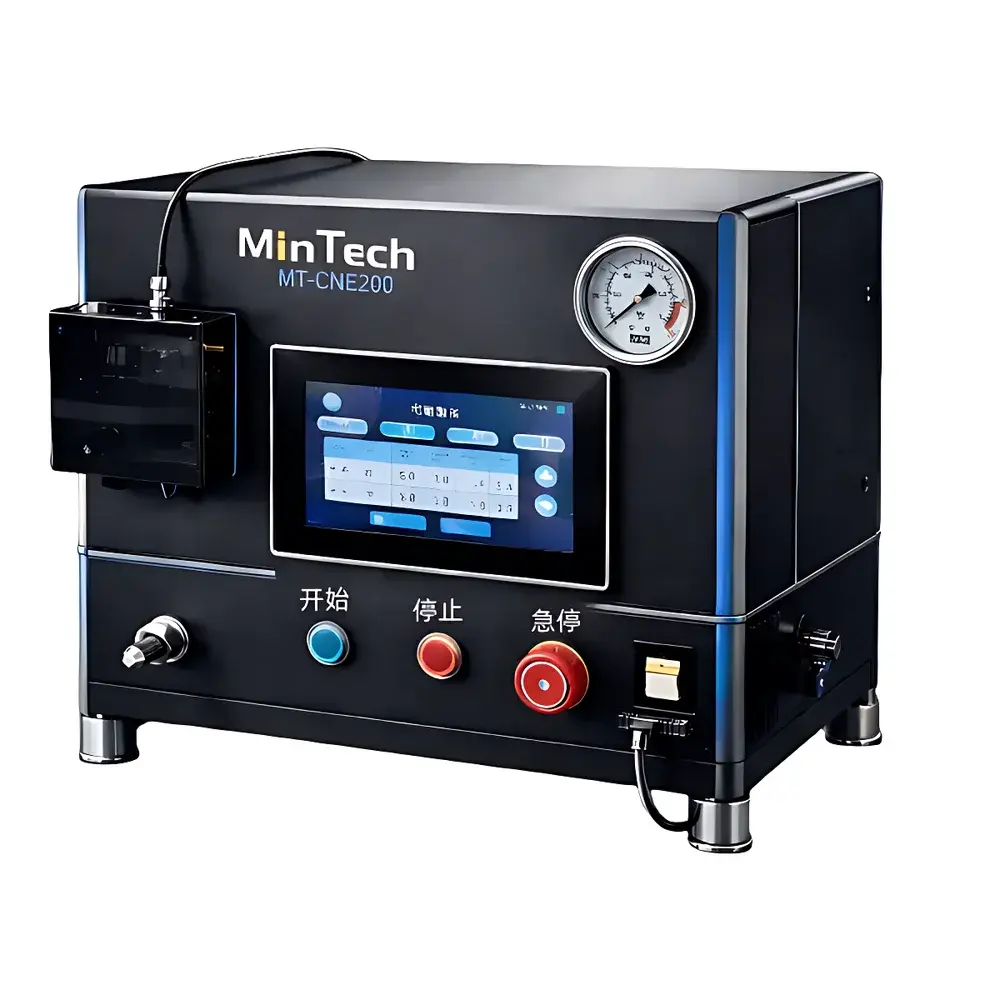
MinTech MT-CNE200 Carbon Nanoelectrode Fabrication System
| Brand | MinTech |
|---|---|
| Origin | Jilin, China |
| Manufacturer Type | Original Equipment Manufacturer (OEM) |
| Country of Origin | China |
| Model | MT-CNE200 |
| Price | Upon Request |
| Functionality | Electrode Fabrication & Thermal Annealing |
| R<sub>G</sub> Ratio | As low as 1.1 |
| Template Material | Fused Silica Quartz |
| Tip Diameter Range | 10 nm – 50 µm (Optimized for 200–500 nm) |
| Electrode Types | Carbon Nanoelectrodes, Carbon Micronelectrodes, Carbon Nanotip Electrodes, Derivative Electrodes (Metallic Nanoelectrodes, Metal Oxide Nanoelectrodes) |
| Dimensions | 480 × 340 × 320 mm |
| Weight | ~20 kg |
Overview
The MinTech MT-CNE200 Carbon Nanoelectrode Fabrication System is a precision-engineered platform designed for the controlled synthesis and post-processing of carbon-based micro- and nanoscale electrochemical transducers. It operates on the principle of catalytic chemical vapor deposition (CVD) combined with localized resistive heating and in-situ thermal annealing within a high-purity quartz template architecture. Unlike conventional electrode fabrication methods relying on lithography or mechanical pulling, the MT-CNE200 enables bottom-up growth of carbon nanostructures—such as graphitic nanotips, bamboo-like multi-walled carbon nanotubes (MWCNTs), and amorphous carbon microrods—directly inside pulled quartz capillaries. This process yields electrodes with reproducible geometry, sub-50 nm tip radii, and an exceptionally low geometric resistance ratio (RG ≤ 1.1), critical for minimizing ohmic drop and maximizing signal-to-noise ratio in ultrafast voltammetry and single-entity electrochemistry.
Key Features
- Integrated dual-mode fabrication: simultaneous carbon deposition and in-chamber resistive annealing for structural graphitization and defect reduction
- Fused silica quartz templates with calibrated taper profiles supporting tip diameters from 10 nm to 50 µm; optimal performance validated at 200–500 nm range
- Programmable temperature ramping (up to 1200 °C) with ±2 °C thermal stability for controlled sp²-carbon formation
- Gas-tight reaction chamber compatible with inert (Ar, N₂), reducing (H₂/Ar), and reactive (CH₄, C₂H₂) atmospheres
- Modular electrode handling stage enabling precise alignment of capillary templates relative to filament heater and gas inlet nozzles
- Compact benchtop footprint (480 × 340 × 320 mm) and lightweight design (~20 kg) for integration into shared lab environments and cleanroom-compatible workflows
Sample Compatibility & Compliance
The MT-CNE200 supports fabrication of carbon electrodes and their functionalized derivatives—including Pt, Au, IrOx, and MnO2 nanoelectrodes—via sequential deposition and annealing protocols. All internal wetted surfaces are constructed from high-purity fused silica and high-temperature ceramics, ensuring minimal metal ion leaching and compatibility with trace-level electroanalytical applications. The system adheres to ISO/IEC 17025 general requirements for calibration traceability of thermal sensors and gas flow controllers. While not certified for GMP production, its operational logs, parameter locking, and manual intervention timestamps support GLP-compliant documentation for academic and preclinical research use. It meets CE electromagnetic compatibility (EMC) directives and conforms to IEC 61010-1 safety standards for laboratory electrical equipment.
Software & Data Management
The MT-CNE200 is operated via a Windows-based control interface featuring real-time monitoring of furnace temperature, gas flow rates (mass flow controllers, ±1% FS accuracy), vacuum level, and deposition time. All experimental parameters—including ramp rate, dwell time, gas composition sequences, and annealing profiles—are saved in timestamped .csv files with SHA-256 checksums for audit integrity. Exported datasets are structured for direct import into MATLAB, Python (Pandas), or OriginLab for kinetic modeling of carbon nucleation and growth. The software includes user role management (admin/operator), password-protected method libraries, and optional export of metadata in ISA-Tab format to align with FAIR data principles.
Applications
- Preparation of ultramicroelectrodes (UMEs) for scanning electrochemical microscopy (SECM) and feedback-mode imaging of biological membranes
- Synthesis of carbon nanotip electrodes for high-temporal-resolution amperometric detection of neurotransmitters (e.g., dopamine, serotonin) with sub-millisecond response
- Development of hybrid carbon/metal oxide interfaces for non-enzymatic glucose sensing and Li–S battery redox mediator characterization
- Generation of site-isolated carbon nanoelectrode arrays for parallelized single-cell electrophysiology and intracellular electron transfer studies
- Fabrication of reference-free quasi-reference counter electrode (QRCE) configurations in microfluidic electrochemical cells
FAQ
What types of carbon structures can be synthesized using the MT-CNE200?
The system produces graphitized carbon nanotips, amorphous carbon microrods, bamboo-structured MWCNTs, and hybrid carbon–metal/metal oxide composites, depending on precursor gas selection, temperature profile, and template geometry.
Is the system compatible with standard borosilicate or aluminosilicate capillaries?
No—only high-purity fused silica quartz templates (OH-content < 1 ppm) are supported due to thermal expansion mismatch and carbon contamination risks associated with other glasses.
Can RG be measured in situ during fabrication?
RG is not measured in real time; it is determined post-fabrication via cyclic voltammetry in standardized redox mediators (e.g., 1 mM ferrocene in acetonitrile) using a known diffusion coefficient.
Does the MT-CNE200 support automated batch processing?
Batch mode is available via scriptable sequence execution, but physical template loading/unloading remains manual to preserve tip integrity and avoid cross-contamination.
What maintenance is required for long-term calibration stability?
Annual recalibration of thermocouples and mass flow controllers is recommended; quartz template holders should be inspected for carbon residue buildup after every 50 fabrication cycles.
Related Products




