
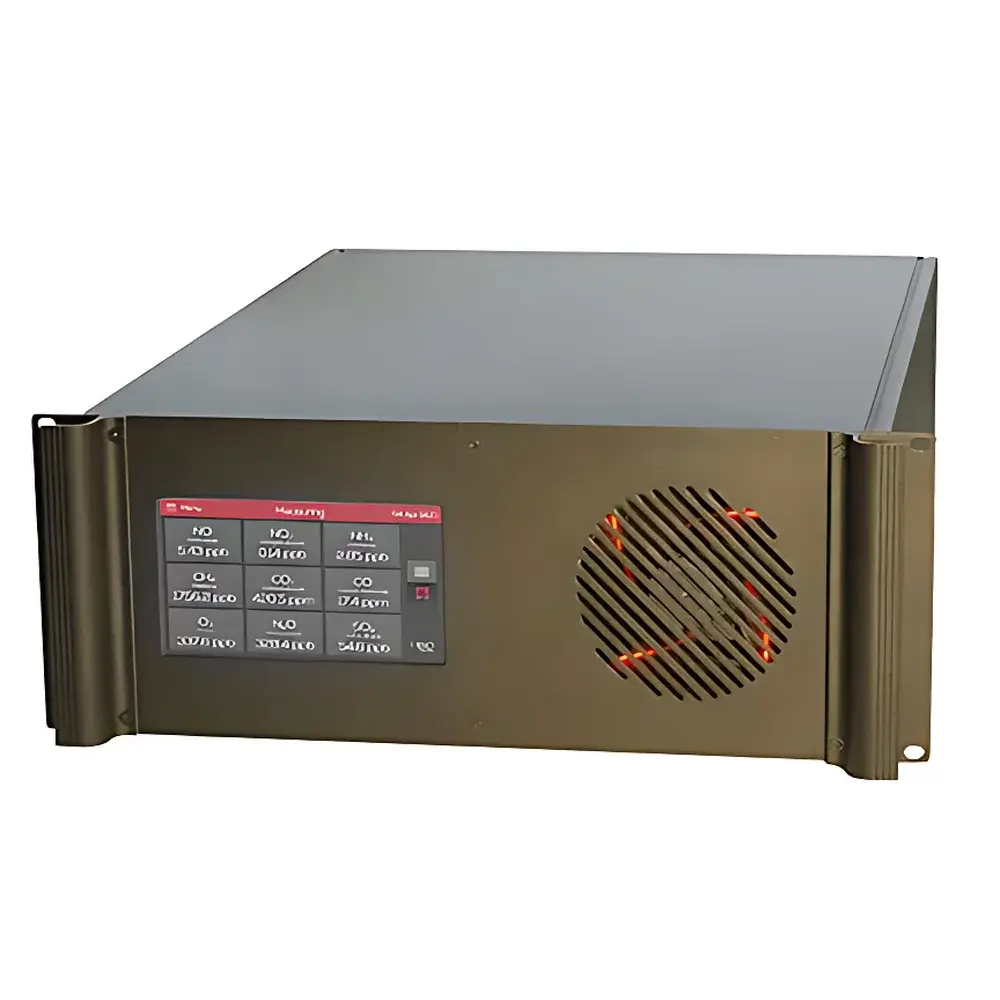
MIRO MGA-5 High-Precision Multi-Gas Analyzer for CO, CO₂, CH₄, N₂O, and H₂O
| Origin | Switzerland |
|---|---|
| Manufacturer Type | Authorized Distributor |
| Origin Category | Imported |
| Model | MGA-5 |
| Pricing | Upon Request |
| Measurement Principle | Time-Multiplexed Intermittent Continuous-Wave Quantum Cascade Laser Absorption Spectroscopy (TM-ICW-QCL) |
| Sampling Frequency | 1 Hz |
| Detection Limits (1 s) | CO: 0.4 ppb, CO₂: 0.8 ppm, CH₄: 1 ppb, N₂O: 0.5 ppb, H₂O: 40 ppm |
| Detection Limits (200 s) | CO: 0.07 ppb, CO₂: 0.08 ppm, CH₄: 0.2 ppb, N₂O: 0.1 ppb, H₂O: 6 ppm |
| Measurement Ranges | CO: 0–20 ppm, CO₂: 0–8000 ppm, CH₄: 0–200 ppm, N₂O: 0–20 ppm, H₂O: 0–10 %v/v |
| Maximum Drift (12 h) | CO: 1 ppb, CO₂: 1 ppm, CH₄: 5 ppb, N₂O: 2 ppb, H₂O: 120 ppm |
| Operating Temperature | –10 to +45 °C |
| Relative Humidity | < 90 % RH (non-condensing) |
| Pressure Range | 700–1050 mbar |
| Sample Flow Rate | 0.5–1.5 L/min (high-flow option available) |
| Power Supply | 220 VAC, 50 Hz, < 450 W |
| Dimensions (Analyzer) | 48 W × 18 H × 62 D cm |
| Weight (Analyzer) | 20 kg |
| (Cooling Unit) | 11 kg |
| (Vacuum Pump) | 9 kg |
| Safety Certifications | CE-marked per IEC 61010-1:2010, IEC 61326-1:2012, IEC 60825:2019 |
Overview
The MIRO MGA-5 is a field-deployable, high-precision multi-gas analyzer engineered for continuous, simultaneous quantification of carbon monoxide (CO), carbon dioxide (CO₂), methane (CH₄), nitrous oxide (N₂O), and water vapor (H₂O) in ambient air and ecosystem flux studies. It employs time-multiplexed intermittent continuous-wave quantum cascade laser absorption spectroscopy (TM-ICW-QCL), a robust mid-infrared optical technique that delivers exceptional selectivity and sensitivity by targeting fundamental vibrational absorption lines of each target gas. Unlike broadband or filter-based methods, TM-ICW-QCL eliminates spectral interference through precise wavelength tuning and temporal separation of detection channels—enabling true simultaneous measurement without cross-sensitivity artifacts. Designed explicitly for long-term atmospheric monitoring, the MGA-5 meets the stringent accuracy requirements defined by the World Meteorological Organization (WMO) for Global Atmosphere Watch (GAW) baseline stations, including specifications for CO (±0.5 ppb, 1 s), CH₄ (±1 ppb), CO₂ (±0.8 ppm), N₂O (±0.5 ppb), and H₂O (±40 ppm). Its ability to replace dual-instrument configurations—e.g., separate CO/CH₄/N₂O and CO₂/H₂O analyzers—reduces operational complexity, calibration overhead, and spatial footprint while maintaining metrological traceability to SI units via NIST-traceable reference gases.
Key Features
- Simultaneous, real-time measurement of five climate-relevant gases at 1 Hz acquisition rate—optimized for eddy covariance, chamber, and mobile platform applications.
- Ultra-low detection limits validated using Allan–Werle deviation analysis: sub-ppt-level precision for N₂O and CH₄ over 200 s averaging windows.
- Integrated temperature-controlled sample conditioning with active cooling and vacuum pumping ensures stable pressure, humidity control (<90% RH, non-condensing), and minimal memory effects.
- Ruggedized mechanical architecture with shock-mounted optics and vibration-damped laser mounts supports deployment on aircraft, research vessels, and remote terrestrial observatories.
- Compliance with international safety standards (IEC 61010-1, IEC 61326-1, IEC 60825) and electromagnetic compatibility (EMC) directives for unattended operation in mixed-signal laboratory and field environments.
Sample Compatibility & Compliance
The MGA-5 accepts untreated ambient air across its full operational range (–10 to +45 °C, 700–1050 mbar, <90% RH non-condensing). No chemical scrubbing or catalytic conversion is required prior to analysis—preserving native isotopic and concentration integrity of all target species. Its measurement protocols align with ISO 14644-1 (cleanroom air quality), ASTM D6348 (gas chromatographic validation), and WMO GAW Data Quality Objectives (DQOs) for greenhouse gas networks. For regulated environmental reporting, raw data streams support audit-ready metadata tagging—including timestamp synchronization (PTP v2.1), instrument status flags, and diagnostic logs—ensuring compliance with GLP and EPA Method TO-15 supplemental criteria. All firmware and calibration routines are version-controlled and documented per ISO/IEC 17025:2017 Annex A.3 requirements.
Software & Data Management
Data acquisition and instrument control are managed via MIRO’s proprietary QCL-Studio software suite, compatible with Windows 10/11 and Linux LTS distributions. The interface provides real-time spectral visualization, automated zero/span validation, and drift-compensation algorithms based on internal reference cell monitoring. Raw absorbance spectra and concentration time series are exported in NetCDF-4 format with CF-1.8 metadata conventions, enabling direct ingestion into FluxNet, ICOS, and NOAA GML processing pipelines. Remote diagnostics, firmware updates, and secure TLS 1.3-enabled data streaming are supported through optional Ethernet or LTE modules. Audit trails—including user login history, parameter modifications, and calibration event timestamps—are retained for ≥12 months and exportable as CSV for FDA 21 CFR Part 11-compliant environments.
Applications
- Long-term atmospheric composition monitoring at WMO GAW stations and regional background sites.
- Ecosystem-scale carbon and nitrogen flux partitioning using eddy covariance towers equipped with fast-response sampling manifolds.
- Mobile surveys of urban emissions, landfill plumes, agricultural zones, and wetland methane hotspots.
- Calibration transfer and intercomparison campaigns involving CRDS, FTIR, and GC-MS reference systems.
- Process monitoring in biogas upgrading facilities and carbon capture pilot plants requiring concurrent CO/CO₂/CH₄/H₂O tracking.
FAQ
Does the MGA-5 require external calibration gases during routine operation?
No—its built-in reference cell enables continuous wavelength stabilization and drift correction. Certified calibration gases are recommended annually or after major maintenance for traceability verification.
Can the MGA-5 be integrated with existing eddy covariance data loggers?
Yes—it outputs ASCII-formatted serial data via RS232 and supports configurable packet structure (e.g., Campbell Scientific CR1000X-compatible framing) with sub-millisecond timestamp alignment.
Is H₂O measurement affected by condensation in high-humidity environments?
The integrated thermoelectric cooler maintains sample dew point below –10 °C, preventing condensation across the full 0–10% v/v range—even at ambient RH up to 90% (non-condensing).
What is the typical warm-up time before achieving specified accuracy?
Full thermal and spectral stabilization is achieved within 45 minutes of power-on under standard lab conditions; field deployments with ambient temperature gradients may require up to 90 minutes.
How is data integrity ensured during power interruptions?
The system includes an embedded non-volatile memory buffer (≥72 h at 1 Hz) and automatic recovery upon restart—preserving all unsaved spectra and concentration values without gaps.







