
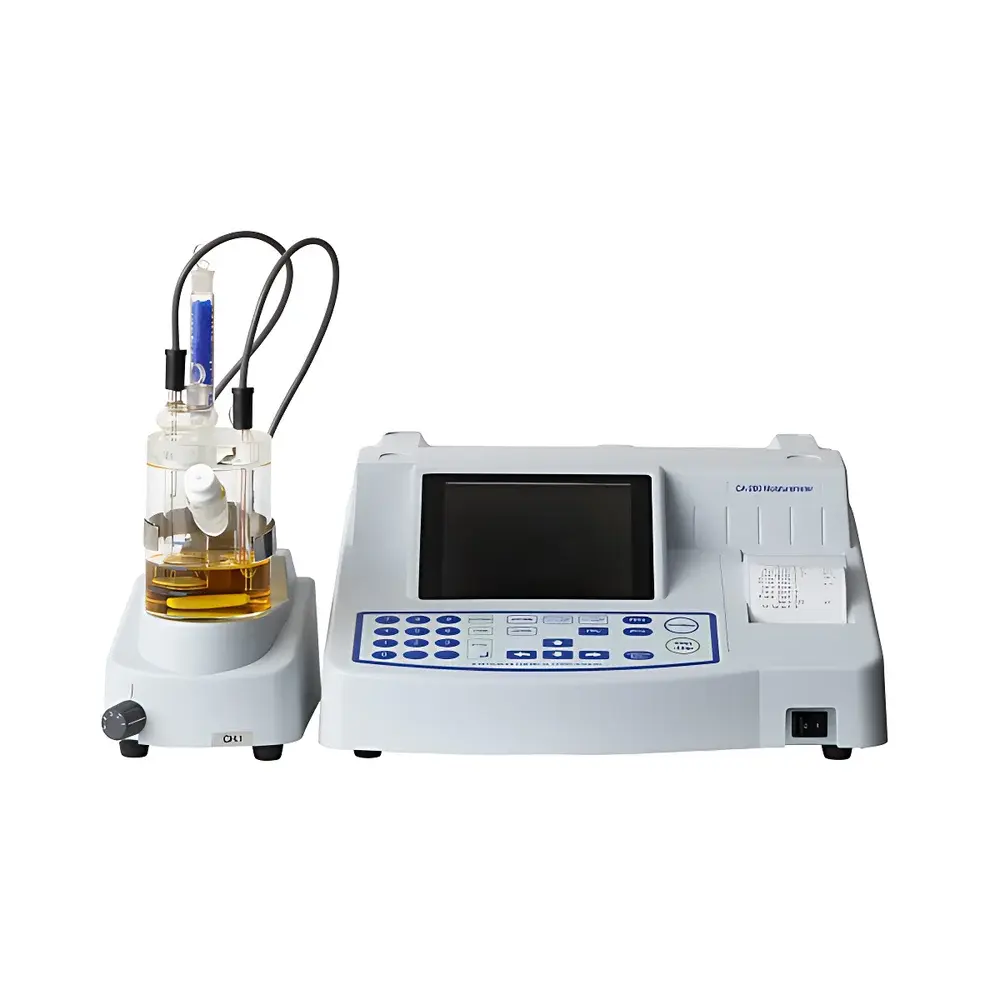
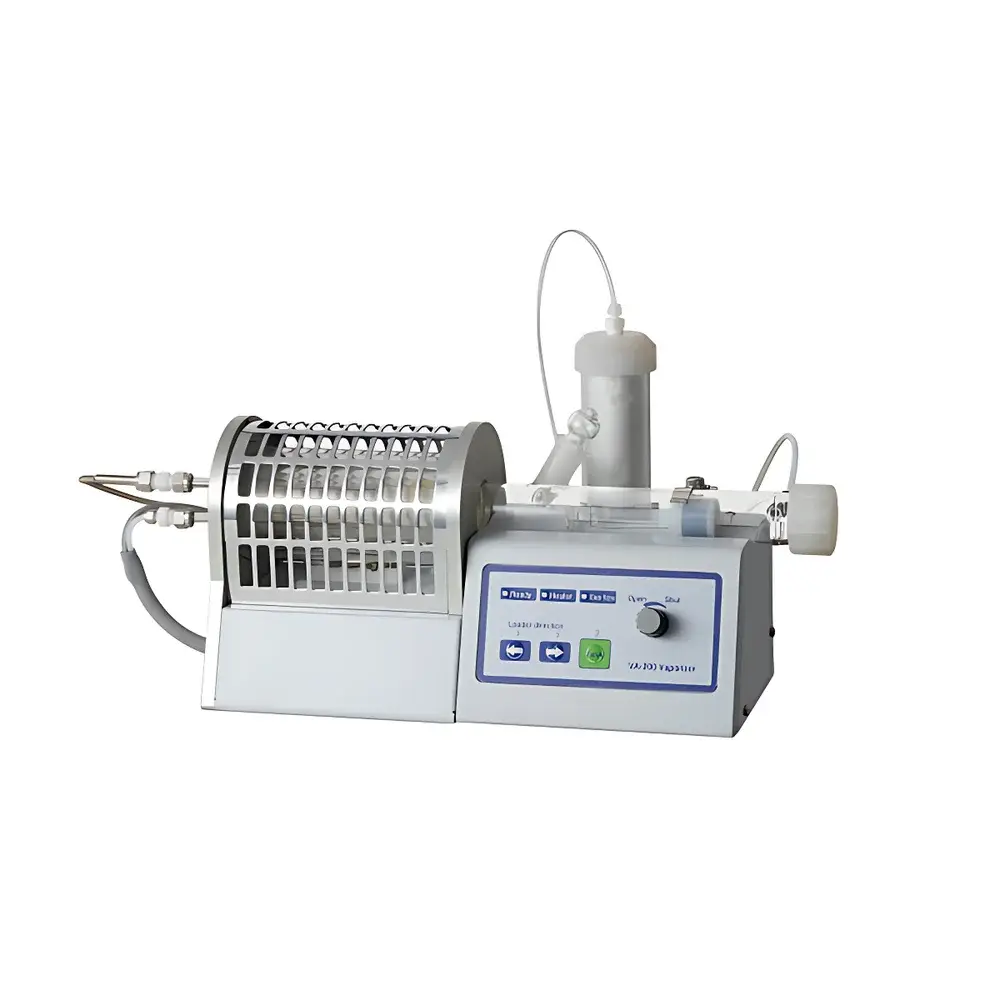
MITSUBISHI CHEMICAL CA-200 Coulometric Karl Fischer Moisture Analyzer
| Brand | MITSUBISHI CHEMICAL |
|---|---|
| Origin | Japan |
| Model | CA-200 |
| Measurement Principle | Coulometric Karl Fischer Titration |
| Water Content Range | 10 µg – 100 mg H₂O |
| Accuracy | ≤ 0.3% RSD (for ≥1 mg H₂O, n=10) |
| Minimum Dispensing Volume | 1/2000 of burette volume |
| Electrolysis Current | 430 mA |
| Average Titration Speed | 2.2 mg H₂O/min |
| Display | 5.7-inch color LCD |
| Data Storage | 20 user-defined methods × 50 sub-files each |
| Interface | RS-232C (optional), USB storage port, balance input |
| Power Supply | AC 100–120 V / 230–240 V, 50/60 Hz |
| Dimensions (Analyzer) | 220 × 350 × 360 mm (W×D×H) |
| Weight | ~5 kg |
Overview
The MITSUBISHI CHEMICAL CA-200 is a high-precision coulometric Karl Fischer moisture analyzer engineered for trace-to-macro-level water quantification in diverse industrial and research laboratories. It operates on the electrochemical principle of coulometric Karl Fischer titration—where iodine is generated *in situ* via controlled electrolysis of iodide ions at the anode, reacting stoichiometrically with water in the titration cell (1 mole I₂ ≡ 1 mole H₂O). This method delivers exceptional specificity for water without interference from solvents or matrix components, making it the reference technique per ASTM E203, ISO 760, USP , and EP 2.5.2. Designed as the successor to the CA-100, the CA-200 integrates enhanced hardware stability, automated electrode maintenance logic, and expanded sample handling flexibility—particularly when paired with the VA-200 vaporizer for thermally labile or heterogeneous solids such as elastomers, polymers, and pharmaceutical excipients.
Key Features
- Dual-Channel Expandability: Supports configuration with two independent titration cells, dual generator electrodes, or dual vaporizers—enabling parallel analysis or method cross-validation without hardware replacement.
- Self-Optimizing Electrode Management: Real-time polarization monitoring and automatic current compensation eliminate manual electrode cleaning, ensuring consistent endpoint detection across extended operation cycles.
- Intelligent Stirring System: Five-step magnetic stirrer with closed-loop speed regulation maintains stable vortex formation across viscosity ranges—from low-viscosity solvents to viscous polymer melts—minimizing diffusion boundary effects.
- Modular Reagent Handling: Optional reagent exchange module enables one-touch purge-and-refill of the titration cell, reducing downtime during routine maintenance and preventing cross-contamination between samples.
- Open Calculation Architecture: Users define custom calculation formulas (e.g., % moisture, ppm H₂O, absolute mass, normalized per unit surface area) directly in the instrument firmware—results display automatically upon assay completion.
- Flexible Electrode Selection: Compatible with both membrane-free and membrane-type generator electrodes: the former simplifies operation with single-component AQUAMICRON reagents; the latter extends applicability to ketones, aldehydes, and carboxylic acids that hydrolyze or react with conventional reagents.
- Integrated Thermal Vaporization Support: Native synchronization with the VA-200 oven (70–300 °C, programmable ramping, N₂ carrier gas flow 0.1–0.5 L/min) ensures quantitative water release from rubber, plastics, powders, and hygroscopic salts without thermal degradation.
Sample Compatibility & Compliance
The CA-200 accommodates gases (e.g., propane, vinyl chloride), liquids (transformer oil, lubricants, solvents), and solids (rubber compounds, pharmaceutical tablets, metal oxides, clays, welding rods) via direct injection, oven coupling, or headspace sampling. Its compliance framework supports GLP and GMP environments through audit-trail-enabled data logging (time-stamped method parameters, raw titration curves, operator ID, balance integration timestamps), electronic signature readiness (when used with validated PC software), and adherence to FDA 21 CFR Part 11 requirements for electronic records. All measurement protocols align with ISO/IEC 17025 calibration traceability pathways when operated with certified reference materials (e.g., sodium tartrate dihydrate, water-in-methanol standards).
Software & Data Management
Data acquisition and reporting are managed via embedded firmware with non-volatile memory supporting 200 full assay records—including titration curves, endpoint voltages, drift corrections, and calculated values. Each of the 20 configurable methods stores up to 50 sub-protocols (e.g., different temperature ramps for VA-200, variable stirring speeds, custom blank subtraction routines). Results export seamlessly to USB flash drives in CSV format for LIMS integration or statistical review. Optional PC-based software provides advanced curve fitting, multi-point calibration management, trend analysis over time, and automated report generation compliant with internal QA templates or regulatory submission formats.
Applications
The CA-200 is routinely deployed in quality control laboratories across sectors requiring strict moisture control: in rubber and polymer manufacturing (ASTM D6980 for vulcanized elastomers), pharmaceutical solid-dose production (USP for API and excipient qualification), petrochemical refining (ASTM D6304 for insulating oils), food ingredient certification (AOAC 992.17 for starches and flours), and electronics-grade chemical supply (SEMI F57 for solvents). Its ability to quantify water down to 10 µg makes it indispensable for lithium battery electrolyte purity testing and catalyst support drying validation.
FAQ
What sample types require the VA-200 vaporizer?
Solid or semi-solid samples with low water volatility (e.g., rubber, thermoplastics, ceramics, hygroscopic salts) must be coupled with the VA-200 to ensure complete and reproducible water release prior to coulometric detection.
Can the CA-200 measure water in ketone-containing solvents?
Yes—but only when equipped with a membrane-type generator electrode and optimized two-component Karl Fischer reagent to prevent side reactions; method validation per ISO 15512 is recommended.
Is balance integration mandatory for accurate results?
While optional, automatic balance input via RS-232 or analog interface is strongly recommended for solid and viscous liquid analyses to eliminate manual entry errors and enable mass-normalized reporting.
How often should the titration cell be cleaned?
Under normal use with AQUAMICRON reagents, cell cleaning intervals exceed 200 assays; the instrument’s self-diagnostic function alerts users when electrode passivation or electrolyte saturation thresholds are approached.
Does the CA-200 support remote diagnostics or network connectivity?
Native Ethernet or Wi-Fi is not included; however, RS-232C and USB interfaces allow integration into centralized lab networks via middleware or custom OPC-UA drivers deployed on external PCs.





