
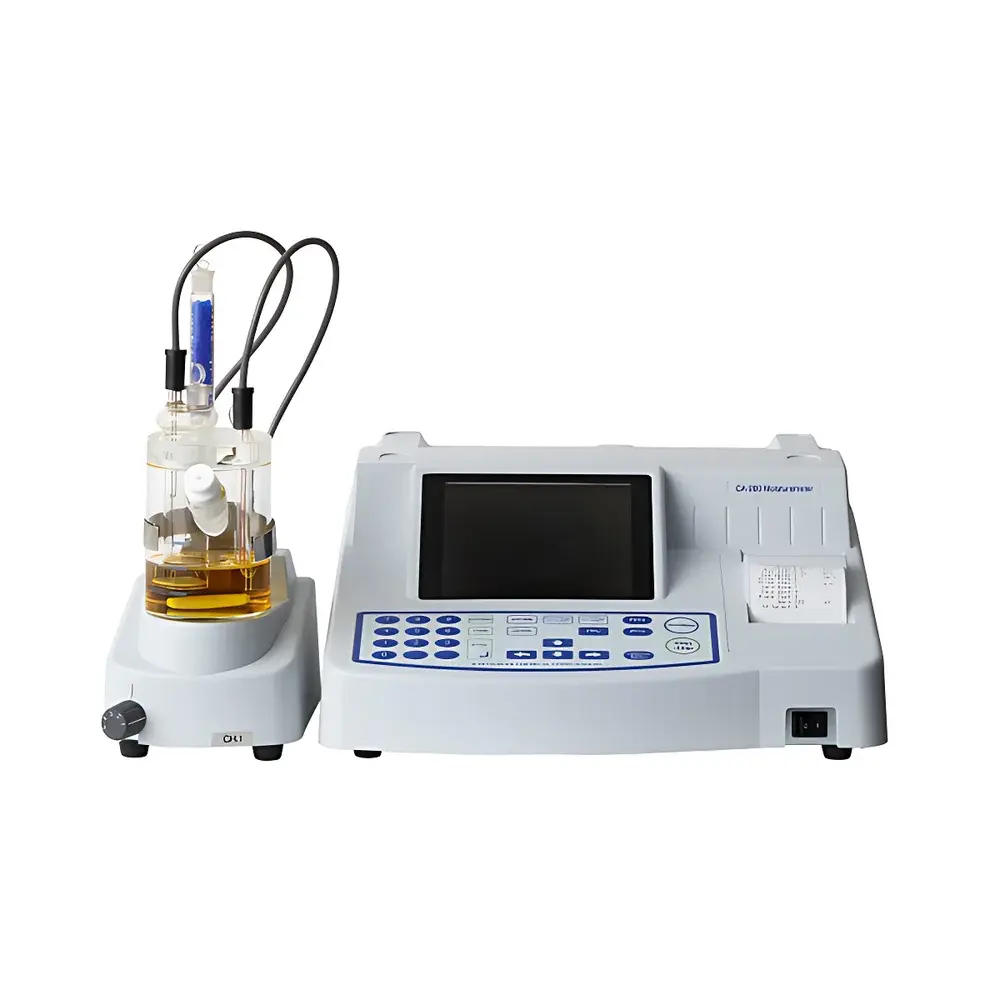
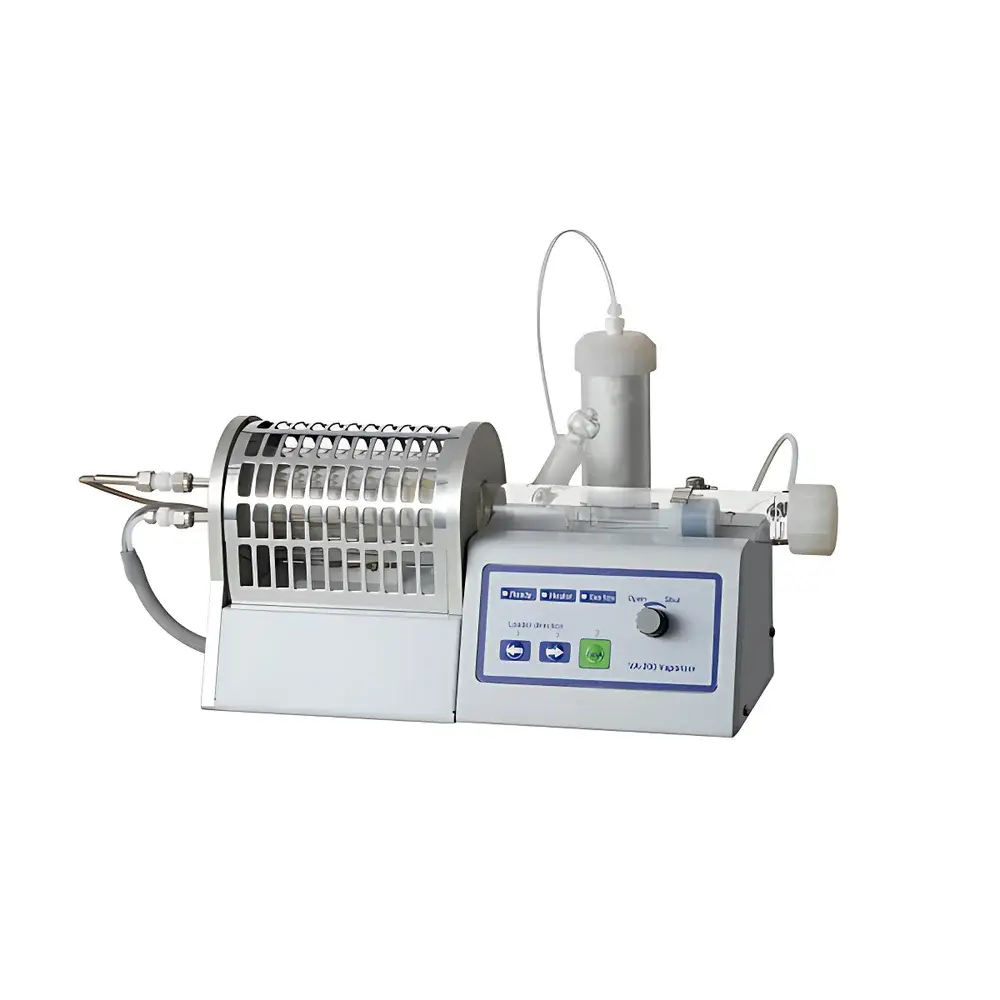
MITSUBISHI CHEMICAL CA-200 Coulometric Karl Fischer Moisture Analyzer
| Brand | MITSUBISHI CHEMICAL |
|---|---|
| Origin | Japan |
| Model | CA-200 |
| Measurement Principle | Coulometric Karl Fischer Titration |
| Water Content Range | 10 µg – 100 mg H₂O |
| Accuracy | ≤ 0.3% RSD (for ≥1 mg H₂O, n=10) |
| Minimum Dispensing Volume | 1/2000 of burette volume |
| Electrolysis Current | 430 mA |
| Average Titration Speed | 2.2 mg H₂O/min |
| Display | 5.7-inch color LCD |
| Dimensions (Analyzer) | 220 × 350 × 360 mm (W×D×H) |
| Weight | ~5 kg |
| Power Supply | AC 100–120 V / 230–240 V, 50/60 Hz |
| VA Consumption | 80 VA (100–120 V), 310 VA (230–240 V) |
Overview
The MITSUBISHI CHEMICAL CA-200 is a high-precision coulometric Karl Fischer moisture analyzer engineered for trace- to macro-level water quantification in diverse industrial and research laboratories. It operates on the electrochemical principle of coulometric Karl Fischer titration—where iodine is generated *in situ* via controlled electrolysis of iodide ions in the anolyte, reacting stoichiometrically with water according to the classic Karl Fischer reaction: I₂ + SO₂ + H₂O + 3RN + CH₃OH → 2RN·HI + RN·HSO₄CH₃. This method delivers exceptional specificity for water, eliminating interference from solvents, volatile organics, or matrix components common in complex samples such as polymers, pharmaceuticals, and petrochemicals. Designed as the successor to the CA-100 series, the CA-200 integrates refined electrode architecture, adaptive current control, and real-time endpoint detection to ensure robust reproducibility across extended operational cycles—particularly critical in regulated environments requiring adherence to ASTM E203, ISO 760, USP , and EP 2.5.1.
Key Features
- Dual-Channel Expandability: Supports connection of two independent titration cells, dual volumetric burettes, or paired vaporization units (e.g., VA-200), enabling parallel analysis without hardware duplication.
- Intelligent Electrode Management: Automatic polarization compensation and impurity drift correction eliminate manual electrode cleaning, maintaining baseline stability during prolonged runs.
- Five-Stage Magnetic Stirring: Precision-controlled stirring platform with five smooth speed settings ensures homogeneous mixing and consistent mass transfer at the electrode surface—critical for low-moisture (<50 µg) determinations.
- Modular Reagent Handling: Optional reagent dispensing/purging unit enables one-touch replacement of spent electrolyte, minimizing downtime and operator exposure to hygroscopic reagents.
- Open-Formula Configuration: User-definable calculation protocols (e.g., % w/w, ppm, absolute µg) allow direct reporting of application-specific results without post-processing.
- Flexible Electrode Options: Compatible with both membrane-free electrodes (optimized for AQUAMICRON single-component reagents) and diaphragm-type electrodes (enabling analysis of ketones, aldehydes, and low-hydroxyl acids per ISO 15512 Annex B).
- Integrated Thermal Printer: Real-time hardcopy output includes timestamp, sample ID, method parameters, titration curve, final result, and statistical summary—supporting audit-ready documentation.
Sample Compatibility & Compliance
The CA-200, when coupled with the VA-200 heated vaporizer (70–300 °C, transparent conductive glass heater), achieves quantitative water release from thermally stable solids including polyolefins, engineering resins (e.g., PA6, PBT), elastomers, inorganic salts, metal oxides, and pharmaceutical excipients. For liquid and gaseous matrices—including transformer oil, LPG (propane/butane), vinyl chloride, and food-grade syrups—the system supports direct injection or gas-phase sparging. All operational parameters, calibration records, and result logs are structured to support GLP and GMP compliance, including full audit trail capability (when interfaced via RS-232C or USB to validated LIMS). The instrument meets IEC 61010-1 safety standards and is CE-marked for laboratory use in the EU.
Software & Data Management
The embedded firmware supports up to 20 customizable method files, each containing 50 sub-protocols—accommodating multi-step procedures (e.g., pre-titration dry-down, dual-stage heating, solvent blank subtraction). Measurement data (200 entries max) are stored with metadata: operator ID, ambient humidity, balance integration timestamp, and raw current/time profiles. USB host port enables export of CSV-formatted reports for external statistical review. Optional PC software (via RS-232C) provides enhanced trend analysis, SPC charting, and 21 CFR Part 11-compliant electronic signature workflows when deployed in FDA-regulated facilities.
Applications
- Polymer manufacturing: QC of hygroscopic resins (PET, PC, ABS) prior to extrusion or injection molding.
- Pharmaceutical development: Residual moisture verification in APIs and lyophilized products per ICH Q5C.
- Energy sector: Water-in-oil analysis for turbine oils, insulating fluids, and biofuels per ASTM D6304.
- Food safety labs: Quantification of bound water in starches, dairy powders, and dehydrated vegetables.
- Electronics materials: Moisture screening of solder pastes, conformal coatings, and encapsulation resins.
- Academic research: Kinetic studies of hydrolysis reactions and desorption isotherms in porous media.
FAQ
What distinguishes coulometric from volumetric Karl Fischer titration?
Coulometric KF generates iodine electrochemically within the titration cell, making it ideal for samples containing ≤100 mg water; it offers superior precision at trace levels (down to 10 µg) without burette calibration drift.
Can the CA-200 analyze samples containing acetone or methanol?
Yes—when equipped with a diaphragm electrode and appropriate two-component reagent (e.g., AQUAMICRON Type C), it reliably measures water in ketones and alcohols per ISO 15512 guidelines.
Is balance integration mandatory?
No—while automatic mass input from analytical balances (via RS-232) is supported, manual entry of sample weight is fully functional for fixed-weight protocols.
How often does the electrolyte require replacement?
Under typical usage (≤10 analyses/day), the anolyte remains stable for 7–14 days; the optional reagent purge module reduces maintenance intervals by >40%.
Does the system support IQ/OQ/PQ documentation?
Yes—MITSUBISHI CHEMICAL provides vendor-validated protocol templates aligned with ASTM E2500 and EU GMP Annex 15 for installation, operational, and performance qualification.
Related Products






