
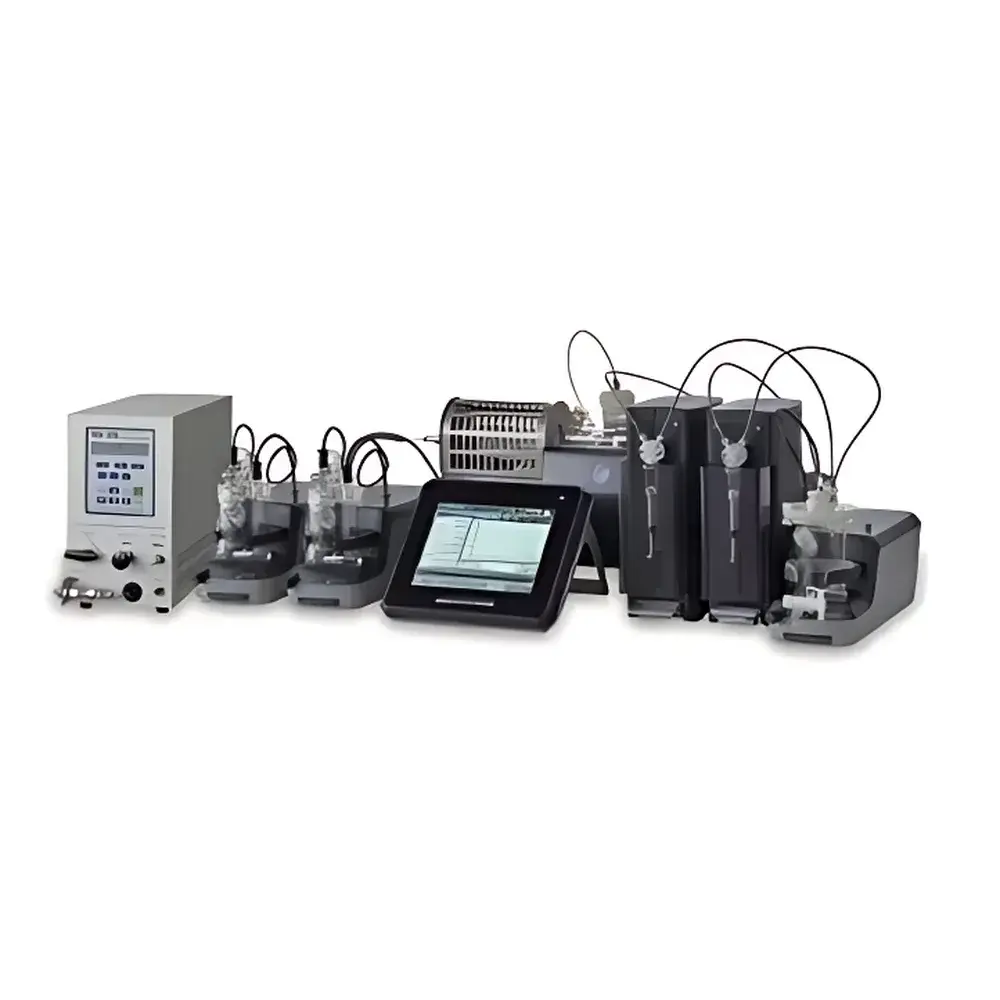
Mitsubishi Chemical CVS-230 Universal Trace Moisture Detection System
| Brand | Mitsubishi Chemical |
|---|---|
| Origin | Japan |
| Model | CVS-230 |
| Titration Method | Fully Automated Coulometric Karl Fischer Titration |
| Instrument Type | Coulometric Karl Fischer Moisture Analyzer |
| Measurement Resolution | ±0.1 μA |
| Water Content Range | 0.5 μg to 999.9999 mg |
| Accuracy | <0.3% RSD |
| Minimum Dispensing Volume | 0 μL |
| Titration Control Precision | 0 (coulometric, current-controlled, no reagent dispensing) |
Overview
The Mitsubishi Chemical CVS-230 Universal Trace Moisture Detection System is an advanced coulometric Karl Fischer (KF) analyzer engineered for quantitative determination of trace water content across solid, liquid, and gaseous samples within a single integrated platform. Unlike conventional volumetric or hybrid KF systems, the CVS-230 operates exclusively on the coulometric principle—electrolytically generating iodine in situ via controlled current application to the generator electrode. This eliminates mechanical bureette variability and ensures exceptional reproducibility for ultra-low moisture quantification (down to 0.5 μg). The system’s architecture supports simultaneous, independent analysis across four dedicated sample introduction pathways—solid, viscous liquid, standard liquid, and gas—enabling laboratories to maintain rigorous moisture control protocols across diverse material classes without instrument reconfiguration or method recalibration.
Key Features
- Four physically isolated, function-specific detection channels: solid-sample oven module with programmable temperature ramping (up to 300 °C), viscous-liquid injection port with heated syringe path, standard liquid titration cell with dual-electrode KF cell, and gas-phase sampling interface with mass-flow controlled carrier gas integration.
- 8.4-inch high-resolution color touchscreen HMI providing real-time visualization of all active channels—including current waveform, titration curve, endpoint stability index, and cumulative charge (Coulombs) converted to μg H₂O.
- Embedded data management system compliant with ALCOA+ principles: stores up to 9,999 complete analytical records with timestamp, operator ID, method name, raw current/time data, and final result—all encrypted and non-editable post-analysis.
- Multi-tier user account structure supporting administrator, supervisor, and analyst roles with configurable access rights to method editing, calibration logging, data export, and audit trail review—fully aligned with FDA 21 CFR Part 11 requirements for electronic records and signatures.
- Modular hardware design allows field-upgradable channel expansion and independent maintenance—minimizing downtime during routine service or validation activities.
Sample Compatibility & Compliance
The CVS-230 accommodates heterogeneous sample matrices without solvent exchange or derivatization. Solid samples—including polymers, pharmaceutical excipients, metal oxides, and hygroscopic salts—are introduced via the thermally controlled oven module, where water is liberated by precise heating and swept into the KF cell using dry nitrogen. Viscous liquids (e.g., silicone oils, resins, adhesives) are handled through a temperature-regulated syringe system preventing clogging and ensuring accurate metering. Gaseous samples (e.g., compressed air, SF₆, process gases) are quantitatively analyzed using calibrated mass flow controllers and inert carrier gas integration. The system conforms to ASTM E203, ISO 760, and USP for coulometric moisture determination and supports full IQ/OQ/PQ documentation packages for GMP-regulated environments.
Software & Data Management
The embedded firmware includes built-in method templates for common applications (e.g., “Pharma API Dry Powder”, “Lithium Battery Electrolyte”, “SF₆ Gas Purity”), each with preconfigured parameters for temperature, stirring speed, endpoint threshold, and drift compensation. All raw electrochemical data (current vs. time) is retained with 100-ms resolution. Data export is supported via USB or Ethernet in CSV and PDF formats—with digital signature embedding and hash verification to ensure integrity. Audit trails record every user action—including method modification, calibration execution, and result deletion—with immutable timestamps and operator attribution. Optional PC-based software (CVS-Link) enables centralized fleet monitoring, statistical process control (SPC) charting, and LIMS integration via ASTM E1384-compliant messaging.
Applications
- Quality control of hygroscopic active pharmaceutical ingredients (APIs) and excipients per ICH Q5C stability guidelines.
- Moisture verification in lithium-ion battery cathode/anode materials and electrolytes—critical for SEI layer formation and cycle life prediction.
- Trace water quantification in semiconductor-grade solvents (e.g., NMP, DMC) where ppm-level H₂O induces etching defects.
- Gas purity certification for industrial and medical applications—including oxygen, nitrogen, and specialty gas cylinders per ISO 8573-3.
- Research into polymer degradation kinetics, where sub-μg water uptake correlates with hydrolytic chain scission rates.
FAQ
Is the CVS-230 compliant with 21 CFR Part 11 for regulated pharmaceutical use?
Yes—the system implements role-based access control, electronic signature workflows, and tamper-evident audit trails meeting all technical and procedural requirements for Part 11 compliance.
Can the solid and gas channels operate simultaneously with liquid analysis?
Yes—each of the four channels functions independently with dedicated electrodes, power supplies, and signal processing; concurrent operation does not compromise measurement accuracy or endpoint detection fidelity.
What is the recommended maintenance interval for the KF cell and generator electrodes?
Under typical usage (≤20 samples/day), electrode cleaning and membrane replacement are advised every 6 months; full cell regeneration is performed during annual preventive maintenance per Mitsubishi Chemical’s service protocol.
Does the system support custom calculation formulas—for example, reporting moisture as wt% relative to sample mass?
Yes—user-defined formula editor allows configuration of derived results including % w/w, ppm, and absolute μg H₂O, with automatic propagation of uncertainty from balance input and current integration error.
How is method validation documented for GMP audits?
The system generates IQ/OQ test reports with pass/fail evidence, including linearity (5–500 μg), repeatability (n=6 at 10/100/500 μg), intermediate precision, and robustness testing against ambient humidity and temperature fluctuations.





