
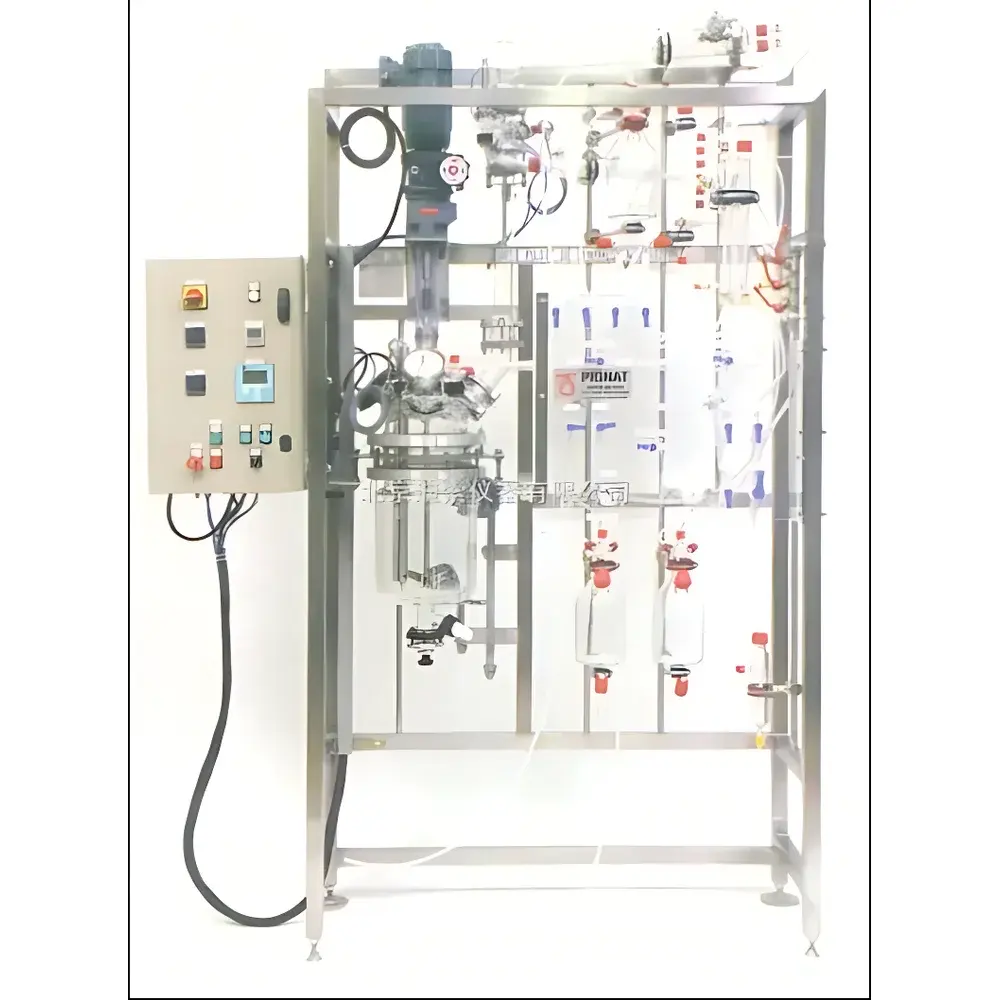
MKE-5 Series Laboratory Chemical Reactor
| Origin | UK |
|---|---|
| Manufacturer Type | Authorized Distributor |
| Origin Category | Imported |
| Model | MKE-5 |
| Pricing | Upon Request |
| Construction Materials | Glass / Stainless Steel (316L) / Hastelloy C-276 |
| Vessel Capacities | 5–250 L (Standard Options: 5, 10, 20, 50, 63, 100, 250 L) |
| Temperature Range | −50 °C to +200 °C (Optional: −90 °C to +250 °C) |
| Absolute Pressure Range | 0.01–1.5 bar (Optional: 0.001–4 bar) |
| Process Capabilities | Multi-component synthesis, liquid–liquid extraction, phase separation, simple & fractional distillation, azeotropic distillation with phase split, evaporation, concentration, crystallization |
Overview
The MKE-5 Series Laboratory Chemical Reactor is an engineered platform for controlled, scalable chemical synthesis and process development under precisely regulated thermal, pressure, and mixing conditions. Designed according to principles of chemical engineering unit operations, the system integrates jacketed vessel geometry, modular agitator assemblies, and multi-port top-plate configurations to support heterogeneous reaction environments—including solid–liquid, liquid–liquid, and gas–liquid systems. Its core architecture enables stoichiometric control, heat transfer optimization, and mass transfer enhancement across batch and semi-batch operation modes. The reactor is widely deployed in early-stage pharmaceutical process R&D, fine chemical route scouting, catalyst screening, and academic mechanistic studies where reproducibility, material compatibility, and operational flexibility are critical.
Key Features
- Modular construction with interchangeable vessel materials—borosilicate glass (DIN 28722), electropolished stainless steel (ASTM A276 Type 316L), or corrosion-resistant Hastelloy C-276—to accommodate aggressive reagents (e.g., HF, hot chlorides, strong oxidizers) and high-purity synthesis requirements.
- Standard volumetric options spanning 5 L to 250 L, supporting scale-up from benchtop feasibility studies to pilot-scale process validation without geometric or hydrodynamic discontinuity.
- Double-jacketed design compatible with external circulators (e.g., Huber, Julabo) for precise temperature control; optional cryogenic integration supports low-temperature lithiation, Grignard formation, and nitration below −40 °C.
- Pressure-rated configuration certified to PED 2014/68/EU (Category I or II depending on specification); vacuum integrity verified to ≤1 × 10⁻³ mbar with helium leak testing per ISO 15848-1.
- Variable-speed mechanical agitation (0–300 rpm typical, torque-sensing motor optional) with multiple impeller types (Rushton, pitched-blade, anchor, helical ribbon) to match rheological profiles—from Newtonian solvents to highly viscous slurries or crystallizing suspensions.
- Multi-port top plate (up to 8 standard ports) configured for thermocouple insertion, pH/Redox probes, dosing lines, inert gas sparging (with mass flow controllers), reflux condensers, and overhead distillation heads.
Sample Compatibility & Compliance
The MKE-5 accommodates diverse sample matrices: homogeneous catalytic solutions, heterogeneous metal-catalyzed hydrogenations, suspension polymerizations, enantioselective asymmetric syntheses, and moisture-sensitive organometallic reactions under nitrogen or argon blanket. All wetted components comply with USP Class VI biocompatibility standards where applicable. Vessels meet ASTM E2877-22 for laboratory glassware dimensional tolerance and ASME BPE-2022 surface finish specifications (Ra ≤ 0.4 µm for stainless variants). Documentation packages include Factory Acceptance Test (FAT) reports, material traceability certificates (EN 10204 3.1), and EU Declaration of Conformity.
Software & Data Management
While the base MKE-5 operates via analog/manual controls, digital instrumentation kits are available as field-upgradable modules—including PID-controlled temperature/pressure loggers (with ±0.2 °C accuracy), real-time torque monitoring, and 4–20 mA signal outputs for integration into existing DCS or SCADA environments. Optional LabVIEW-based acquisition software provides time-stamped parameter logging, alarm thresholds, and CSV export compliant with ALCOA+ data integrity principles. Audit trail functionality and electronic signature support align with FDA 21 CFR Part 11 requirements when deployed in GMP-regulated settings.
Applications
- Pharmaceutical process development: API crystallization optimization, solvent swap studies, impurity profiling under controlled supersaturation.
- Catalyst evaluation: Screening of heterogeneous Pd/C, Ni/Raney, or enzyme-immobilized reactors under varied H2 partial pressures.
- Electrochemical synthesis: Paired electrolysis setups with integrated reference electrodes and potentiostatic control interfaces.
- Sustainable chemistry: Solvent-free mechanochemical activation, microwave-assisted hybrid configurations (with external cavity coupling), and photochemical reactions using quartz-jacketed vessels.
- Regulatory submissions: Generation of robust process understanding (ICH Q5, Q8, Q9) through Design of Experiments (DoE)-driven parameter mapping.
FAQ
What vessel material is recommended for hydrofluoric acid (HF) handling?
Hastelloy C-276 is the minimum recommended alloy for concentrated or anhydrous HF service; glass vessels are not suitable due to rapid etching.
Can the MKE-5 be validated for GMP manufacturing use?
Yes—when equipped with qualified sensors, audit-trail-capable software, and executed within a documented IQ/OQ/PQ protocol aligned with Annex 15 and ASTM E2500-22.
Is explosion-proof (ATEX) certification available?
ATEX Zone 1 or 2 configurations are offered ex-factory upon request, including flameproof motor housings, intrinsically safe instrumentation, and static-dissipative coatings.
What level of vacuum can be achieved with the standard vacuum pump interface?
Using a two-stage oil-sealed rotary vane pump, base pressure ≤5 × 10⁻² mbar is routinely attainable; high-vacuum options (≤1 × 10⁻⁴ mbar) require diffusion or turbomolecular pumping integration.
Are spare parts and technical support available outside the UK?
Global spares logistics and remote engineering support are provided through authorized distributor networks, with lead times documented per ISO 55001 asset management framework.



