
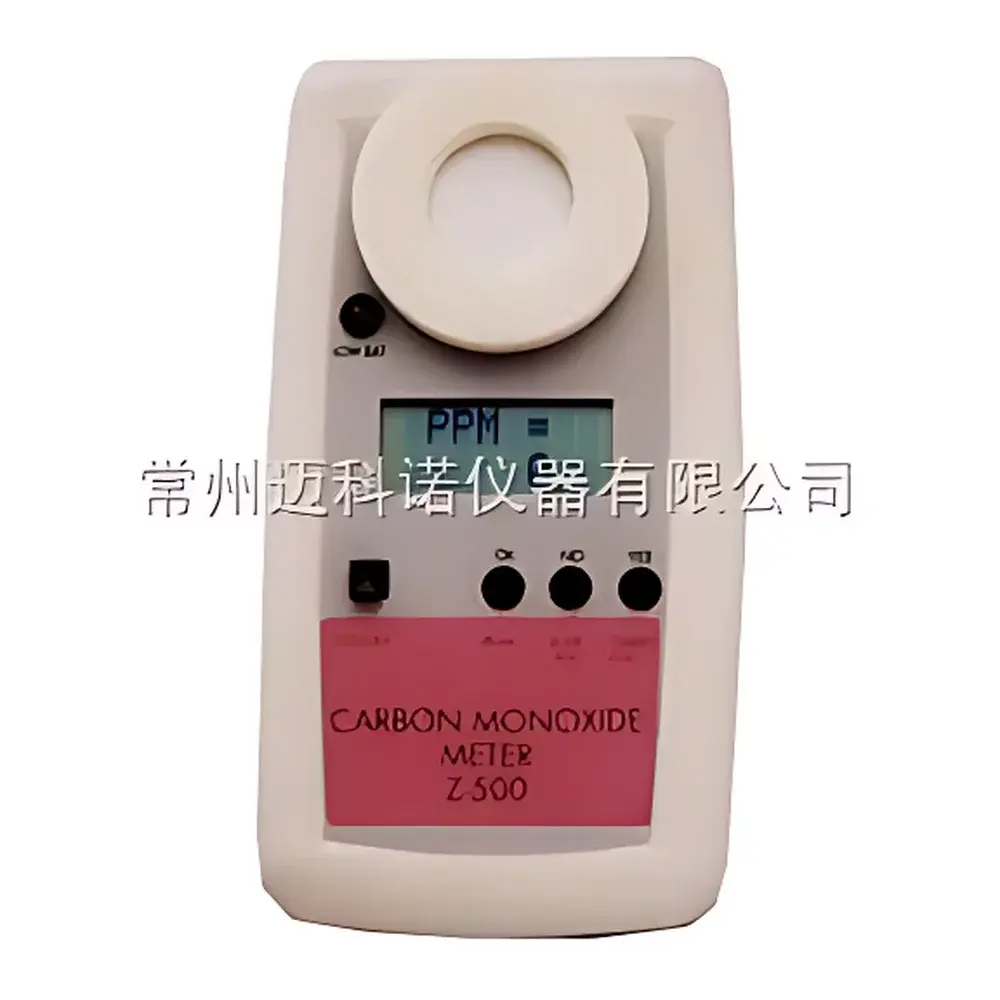
MKN Z-500 / ZDL-500 Portable Electrochemical Carbon Monoxide (CO) Detector
| Brand | MKN |
|---|---|
| Origin | Zhejiang, China |
| Model | Z-500 / ZDL-500 |
| Instrument Type | Portable Gas Detector |
| Detection Target | Carbon Monoxide (CO) |
| Sensor Principle | Electrochemical |
| Sampling Method | Diffusion |
| Typical Range | 0–300 ppm |
| Extended Range | 0–2000 ppm |
| Resolution | 0.1 ppm (≤100 ppm), 1 ppm (>100 ppm) |
| LOD | 0.1 ppm |
| Accuracy | ±5% of reading |
| Response Time (T90) | <30 s |
| Preheat Time | 60 s |
| Operating Temperature | –20 to +50 °C |
| Relative Humidity | 15–90% RH (non-condensing) |
| Atmospheric Pressure Tolerance | ±10% of standard atm |
| Power Supply | 9 V alkaline battery (typ. 240 h operation) |
| Dimensions | 120 × 63.5 × 38 mm |
| Weight | 170 g |
| Alarm | 80 dB audible alarm, user-configurable threshold |
| Display | LCD with 10-second real-time update |
| Data Logging | ZDL-500 only — stores up to 5 complete measurement sessions (date, time, sampling interval, point count, and all recorded values) |
| Interface | RS-232 serial port |
| Compliance | Designed for industrial hygiene and ambient air monitoring per OSHA PEL and ACGIH TLV guidelines |
| Standard Accessories | Host unit, 9 V battery, user manual, calibration certificate, rugged carrying case, RS-232 cable and PC software (ZDL-500 only) |
Overview
The MKN Z-500 and ZDL-500 are handheld, battery-powered electrochemical gas detectors engineered for reliable, field-deployable measurement of carbon monoxide (CO) in occupational and environmental settings. Based on amperometric electrochemical sensing technology, these instruments detect CO through selective oxidation at a working electrode, generating a current linearly proportional to gas concentration. The Z-500 serves as a real-time monitoring tool with continuous LCD readout, while the ZDL-500 extends functionality with embedded data logging and serial interface capability—enabling traceable, auditable exposure assessment in compliance with industrial hygiene protocols. Both models operate without external pumps or consumables, relying on passive diffusion sampling—a design choice that ensures low maintenance, mechanical robustness, and suitability for routine spot-checking in confined spaces, laboratories, HVAC systems, boiler rooms, parking garages, and post-combustion environments.
Key Features
- Electrochemical sensor with typical service life exceeding 24 months under normal operating conditions
- Dual-range capability: high-resolution mode (0.1 ppm) up to 100 ppm; extended range (1 ppm resolution) up to 2000 ppm
- Real-time digital display updated every 10 seconds; supports instantaneous concentration, peak hold, 15-minute short-term exposure limit (STEL), and 8-hour time-weighted average (TWA)
- User-programmable audible alarm (80 dB) with adjustable threshold across full measurement span
- Low-battery indicator and automatic zero-stability verification during startup
- ZDL-500-specific features: non-volatile memory storing five independent measurement sessions—including timestamps, sampling intervals, number of data points, and full value arrays
- RS-232 interface with dedicated Windows-compatible software for data export, report generation, and audit-log review
- Compact ergonomic housing (120 × 63.5 × 38 mm) rated for use in temperatures from –20 to +50 °C and humidity up to 90% RH (non-condensing)
Sample Compatibility & Compliance
These detectors are optimized for CO measurement in ambient air and indoor environments where CO concentrations remain within regulatory thresholds. They are not intended for use in inert atmospheres, explosive gas mixtures (e.g., methane-rich headspaces), or corrosive process streams. The electrochemical cell exhibits minimal cross-sensitivity to common interferents such as H2, NO2, and SO2 when operated within specified environmental limits. While not certified to IECEx or ATEX standards, the Z-500/ZDL-500 aligns with OSHA 29 CFR 1910.1000 (PEL = 50 ppm TWA), ACGIH TLV® (25 ppm TWA, 200 ppm STEL), and ISO 16200-1 for workplace air quality screening. Calibration is performed using NIST-traceable CO standard gas (certified reference material), and each unit ships with a factory calibration certificate valid for initial deployment.
Software & Data Management
The ZDL-500 includes proprietary PC software compatible with Windows 7–11 (32/64-bit) that facilitates structured data retrieval via RS-232 connection. Export formats include CSV and PDF, supporting integration into enterprise EHS platforms or spreadsheet-based exposure trending analysis. Software enforces immutable timestamping and preserves original session metadata—critical for GLP-aligned recordkeeping. Though not FDA 21 CFR Part 11 compliant out-of-the-box, audit trails can be generated manually for internal QA/QC documentation. Firmware updates are delivered via serial interface, ensuring long-term adaptability to evolving reporting requirements.
Applications
- Occupational safety inspections in manufacturing, welding, and combustion-based facilities
- Indoor air quality (IAQ) assessments in schools, hospitals, and residential buildings
- Post-incident evaluation following fuel-burning appliance malfunctions or generator misuse
- Field validation of fixed CO monitoring systems during commissioning or periodic verification
- Educational laboratory demonstrations of toxic gas detection principles and exposure modeling
- Emergency response pre-screening prior to entry into potentially hazardous zones
FAQ
What is the recommended calibration frequency?
Calibration is advised before each day’s use for critical applications; at minimum, prior to any measurement campaign and after exposure to extreme concentrations or environmental stressors.
Can the instrument measure CO in oxygen-deficient environments?
No—electrochemical CO sensors require ambient oxygen to sustain the catalytic reaction; operation below 19.5% O2 vol/vol may yield inaccurate or unstable readings.
Is the ZDL-500 compatible with modern laptops lacking RS-232 ports?
Yes—USB-to-RS-232 adapters meeting FTDI or CP210x chipset specifications are fully supported; driver installation is required.
Does the device support bump testing?
Yes—integrated span-check functionality allows rapid functional verification using a known CO challenge gas (e.g., 100 ppm in air).
How is sensor drift managed over time?
The instrument performs automatic baseline correction during power-up; however, scheduled zero and span adjustments using certified gases remain essential for metrological integrity beyond 6 months of continuous use.
Related Products







