
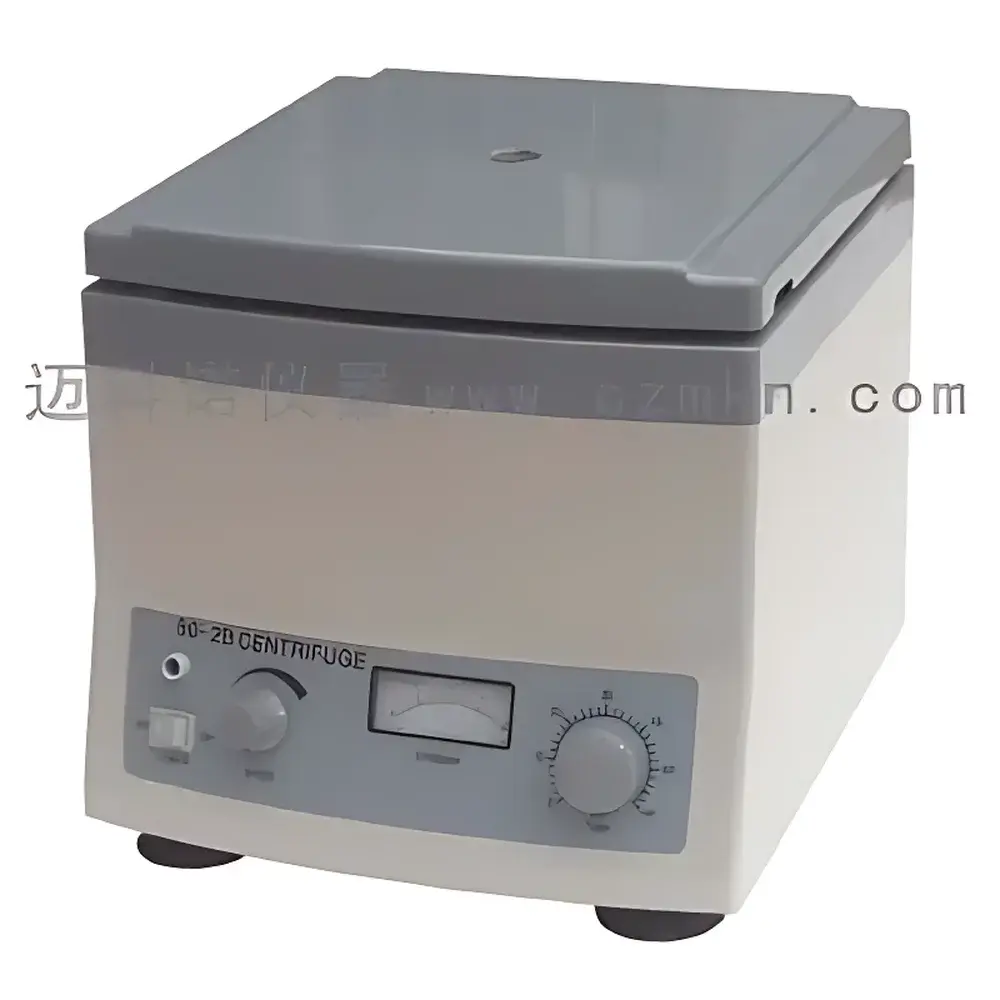
MKN 80-2B Benchtop Electric Centrifuge
| Brand | MKN |
|---|---|
| Origin | Jiangsu, China |
| Model | 80-2B |
| Max Speed | 0–4000 rpm |
| Relative Centrifugal Force (RCF) | 2325 × g |
| Capacity | 12 × 20 mL (or 12 × 15 mL) |
| Timer Range | 0–60 min |
| Power | 135 W |
| Noise Level | ≤60 dB(A) |
| Input Voltage/Frequency | AC 220 V, 50 Hz, 2 A |
| Rotor Material | Anodized Aluminum |
| Drive System | Dedicated Brushed DC Motor |
| Safety Features | Mechanical Lid Interlock Switch, Dual-Fuse Protection, Imbalance Detection & Auto-Shutdown |
| Control Type | Analog Speed Dial + Mechanical Timer with Pointer Display |
Overview
The MKN 80-2B is a compact, benchtop electric centrifuge engineered for routine separation tasks in academic laboratories, clinical diagnostics, pharmaceutical QC labs, and environmental testing facilities. It operates on the principle of sedimentation under controlled centrifugal force—generating up to 2325 × g at 4000 rpm—to separate suspended particles, cells, precipitates, or immiscible phases based on density differentials. Designed for reliability in high-throughput environments, the unit features a robust brushed DC motor optimized for consistent torque delivery across its full speed range (0–4000 rpm), paired with mechanical analog controls that eliminate software dependencies and ensure operational continuity in resource-constrained settings. Its lightweight yet rigid housing—constructed from high-impact engineering-grade thermoplastics—provides structural integrity while minimizing footprint and vibration transmission. The device complies with IEC 61010-1:2010 safety standards for laboratory electrical equipment and meets electromagnetic compatibility (EMC) requirements per EN 61326-1.
Key Features
- High-reproducibility mechanical speed control with calibrated pointer dial and ±50 rpm accuracy across the operating range
- Dual-stage safety architecture: integrated lid interlock switch prevents operation when open, and dual thermal fuses provide overcurrent protection independent of main circuitry
- Dynamic imbalance detection system automatically halts rotation if rotor load asymmetry exceeds 5% mass differential between opposing tubes
- Anodized aluminum rotor (Type A-12) rated for continuous operation at maximum speed; compatible with standard 15 mL and 20 mL conical centrifuge tubes
- Low-noise acoustic enclosure (<60 dB[A] at 1 m distance) achieved through precision-balanced rotor assembly and vibration-damping base mount
- Mechanical timer with tactile feedback knob and visual scale (0–60 min); no battery or digital display required for timekeeping
Sample Compatibility & Compliance
The 80-2B accommodates common laboratory tube formats without adapters: twelve positions for either 15 mL or 20 mL polypropylene or polycarbonate conical tubes (max. diameter 17 mm). It supports protocols requiring low-speed pelleting of mammalian blood components (e.g., plasma isolation per CLSI H20-A2 guidelines), bacterial cell harvesting (OD600 normalization), and particulate removal from aqueous extracts in food safety or environmental analysis. All electrical and mechanical design elements conform to ISO/IEC 17025:2017 general requirements for competence of testing and calibration laboratories. While not certified for GMP production environments, the unit is routinely deployed in GLP-compliant research workflows where instrument logs and maintenance records are retained per internal SOPs.
Software & Data Management
This model is hardware-only and does not incorporate embedded firmware, touchscreen interfaces, or data export functionality. Operational parameters—speed and time—are set manually and not logged internally. For laboratories requiring audit trails, users may integrate external documentation practices such as paper-based run logs or LIMS-linked manual entry. No network connectivity, USB ports, or cloud synchronization capabilities are included, aligning with security-sensitive environments where air-gapped instrumentation is mandated. Routine calibration verification (e.g., tachometer validation against NIST-traceable reference) is recommended every six months per ISO/IEC 17025 Clause 6.5.2.
Applications
- Routine plasma and serum separation from whole blood specimens prior to ELISA, PCR, or clinical chemistry assays
- Pelleting of E. coli, S. cerevisiae, or other microorganisms during culture processing for downstream DNA extraction or protein expression studies
- Clarification of plant tissue homogenates or soil leachates in environmental monitoring programs
- Removal of insoluble excipients from liquid pharmaceutical formulations during stability testing
- Preparative separation of lipid droplets or extracellular vesicles in basic cell biology investigations
FAQ
Is the 80-2B suitable for use with infectious or biohazardous samples?
Yes, provided appropriate biosafety containment measures are followed—including use of sealed tube caps, secondary containment buckets, and post-run decontamination per BMBL 5th Edition Section IV-A.
Can the rotor be autoclaved?
No—the anodized aluminum rotor is not autoclavable. Clean with 70% ethanol or mild detergent; avoid caustic or chloride-based cleaners to prevent surface degradation.
What is the expected service life under normal usage?
With scheduled maintenance (bearing lubrication every 12 months and belt inspection per manufacturer’s technical bulletin TB-802B-REV3), typical operational lifespan exceeds 10,000 hours.
Does MKN provide calibration certificates with shipment?
Calibration certificates are available upon request at time of order; they include speed verification using a traceable optical tachometer and timer accuracy assessment per ISO 17025 Annex A.3.
Is spare rotor availability guaranteed beyond product discontinuation?
MKN maintains a minimum 5-year post-discontinuation spare parts inventory for all legacy models, including rotor assemblies, drive belts, and fuse kits, documented in their Parts Lifecycle Register (PLR-MKN-2024).



