
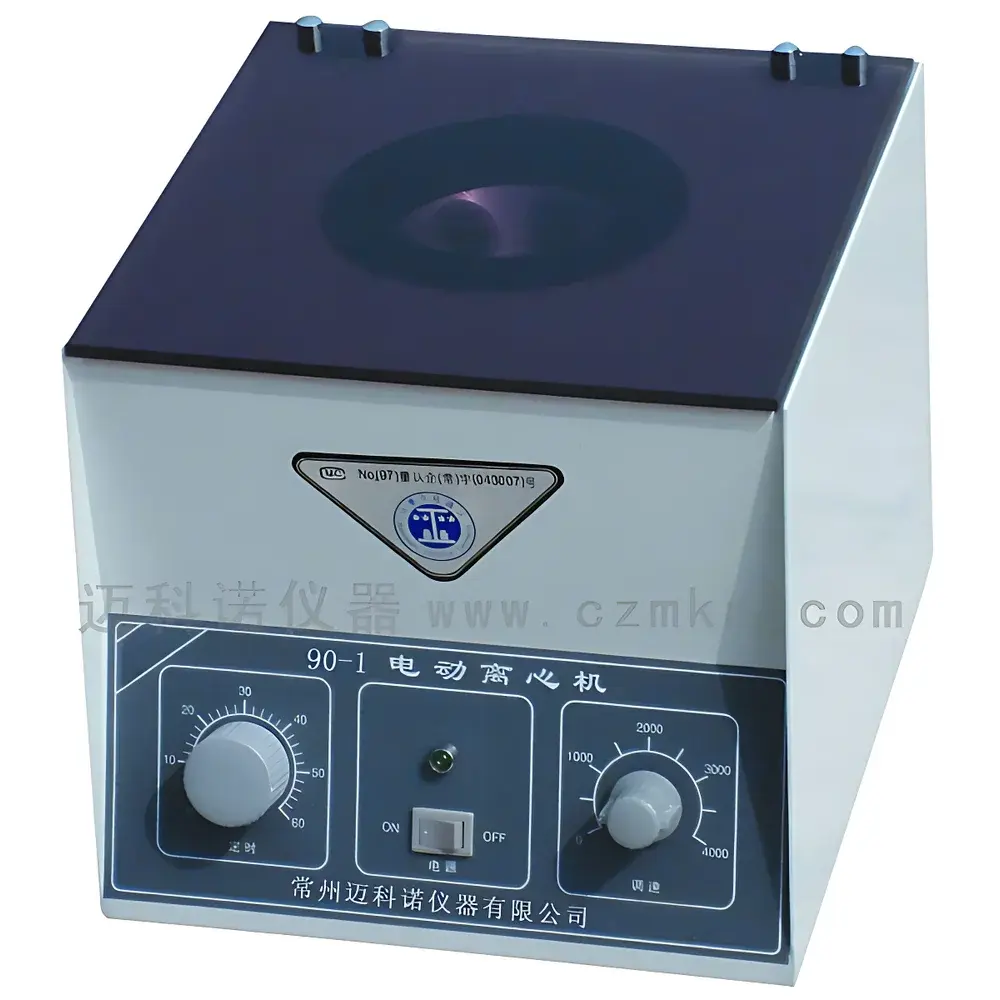
MKN 90-1 Benchtop Electric Centrifuge
| Brand | MKN |
|---|---|
| Model | 90-1 |
| Max Speed | 4000 rpm |
| Relative Centrifugal Force (RCF) | 1430 × g |
| Capacity | 6 × 20 mL or 6 × 15 mL or 8 × 5 mL |
| Timer Range | 0–60 min |
| Noise Level | ≤60 dB(A) |
| Power Supply | AC 220 V, 50 Hz, 2 A |
| Safety | Lid-open automatic stop |
| Construction | Die-cast aluminum rotor assembly |
| Compliance | Designed for GLP-compliant laboratory environments |
Overview
The MKN 90-1 Benchtop Electric Centrifuge is a compact, general-purpose centrifugation instrument engineered for routine separation tasks in clinical, biochemical, and research laboratories. It operates on the principle of sedimentation under controlled rotational force—generating relative centrifugal force (RCF) to accelerate phase separation of heterogeneous mixtures based on particle density, size, and shape. Unlike high-speed or refrigerated models, the 90-1 is optimized for low-to-medium speed applications where thermal stability is not critical but operational reliability, ease of use, and mechanical safety are paramount. Its brushless DC motor delivers smooth acceleration and deceleration profiles, minimizing sample disturbance and rotor stress. The unit features an integrated lid interlock system that halts rotation immediately upon lid opening—a fundamental safety requirement aligned with IEC 61010-1 standards for laboratory electrical equipment.
Key Features
- Stepless speed control from 0 to 4000 rpm, enabling precise adaptation to diverse sample viscosities and sedimentation coefficients.
- Automatic rotor balancing mechanism compensates for minor tube mass asymmetry, reducing vibration and extending bearing service life.
- Die-cast aluminum rotor ensures dimensional stability across repeated thermal cycles and resists corrosion from common reagents (e.g., saline, EDTA, mild buffers).
- Low-noise operation (≤60 dB[A]) achieved through precision-machined rotor geometry and vibration-damping chassis design—suitable for shared lab spaces and teaching environments.
- Integrated digital timer (0–60 minutes) with audible end-of-run alert; auto-stop function prevents over-centrifugation and sample degradation.
- Compact footprint (W × D × H: 260 × 300 × 270 mm, approx.) facilitates placement on standard benchtops without dedicated ventilation or floor mounting.
Sample Compatibility & Compliance
The MKN 90-1 supports standardized conical-bottom centrifuge tubes (5 mL, 15 mL, and 20 mL), including polypropylene and polycarbonate variants compatible with common biological and diagnostic workflows. It is routinely deployed in serum/plasma separation prior to immunoassay, ELISA, or electrophoresis; in cell pellet recovery during basic microbiology protocols; and in precipitate clarification steps for protein or nucleic acid extraction kits. While not certified to ISO 13485 or FDA 21 CFR Part 11, its mechanical design and operational consistency meet baseline requirements for Good Laboratory Practice (GLP) documentation—particularly when paired with lab-specific SOPs governing run logs, maintenance records, and calibration verification intervals. The absence of refrigeration limits use to ambient-stable samples only; it is not intended for temperature-sensitive enzymes, cryopreserved cells, or volatile organic extractions.
Software & Data Management
The 90-1 operates as a standalone analog-digital hybrid instrument with no embedded microprocessor-based data logging or network connectivity. All operational parameters (speed, time, RCF) are set manually via front-panel dials and displayed on an LED readout. For traceability in regulated environments, users are advised to record run conditions in bound logbooks or electronic lab notebooks (ELNs) compliant with ALCOA+ principles (Attributable, Legible, Contemporaneous, Original, Accurate, Complete, Consistent, Enduring, Available). Routine performance verification—including speed accuracy (±50 rpm at 4000 rpm), timer deviation (<±10 s per 30 min), and rotor integrity inspection—is recommended quarterly per manufacturer guidelines and aligns with ISO/IEC 17025 clause 6.4.2 on equipment verification.
Applications
- Clinical diagnostics: Rapid separation of whole blood into serum or plasma layers for subsequent analysis by spectrophotometry, immunochemistry, or coagulation assays.
- Academic teaching labs: Demonstrating sedimentation kinetics, density gradient principles, and centrifugal force calculations in undergraduate biophysics and biochemistry courses.
- Quality control in pharmaceutical manufacturing: Clarification of buffer solutions, excipient suspensions, and final product filtration validation runs.
- Environmental testing labs: Solid-liquid separation of waterborne particulates prior to gravimetric or elemental analysis (e.g., EPA Method 160.1).
- Veterinary clinics: Processing animal blood samples for hematocrit determination and serological screening panels.
FAQ
What is the maximum relative centrifugal force (RCF) achievable with the MKN 90-1?
The unit generates up to 1430 × g at its rated maximum speed of 4000 rpm with the standard 20 mL rotor configuration.
Does this centrifuge require routine calibration?
Yes—speed and timer accuracy should be verified at least quarterly using NIST-traceable tachometers and stopwatch standards, especially when used in GLP or ISO-accredited workflows.
Can I use glass centrifuge tubes in this instrument?
No. Only plastic centrifuge tubes rated for ≥4000 rpm (e.g., polypropylene or polycarbonate) are approved; glass tubes pose unacceptable shattering risk under operational RCF.
Is the rotor autoclavable?
The aluminum rotor is not autoclavable. Clean with 70% ethanol or mild detergent; avoid prolonged exposure to strong oxidizers (e.g., sodium hypochlorite) or acidic solutions.
What maintenance is required beyond cleaning?
Annual inspection of motor brushes (if applicable), bearing lubrication status, and lid interlock switch functionality is recommended. Refer to the Maintenance Schedule in Section 7 of the English-language Operation Manual (Rev. 2023).



