
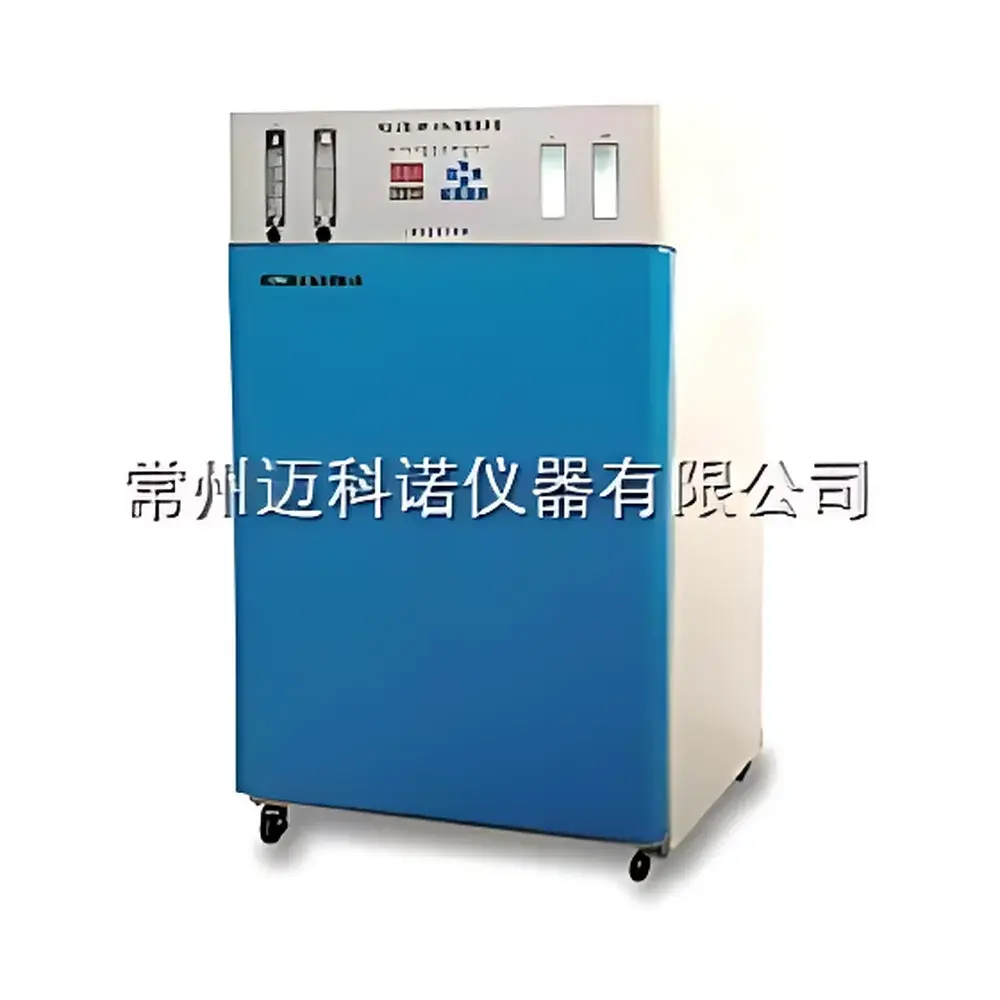
MKN CHP-160 Water-Jacketed CO₂ Incubator
| Brand | MKN |
|---|---|
| Model | CHP-160 |
| Capacity | 160 L |
| Temperature Control Range | Ambient +5°C to 60°C |
| Temperature Accuracy | ±0.3°C at 37°C |
| Temperature Resolution | 0.1°C |
| CO₂ Range | 0–20% (v/v) |
| CO₂ Accuracy | ±0.1% |
| CO₂ Uniformity | ±0.1% at 5% setpoint |
| CO₂ Recovery Time | ≤1.2 × setpoint concentration (minutes) |
| Heating Method | Water-jacketed |
| Humidification | Natural evaporation |
| Power Consumption | 950 W |
| Working Environment | 5–35°C, 220 V / 50 Hz |
| Interior Dimensions (W×D×H) | 500×500×650 mm |
| Exterior Dimensions (W×D×H) | 650×610×990 mm |
| Standard Shelving | 2 stainless steel trays |
| Construction | Stainless steel inner chamber with seamless argon arc-welded water jacket |
| Door | Heated double-glazed glass with anti-condensation function |
| Filtration | Dual-stage CO₂ gas filtration (particulate + hydrocarbon) |
| Alarm System | Independent audible/visual alarms for CO₂ deviation, temperature excursion, and door open |
Overview
The MKN CHP-160 is a precision-engineered, water-jacketed CO₂ incubator designed for reliable, long-term maintenance of mammalian cell cultures, primary tissues, and sensitive microbial strains under tightly controlled physiological conditions. Operating on the principle of stable thermal mass regulation via a circulating water jacket—rather than forced-air convection—the CHP-160 delivers exceptional temperature uniformity and minimal fluctuation, critical for experiments requiring high reproducibility across multi-day or multi-week culture periods. Its dual-stage CO₂ gas filtration system ensures consistent, contaminant-free gas delivery, while the heated glass door prevents condensation and maintains optical clarity without compromising internal humidity integrity. The unit complies with core design principles outlined in ISO 13485 for medical device manufacturing environments and supports GLP-compliant workflows through traceable parameter logging and configurable alarm thresholds.
Key Features
- Water-jacketed thermal architecture for superior temperature stability (±0.3°C at 37°C) and reduced sensitivity to ambient fluctuations.
- Microprocessor-based control system with digital LED display for simultaneous monitoring of temperature, CO₂ concentration, and operational status.
- Dual-stage CO₂ filtration: integrated particulate filter (0.2 µm) and hydrocarbon adsorption layer to protect sensor integrity and ensure gas purity.
- Heated double-glazed observation door with anti-fog circuitry—eliminates condensation during frequent access while preserving internal humidity profile.
- Electropolished 304 stainless steel interior with fully rounded corners (R ≥ 25 mm) and seamless argon arc-welded water jacket—designed for autoclave-compatible cleaning and corrosion resistance.
- Independent alarm system with visual indicators and audible alerts for CO₂ deviation (>±1% from setpoint), temperature excursion (>±1°C), and unsecured door status.
- Natural evaporation humidification method—no ultrasonic components or reservoir pumps—to minimize aerosol generation and microbial carryover risk.
Sample Compatibility & Compliance
The CHP-160 accommodates standard T-25, T-75, and T-175 flasks, multi-well plates (6–96-well), Petri dishes, and roller bottles up to 5 L volume. Its chamber geometry (500 × 500 × 650 mm) allows vertical stacking of two full-height shelves (included), each rated for 15 kg load capacity. The unit meets IEC 61010-1 safety requirements for laboratory equipment and incorporates electrical isolation per EN 60601-1 where applicable. While not certified for ISO Class 5 cleanroom integration, its sealed construction and HEPA-filtered air recirculation path (optional upgrade) support use in ISO 8 (Class 100,000) environments. It is routinely deployed in academic cell biology labs, biopharmaceutical QC facilities, and contract research organizations performing ASTM E2576-22 (Standard Guide for Cell Culture Contamination Monitoring) protocols.
Software & Data Management
The embedded controller records real-time temperature and CO₂ values at user-defined intervals (1–60 min), storing up to 30 days of data internally. Export is supported via USB port in CSV format for post-hoc analysis in Excel or LIMS platforms. Optional RS-485 interface enables integration into centralized building management systems (BMS) or SCADA networks using Modbus RTU protocol. Audit trail functionality includes timestamped event logs for all parameter changes, alarm triggers, and door openings—fully compliant with FDA 21 CFR Part 11 requirements when paired with validated third-party electronic signature software. No cloud connectivity or proprietary firmware updates are implemented, ensuring data sovereignty and minimizing cybersecurity exposure vectors.
Applications
- Mammalian cell line expansion (e.g., HEK293, CHO, HeLa) for transfection, bioproduction, and cytotoxicity screening.
- Primary neuronal and stem cell culture where metabolic stability and low thermal drift are essential.
- Embryology and assisted reproductive technology (ART) labs maintaining gametes and early-stage embryos.
- Microbiological studies involving capnophilic organisms (e.g., Neisseria gonorrhoeae, Campylobacter jejuni) requiring precise CO₂ tension.
- Regulatory batch testing under USP sterility assurance and EP 2.6.27 cell culture validation guidelines.
- Long-term organoid culture systems requiring uninterrupted environmental fidelity over 14+ day timelines.
FAQ
What is the recommended calibration frequency for the CO₂ sensor?
Annual verification against NIST-traceable gas standards is advised; in GMP settings, semi-annual calibration with documented uncertainty budgets is typical.
Can the CHP-160 operate continuously for extended periods (e.g., >30 days)?
Yes—the water jacket design and solid-state relay control enable uninterrupted operation with scheduled maintenance (water top-up every 7–10 days under standard lab humidity).
Is external humidification support available?
No; the unit relies exclusively on passive natural evaporation. For applications demanding >95% RH, supplemental in-chamber humidity pans or external steam generators must be evaluated separately.
Does the incubator include a CO₂ cylinder regulator or supply manifold?
No—only the internal gas delivery pathway and solenoid valve are provided. Users must supply ISO-certified CO₂ cylinders with compatible pressure regulators (output: 0.5–1.0 bar).
How is contamination control addressed beyond filtration?
The chamber supports routine decontamination via 70% ethanol wipe-downs, and optional copper-clad interior panels (MKN-Cu option) are available for enhanced antimicrobial surface properties.
Related Products



