
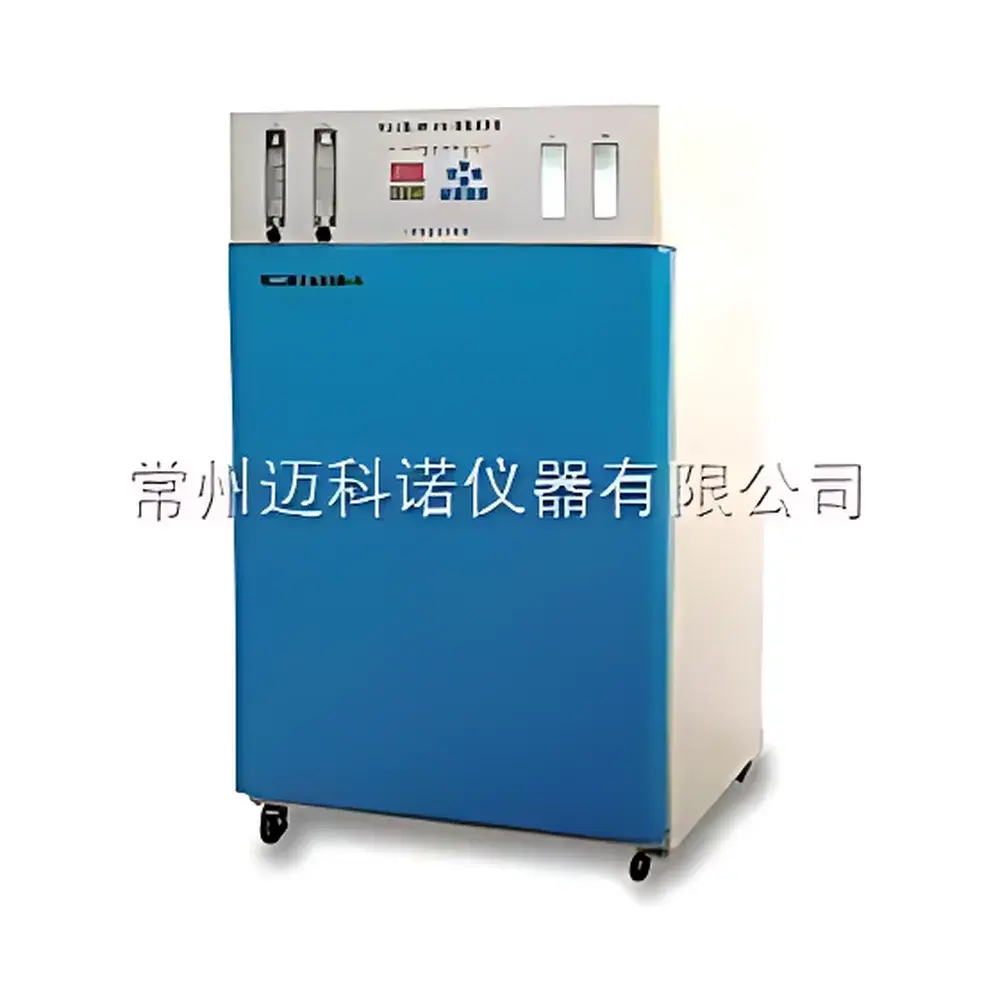
MKN CHP-80 Water-Jacketed CO₂ Incubator
| Brand | MKN |
|---|---|
| Model | CHP-80 |
| Capacity | 80 L |
| Temperature Control Range | Ambient +5°C to 60°C |
| Temperature Accuracy | ±0.3°C at 37°C |
| Temperature Resolution | 0.1°C |
| CO₂ Range | 0–20% |
| CO₂ Accuracy | ±0.1% |
| CO₂ Uniformity | ±0.1% at 5% setpoint |
| CO₂ Recovery Time | ≤1.2 × target concentration (min) |
| Heating Method | Water-jacketed |
| Power Consumption | 680 W |
| Humidification | Natural evaporation |
| Working Environment | 5–35°C |
| Voltage | 220 V, 50 Hz |
| Internal Dimensions (W×D×H) | 500×400×400 mm |
| External Dimensions (W×D×H) | 500×510×840 mm |
| Standard Shelves | 2 pcs |
| Construction | Stainless steel inner chamber with argon arc welding, semi-circular corners |
Overview
The MKN CHP-80 Water-Jacketed CO₂ Incubator is a precision-engineered environmental control system designed for reliable, long-term cultivation of mammalian cells, primary tissues, hybridomas, and sensitive microbial strains under tightly regulated physiological conditions. Operating on the principle of water-jacketed thermal stabilization—where a surrounding water reservoir provides superior thermal mass and insulation—the CHP-80 achieves exceptional temperature stability and uniformity, minimizing thermal fluctuations that can compromise cell viability, proliferation kinetics, or differentiation fidelity. Its dual-gas filtration system ensures consistent CO₂ delivery while mitigating contamination risk from ambient air ingress, and its microprocessor-based control architecture enables real-time monitoring and closed-loop regulation of both temperature and CO₂ concentration. The incubator complies with fundamental requirements for GLP-compliant cell culture workflows and supports adherence to ISO 13485 and ASTM E1982 standards for laboratory equipment validation in biomedical research settings.
Key Features
- Water-jacketed heating system with stainless steel welded chamber—engineered for thermal inertia, energy efficiency, and long-term structural integrity.
- Microprocessor-controlled digital interface with independent PID algorithms for simultaneous, decoupled regulation of temperature (range: ambient +5°C to 60°C) and CO₂ (0–20% v/v).
- Dual-stage CO₂ gas filtration: particulate pre-filter followed by catalytic scrubber, reducing hydrocarbon and volatile organic compound interference in the gas stream.
- Heated glass door with anti-condensation circuit—prevents fogging during high-humidity operation and maintains optical clarity for non-invasive observation without opening the chamber.
- Rounded internal corners and seamless stainless steel construction (304 grade)—facilitates cleaning, reduces microbial retention sites, and supports routine decontamination protocols including vaporized hydrogen peroxide (VHP) cycles.
- Integrated audible/visual alarm system with configurable thresholds for CO₂ deviation (>±1% from setpoint), temperature excursion, door-open duration, and sensor failure diagnostics.
Sample Compatibility & Compliance
The CHP-80 accommodates standard tissue culture vessels—including T-flasks (up to T-175), multi-well plates (6–96-well), Petri dishes, and roller bottles—within its 80 L working volume. Its stable humidity environment (maintained via natural evaporation from a built-in water pan) supports cultures requiring ≥95% RH without active humidification hardware, reducing condensation-related cross-contamination risks. The unit meets essential electrical safety requirements per IEC 61010-1 and carries CE marking for laboratory equipment. While not certified for GMP manufacturing environments out-of-the-box, its design supports IQ/OQ/PQ validation documentation and aligns with core elements of FDA 21 CFR Part 11 for electronic record integrity when paired with compliant data logging software.
Software & Data Management
The CHP-80 features an embedded RS-232 communication port for optional integration with centralized lab monitoring systems or third-party SCADA platforms. Real-time operational parameters—including chamber temperature, CO₂ concentration, door status, and alarm events—are timestamped and exportable as CSV files for audit trail generation. When connected to validated external data loggers, the system supports ALCOA+ principles (Attributable, Legible, Contemporaneous, Original, Accurate, Complete, Consistent, Enduring, Available) required for regulatory submissions in academic, clinical trial, and preclinical development contexts.
Applications
- Long-term maintenance of adherent and suspension mammalian cell lines (e.g., HEK293, CHO-K1, HeLa) under physiologically relevant CO₂ (5%) and pH-buffered conditions.
- Cultivation of primary neurons, stem cells, and organoids where thermal drift or CO₂ instability may induce phenotypic drift or spontaneous differentiation.
- Supporting immunology assays—including dendritic cell maturation, T-cell activation, and co-culture experiments—requiring strict environmental reproducibility across replicate runs.
- Microbiology applications involving capnophilic organisms (e.g., Neisseria gonorrhoeae, Haemophilus influenzae) and fastidious anaerobes cultured under microaerophilic CO₂ supplementation.
- Academic and industrial bioprocess development, where benchtop incubators serve as scalable analogs to larger bioreactor systems during seed train expansion and media optimization studies.
FAQ
What is the purpose of the water jacket in this CO₂ incubator?
The water jacket provides passive thermal buffering—stabilizing internal temperature against ambient fluctuations and ensuring minimal overshoot during recovery after door openings.
Does the CHP-80 support humidity monitoring or active humidification control?
No. Humidity is maintained passively via natural evaporation from a removable water pan; relative humidity is not actively measured or regulated.
Can the CO₂ sensor be calibrated in-house?
Yes—the infrared CO₂ sensor includes a zero-point calibration mode and supports span adjustment using certified reference gas (5% CO₂ in N₂), per manufacturer-specified procedures.
Is the stainless steel interior electropolished?
The chamber is constructed from brushed 304 stainless steel with semi-circular corner welds; electropolishing is not standard but available as a factory option upon request.
What validation documentation is provided with the unit?
A Factory Acceptance Test (FAT) report, electrical safety certification summary, and basic operating manual are included; full IQ/OQ protocols must be developed by the end user or qualified service provider.





