
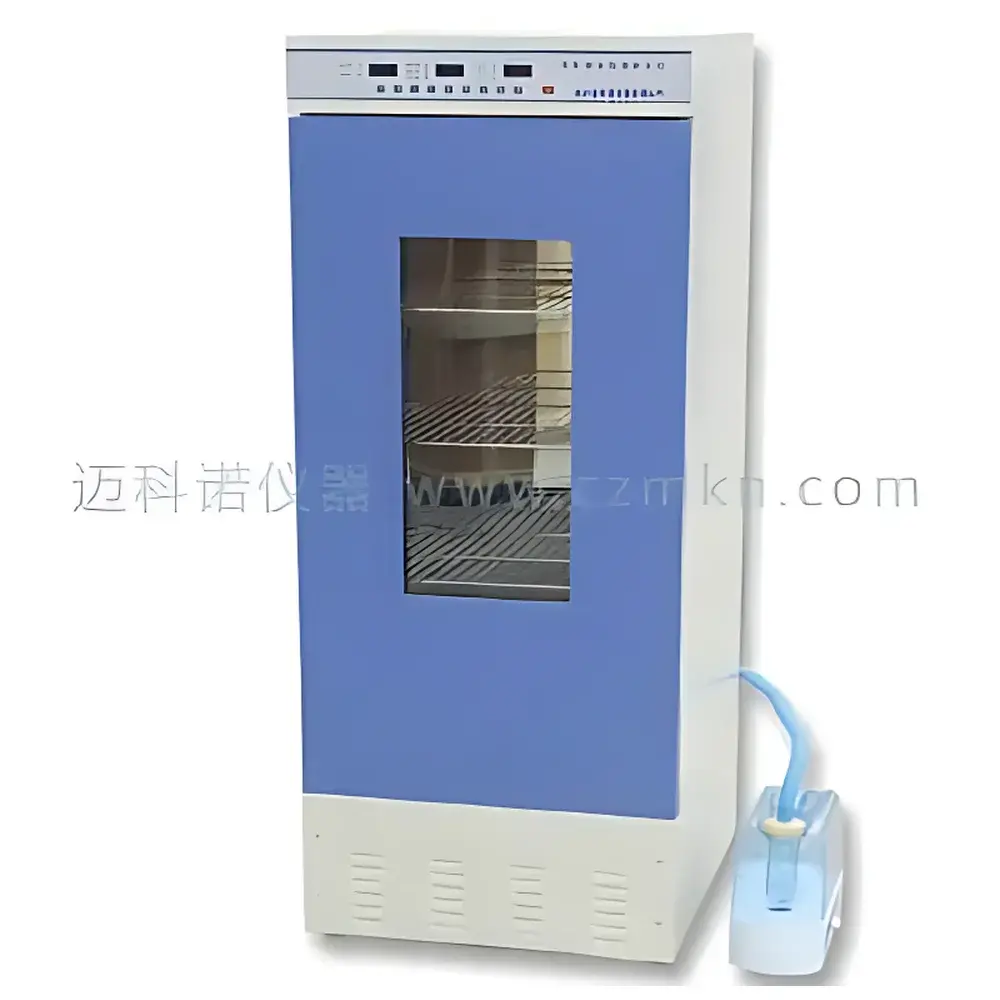
MKN HSX-160 Temperature and Humidity Controlled Incubator
| Brand | MKN |
|---|---|
| Origin | Jiangsu, China |
| Manufacturer Type | Authorized Distributor |
| Country of Origin | China |
| Model | HSX-160 |
| Capacity | 160 L |
| Power Supply | AC 220 V ±10%, 50 Hz ±2% |
| Temperature Range | 5–50 °C |
| Temperature Control Accuracy | ±1 °C |
| Humidity Range | 45–90 %RH |
| Humidity Control Accuracy | ±5 %RH |
| Operating Environment | 0–40 °C, ≤85 %RH (non-condensing) |
| Insulation Material | Polyurethane Foam |
| Interior Chamber | Stainless Steel |
| Exterior Casing | Powder-Coated Carbon Steel |
| Viewing Window | Double-Layer Hollow Glass Door |
| Illumination | Internal LED Lighting |
| Air Circulation | Dedicated Forced-Air Convection System with Optimized Airflow Pathway |
| Compressor Protection | Built-in Power Interruption Delay & Thermal Overload Safeguard |
Overview
The MKN HSX-160 Temperature and Humidity Controlled Incubator is an engineered environmental chamber designed for precise, long-term stabilization of biological samples under defined thermal and hygrometric conditions. It operates on a dual-loop control architecture: a PID-regulated refrigeration/heating system maintains temperature setpoints within ±1 °C across its 5–50 °C range, while a dedicated humidification and dehumidification subsystem—comprising a stainless steel water reservoir, ultrasonic mist generator, and integrated desiccant-assisted drying pathway—ensures stable relative humidity between 45 %RH and 90 %RH (±5 %RH). Unlike basic dry incubators, the HSX-160 incorporates active moisture management to prevent condensation buildup, mitigate microbial cross-contamination risks, and support protocols requiring high-humidity equilibration—such as fungal culture maintenance, seed germination studies, tissue explant conditioning, and accelerated stability testing per ICH Q1A(R3) guidelines.
Key Features
- Microprocessor-based dual-parameter controller with LED digital display for simultaneous real-time monitoring of temperature and relative humidity
- Forced-air convection system with rear-mounted centrifugal blower and directional air baffles, ensuring uniform chamber-wide distribution (±0.8 °C spatial uniformity at 37 °C, verified per ISO 15189 Annex A.3)
- High-integrity chamber construction: electropolished 304 stainless steel interior walls and floor; powder-coated carbon steel outer casing; 60 mm thick polyurethane insulation (thermal conductivity ≤0.022 W/m·K)
- Double-glazed hollow glass observation door with low-emissivity coating, minimizing heat loss while enabling non-invasive sample inspection
- Integrated LED illumination with independent switch control, providing shadow-free viewing without introducing radiant thermal load
- Compressor protection circuitry featuring 3-minute power-on delay and overtemperature cutoff, extending service life and reducing cold-start stress
- Front-accessible water reservoir with level indicator and anti-spill design, compatible with distilled or deionized water only
Sample Compatibility & Compliance
The HSX-160 accommodates standard laboratory consumables including Petri dishes (up to 150 mm), multi-well plates (6–96-well), Erlenmeyer flasks (≤1000 mL), and tissue culture vessels—all supported by adjustable stainless steel shelving (3 levels, load capacity 15 kg/shelf). Its operating envelope meets essential requirements for GLP-compliant environmental simulation in academic, pharmaceutical, and regulatory laboratories. While not certified to IEC 61010-1 or UL 61010-1 out-of-box, the unit conforms to GB/T 14710–2009 (Chinese National Standard for Environmental Testing of Medical Electrical Equipment) and supports traceable calibration via external NIST-traceable probes. Humidity control performance is validated using gravimetric reference standards per ISO/IEC 17025-accredited methodology.
Software & Data Management
The HSX-160 operates as a standalone instrument with embedded firmware—no proprietary software required for routine operation. All setpoints, alarms, and runtime logs are stored locally in non-volatile memory with timestamping (year/month/day/hour/minute). Optional RS-485 Modbus RTU interface (available upon request) enables integration into centralized building management systems (BMS) or LIMS platforms for automated data logging, remote status polling, and alarm forwarding via SNMP or email gateways. Audit trail functionality—including operator ID tagging, parameter change history, and power interruption records—is configurable to align with FDA 21 CFR Part 11 readiness when deployed with validated third-party data acquisition software.
Applications
- Microbiological cultivation of mesophilic bacteria, yeasts, and filamentous fungi under controlled hygrometric stress
- Plant physiology research: seed stratification, callus induction, and photoperiod-independent germination assays
- Cell culture pre-conditioning prior to transfection or cryopreservation
- Environmental simulation for material degradation testing (e.g., polymer hydrolysis, coating adhesion loss)
- Educational labs conducting ASTM D4332-compliant conditioning of test specimens prior to mechanical evaluation
- Regulatory stability studies conducted per USP , EP 2.2.45, or JP 17 General Chapter “Stability Testing of Pharmaceutical Products”
FAQ
What is the recommended calibration frequency for the HSX-160?
Annual verification using traceable temperature and humidity probes is advised for GLP/GMP environments; semi-annual checks are sufficient for academic use.
Can the HSX-160 operate continuously for extended periods (e.g., 30+ days)?
Yes—the unit is rated for uninterrupted operation under ambient conditions ≤40 °C and ≤85 %RH (non-condensing), with compressor duty cycle optimized for longevity.
Is external dehumidification required in high ambient humidity locations?
Not inherently, but supplemental room-level dehumidification is recommended if ambient RH exceeds 75 % for >8 hours/day to maintain internal humidity setpoint stability.
Does the incubator support programmable ramp-and-soak profiles?
No—the HSX-160 provides static setpoint control only; multi-step profiling requires external programmable controllers interfaced via Modbus.
What validation documentation is supplied with the unit?
Factory-installed calibration certificates (temperature/humidity at three points), electrical safety test report, and conformity statement to GB/T 14710–2009 are included in the technical dossier.




