
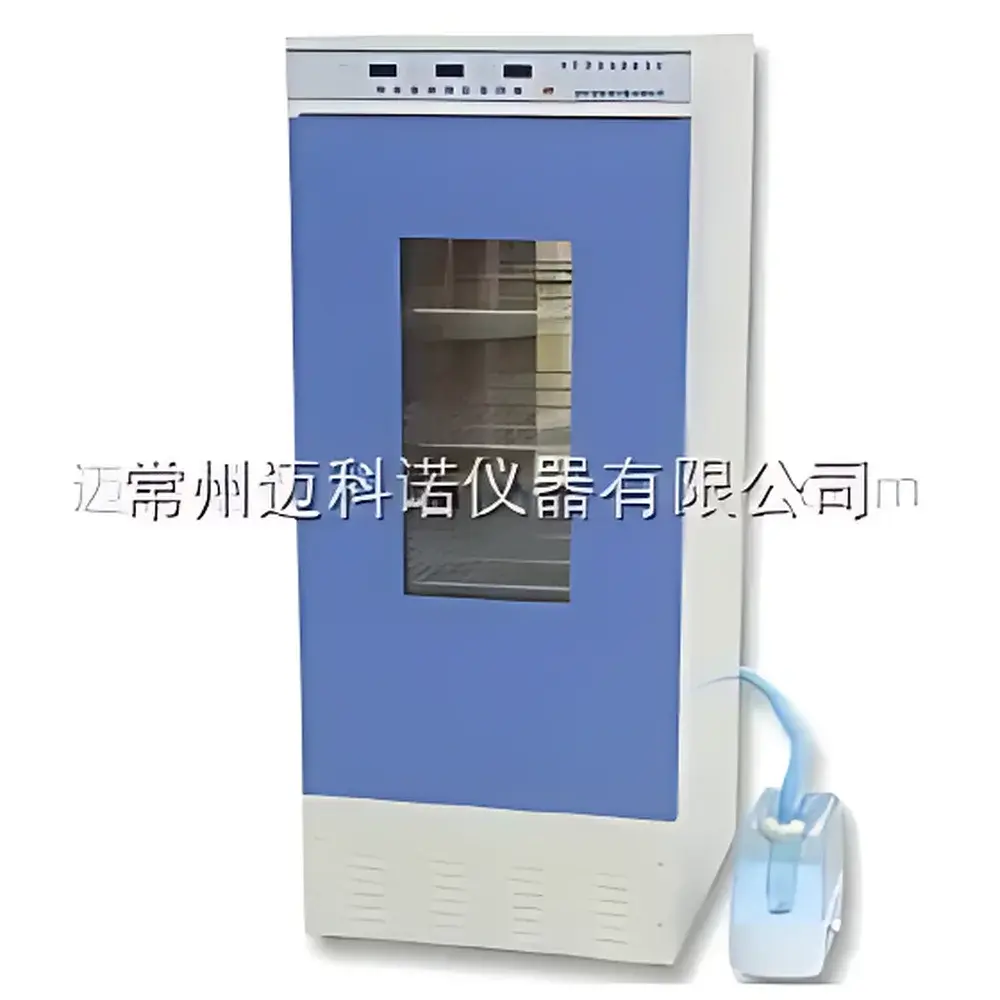
MKN HSX-160 Temperature and Humidity Controlled Incubator
| Brand | MKN |
|---|---|
| Model | HSX-160 |
| Capacity | 160 L |
| Temperature Range | 5–50 °C |
| Temperature Uniformity | ±1 °C |
| Humidity Range | 45–90 %RH |
| Humidity Control Accuracy | ±5 %RH |
| Power Supply | AC 220 V ±10%, 50 Hz ±2% |
| Operating Environment | 0–40 °C, ≤85 %RH (non-condensing) |
| Construction | External cold-rolled steel with epoxy coating |
| Insulation | rigid polyurethane foam |
| Air Circulation | Forced-air convection with optimized ducted airflow design |
| Safety Features | Compressor delay start, over-temperature/over-humidity protection, power failure recovery |
Overview
The MKN HSX-160 Temperature and Humidity Controlled Incubator is an engineered environmental chamber designed for precise, stable, and reproducible control of both temperature and relative humidity (RH) within a 160-liter working chamber. It operates on a dual-loop feedback principle: independent PID-controlled heating and refrigeration circuits regulate temperature, while a dedicated humidification system—comprising a stainless-steel water reservoir, controlled evaporation surface, and integrated RH sensor—maintains specified moisture levels. This architecture ensures minimal thermal gradient and consistent vapor distribution across the chamber volume, critical for long-term cell culture, microbial growth studies, seed germination assays, and stability testing of biological reagents. The unit complies with fundamental operational requirements outlined in ISO 17025 for laboratory environmental conditioning equipment and supports GLP-compliant workflows when paired with external data logging.
Key Features
- Microprocessor-based dual-parameter control system with LED digital display for real-time monitoring of setpoints and actual values for both temperature (°C) and relative humidity (%RH)
- Forced-air convection system with rear-mounted centrifugal blower and directional air ducts to minimize spatial deviation—validated uniformity of ±1 °C at 37 °C and ±5 %RH across 9-point chamber mapping
- Robust chamber construction: exterior carbon steel housing with anti-corrosive epoxy powder coating; interior chamber fabricated from electropolished AISI 304 stainless steel for chemical resistance and ease of decontamination
- High-efficiency thermal insulation using rigid polyurethane foam (≥40 mm thickness, closed-cell structure) with thermal conductivity <0.022 W/m·K
- Double-glazed, low-emissivity tempered glass door with magnetic seal and internal lighting (LED, non-UV emitting) for non-intrusive observation without compromising chamber integrity
- Compressor protection circuitry including programmable delay-on-restart (≥3 minutes), high-pressure cut-off, and ambient temperature interlock to extend refrigeration system service life
Sample Compatibility & Compliance
The HSX-160 accommodates standard laboratory consumables including Petri dishes (up to 150 mm diameter), multi-well plates (6–96-well), Erlenmeyer flasks (up to 2 L), and tissue culture flasks (T75–T225). Its chamber geometry allows for flexible shelf configuration (three adjustable stainless-steel shelves included). The incubator meets essential safety and electromagnetic compatibility requirements per IEC 61000-6-3 (EMI emission) and IEC 61000-6-2 (immunity). While not certified to IEC 61010-1 as a Class II medical device, its performance characteristics align with routine environmental conditioning needs described in ASTM E145 (Standard Specification for Gravity-Convection and Forced-Ventilation Ovens) and USP (Environmental Control for Biological Testing). For regulated environments, users may implement audit-trail-capable external data loggers compliant with FDA 21 CFR Part 11.
Software & Data Management
The HSX-160 operates via embedded firmware with no proprietary PC software dependency. All operational parameters—including setpoints, runtime hours, alarm history (max. 50 events), and calibration offsets—are stored in non-volatile memory and accessible via front-panel interface. Optional RS-485 Modbus RTU communication port (available on request) enables integration into centralized building management systems (BMS) or SCADA platforms for remote status polling and basic parameter adjustment. Data export requires external Modbus master devices; no built-in USB or Ethernet connectivity is provided. Calibration records must be maintained manually per ISO/IEC 17025 Clause 6.4.10, and users are advised to perform annual verification using NIST-traceable temperature/humidity probes.
Applications
- Mammalian and insect cell culture under physiologically relevant conditions (e.g., 37 °C / 95 %RH for CO₂-independent media)
- Microbial growth kinetics studies for bacteria, fungi, and yeasts requiring defined hygrometric profiles
- Plant tissue culture and seed viability testing under controlled photoperiod-agnostic environments
- Stability assessment of diagnostic reagents, vaccines, and lyophilized biologics per ICH Q1A(R2) guidance
- Environmental simulation for ecotoxicology assays and biofilm development studies
- Quality control of raw materials in pharmaceutical excipient manufacturing where moisture content affects flow properties
FAQ
Does the HSX-160 support CO₂ concentration control?
No. This model is strictly a temperature- and humidity-controlled incubator. CO₂ regulation requires additional gas injection hardware, sensors, and feedback control not present in the HSX-160 design.
Can the unit operate continuously for 72+ hours without interruption?
Yes. Rated for continuous operation under specified ambient conditions (0–40 °C, ≤85 %RH). Compressor duty cycle and thermal load depend on setpoint combination and door-opening frequency.
Is stainless-steel shelving included as standard?
Yes. Three (3) adjustable, perforated AISI 304 stainless-steel shelves are supplied with each unit.
What is the recommended calibration interval?
MKN recommends annual verification using traceable reference standards. Critical applications may require quarterly checks per internal quality protocols.
Does the incubator include a data logger or USB export capability?
No. Data logging requires external Class I or II calibrated sensors connected via RS-485 (optional port) or manual recording from the LED display.





